Escalating US-Iran conflict and rising expectations of a Bank of Canada rate hike: Can the Canadian dollar maintain its strength amid these two positive factors?
2026-07-09 13:20:54
On Thursday (July 9) during the Asian session, the US dollar fell back to around 1.4160 against the Canadian dollar, and the exchange rate is expected to fall for the third consecutive trading day.
The Canadian dollar was supported by two positive factors: first, the escalating conflict between the US and Iran has driven up crude oil prices, which has benefited the Canadian currency as a major oil exporter; second, market bets on the Bank of Canada raising interest rates this year have increased significantly, with the probability of a rate hike jumping from 40% to about 60% in just two days.
In a report, Scotiabank strategists Sean Osborne and Eric Teoret noted, "The Canadian dollar performed relatively well during overnight volatility. Negative sentiment towards the Canadian dollar is easing, but the spot rate remains at a fairly high level." This assessment accurately summarizes the current tug-of-war between bulls and bears facing the Canadian dollar—positive factors are accumulating, but the previously accumulated weakness has not yet been completely reversed.
Geopolitical tensions escalated further on Thursday.
Media reports indicate that the U.S. military used cruise missiles to strike a railway line near the border in Golestan province in northeastern Iran, marking the first U.S. strike on Iranian infrastructure since the ceasefire agreement took effect. Iran, however, stated that multiple U.S. shells hit a railway bridge west of Ahala in Golestan province, triggering several explosions.
This round of military escalation occurred after Trump announced on Wednesday that the interim U.S.-Iran agreement had "ended." Iranian Parliament Speaker Mohammad Bagher Ghalibaf warned Washington that any U.S. military action would invite retaliation.
For the Canadian dollar, the transmission path of geopolitical conflicts is relatively direct. As a major oil exporter, Canada is typically supported by rising oil prices driven by tensions in the Strait of Hormuz. West Texas Intermediate (WTI) crude oil prices, after a previous surge of over 3%, have remained strong, providing continued support for the Canadian dollar.
In addition to oil price factors, changes in monetary policy expectations are also providing additional upward momentum for the Canadian dollar.
The Bank of Canada decided to keep its benchmark overnight interest rate unchanged at 2.25% at its June policy meeting, marking the fifth consecutive time it has held steady. However, market pricing in the Bank of Canada's future policy path is undergoing significant changes.
Market data shows that traders now believe there is about a 60% chance of the Bank of Canada raising interest rates this year, a significant increase of 20 percentage points from 40% on Tuesday. This rising expectation comes against the backdrop of a resurgence in expectations of a Federal Reserve rate hike due to inflation concerns, and a narrowing policy divergence between the Bank of Canada and the Federal Reserve. If the Bank of Canada does indeed need to follow suit with a rate hike to curb inflationary pressures, the Canadian dollar's interest rate advantage will be solidified.
Scotiabank strategists offer a professional third-party perspective on the Canadian dollar. They believe the Canadian dollar "performed relatively well" during overnight volatility, and negative sentiment is "easing." This indicates that the market's outlook for the Canadian dollar is gradually recovering from excessive pessimism.
However, they also cautiously pointed out that "the spot exchange rate remains at a fairly high level"—meaning that although the USD/CAD exchange rate has retreated from its recent high, the current exchange rate level is still relatively high, and further strengthening of the Canadian dollar requires confirmation from more positive factors.
Scotiabank's assessment echoes the market's growing expectation of a Bank of Canada rate hike, but also suggests that the Canadian dollar's upside potential may not be smooth sailing in the short term.
In summary, the Canadian dollar is currently supported by the dual benefits of stronger oil prices and rising expectations of a Bank of Canada interest rate hike. The ongoing escalation of the US-Iran conflict provides a sustained positive driver for the Canadian dollar through energy prices, while the market's repricing of the Bank of Canada's policy path reinforces the Canadian dollar's attractiveness from an interest rate differential perspective.
However, whether the Canadian dollar can strengthen further remains uncertain. Geopolitical factors are highly unpredictable—if the situation in the Middle East eases, a decline in oil prices would weaken a key support for the Canadian dollar. Furthermore, the performance of Canada's own economic data will also affect the sustainability of market expectations for central bank interest rate hikes.
In the short term, USD/CAD may test the key support zone of 1.4150 or even 1.4100, but further downside is likely limited in the absence of more catalysts. Traders are awaiting Thursday's US initial jobless claims data, which will indirectly affect USD/CAD by influencing the overall movement of the US dollar.
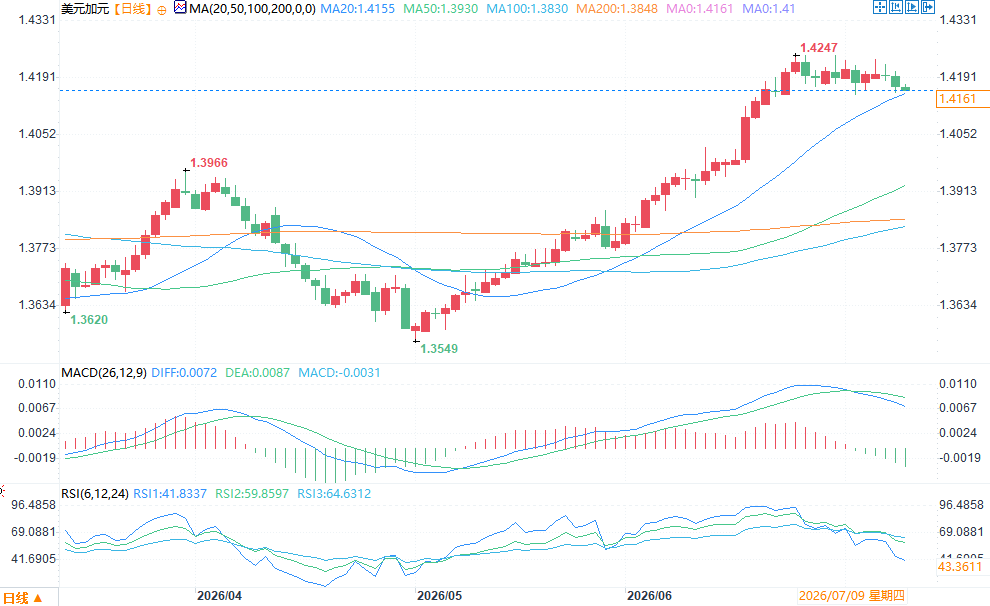
(USD/CAD daily chart, source: EasyForex)
At 13:20 Beijing time on July 9, the USD/CAD exchange rate was 1.4161/62.
The Canadian dollar was supported by two positive factors: first, the escalating conflict between the US and Iran has driven up crude oil prices, which has benefited the Canadian currency as a major oil exporter; second, market bets on the Bank of Canada raising interest rates this year have increased significantly, with the probability of a rate hike jumping from 40% to about 60% in just two days.
In a report, Scotiabank strategists Sean Osborne and Eric Teoret noted, "The Canadian dollar performed relatively well during overnight volatility. Negative sentiment towards the Canadian dollar is easing, but the spot rate remains at a fairly high level." This assessment accurately summarizes the current tug-of-war between bulls and bears facing the Canadian dollar—positive factors are accumulating, but the previously accumulated weakness has not yet been completely reversed.
Geopolitics: US and Iran clash for the second consecutive day, oil supply concerns continue to escalate.
Geopolitical tensions escalated further on Thursday.
Media reports indicate that the U.S. military used cruise missiles to strike a railway line near the border in Golestan province in northeastern Iran, marking the first U.S. strike on Iranian infrastructure since the ceasefire agreement took effect. Iran, however, stated that multiple U.S. shells hit a railway bridge west of Ahala in Golestan province, triggering several explosions.
This round of military escalation occurred after Trump announced on Wednesday that the interim U.S.-Iran agreement had "ended." Iranian Parliament Speaker Mohammad Bagher Ghalibaf warned Washington that any U.S. military action would invite retaliation.
For the Canadian dollar, the transmission path of geopolitical conflicts is relatively direct. As a major oil exporter, Canada is typically supported by rising oil prices driven by tensions in the Strait of Hormuz. West Texas Intermediate (WTI) crude oil prices, after a previous surge of over 3%, have remained strong, providing continued support for the Canadian dollar.
Bank of Canada: Expectations for an interest rate hike have risen significantly, with the probability jumping from 40% to 60%.
In addition to oil price factors, changes in monetary policy expectations are also providing additional upward momentum for the Canadian dollar.
The Bank of Canada decided to keep its benchmark overnight interest rate unchanged at 2.25% at its June policy meeting, marking the fifth consecutive time it has held steady. However, market pricing in the Bank of Canada's future policy path is undergoing significant changes.
Market data shows that traders now believe there is about a 60% chance of the Bank of Canada raising interest rates this year, a significant increase of 20 percentage points from 40% on Tuesday. This rising expectation comes against the backdrop of a resurgence in expectations of a Federal Reserve rate hike due to inflation concerns, and a narrowing policy divergence between the Bank of Canada and the Federal Reserve. If the Bank of Canada does indeed need to follow suit with a rate hike to curb inflationary pressures, the Canadian dollar's interest rate advantage will be solidified.
Scotiabank's assessment: Negative sentiment has eased, but spot levels remain high.
Scotiabank strategists offer a professional third-party perspective on the Canadian dollar. They believe the Canadian dollar "performed relatively well" during overnight volatility, and negative sentiment is "easing." This indicates that the market's outlook for the Canadian dollar is gradually recovering from excessive pessimism.
However, they also cautiously pointed out that "the spot exchange rate remains at a fairly high level"—meaning that although the USD/CAD exchange rate has retreated from its recent high, the current exchange rate level is still relatively high, and further strengthening of the Canadian dollar requires confirmation from more positive factors.
Scotiabank's assessment echoes the market's growing expectation of a Bank of Canada rate hike, but also suggests that the Canadian dollar's upside potential may not be smooth sailing in the short term.
Outlook: The Canadian dollar is supported by two factors, but further upside requires more catalysts.
In summary, the Canadian dollar is currently supported by the dual benefits of stronger oil prices and rising expectations of a Bank of Canada interest rate hike. The ongoing escalation of the US-Iran conflict provides a sustained positive driver for the Canadian dollar through energy prices, while the market's repricing of the Bank of Canada's policy path reinforces the Canadian dollar's attractiveness from an interest rate differential perspective.
However, whether the Canadian dollar can strengthen further remains uncertain. Geopolitical factors are highly unpredictable—if the situation in the Middle East eases, a decline in oil prices would weaken a key support for the Canadian dollar. Furthermore, the performance of Canada's own economic data will also affect the sustainability of market expectations for central bank interest rate hikes.
In the short term, USD/CAD may test the key support zone of 1.4150 or even 1.4100, but further downside is likely limited in the absence of more catalysts. Traders are awaiting Thursday's US initial jobless claims data, which will indirectly affect USD/CAD by influencing the overall movement of the US dollar.
(USD/CAD daily chart, source: EasyForex)
At 13:20 Beijing time on July 9, the USD/CAD exchange rate was 1.4161/62.
- Risk Warning and Disclaimer
- The market involves risk, and trading may not be suitable for all investors. This article is for reference only and does not constitute personal investment advice, nor does it take into account certain users’ specific investment objectives, financial situation, or other needs. Any investment decisions made based on this information are at your own risk.