Improved Eurozone trade data failed to boost the euro, while a rebound in crude oil prices pushed the euro down to near a one-year low against the pound.
2026-07-09 14:57:43
The euro weakened against the pound in Asian trading on Thursday, holding near 0.8530 and continuing to hover around its lowest level in nearly a year. Despite better-than-expected German trade data, the market failed to provide significant support for the euro, which remained influenced by global risk factors and volatility in the energy market.

Data released by the Federal Statistical Office of Germany shows that Germany's trade surplus reached €19.1 billion in May, up from €14.5 billion in April, mainly due to stronger-than-expected export performance. The data indicates that Germany's external demand environment has improved to some extent, alleviating investors' concerns about weak European economic growth.
However, German trade data failed to effectively boost the euro. The market believes that the current euro's performance is more influenced by external risk factors, including deteriorating relations between the US and Iran, rising international energy prices, and changing global inflation expectations. Recently, tensions between the US and Iran have escalated again. Following the US's new round of military action against Iranian targets, Iran has retaliated against targets in the Gulf region, significantly increasing market risk aversion.
As conflict risks escalated, international oil prices rebounded rapidly. Brent crude oil prices rose to around $80 per barrel at one point, after previously hitting a low of nearly $70 per barrel , representing a nearly 10% increase in a short period. Rising energy prices have increased inflationary pressures on the European economy and prompted the market to reassess the European Central Bank's future policy space.
With the Eurozone's economic recovery remaining weak, rising energy costs could further dampen consumer confidence and impact corporate profits, a significant factor limiting the euro's rebound. Meanwhile, the pound has recently been supported by reduced political risk in the UK. As the leadership transition progresses, market concerns about the stability of UK policies have eased, allowing the pound to maintain a certain advantage over the euro.
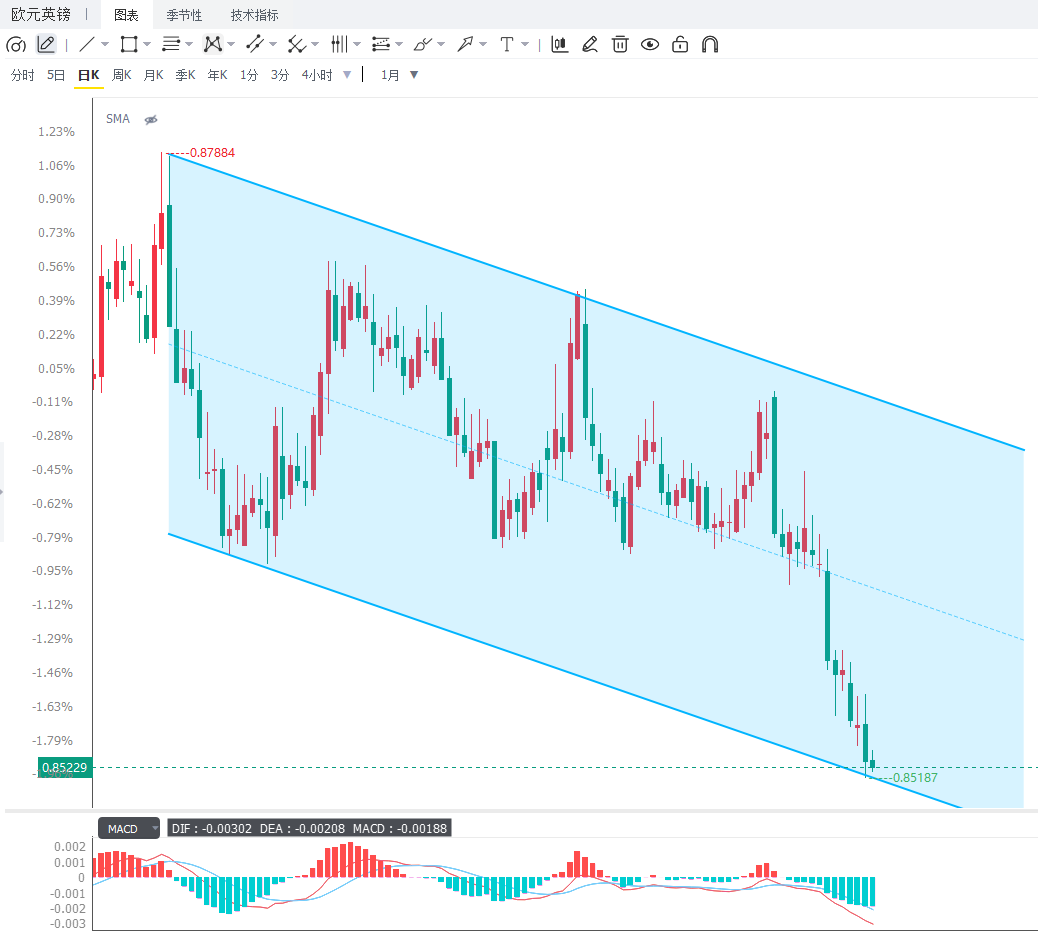
From a technical perspective, the euro/pound pair remains in a short-term downtrend, but bearish momentum has weakened. Currently, the exchange rate is trading around 0.8530 , with the market testing one-year lows. Technical indicators show the 14-period RSI near 28 , in oversold territory, while also exhibiting some bullish divergence; the MACD indicator is stabilizing near the zero line, suggesting the market may be entering a consolidation phase rather than immediately forming a clear reversal.
From a daily chart perspective, the EUR/GBP pair remains in a weak downward trend, with prices continuing to be suppressed by the descending trendline. However, with indicators showing signs of correction, a short-term technical rebound is possible. The first resistance level to watch is the previous yearly low around 0.8533. A successful break above this level could lead to a further test of the upper trendline of the descending wedge around 0.8555 . Failure to break through this level would likely result in the continuation of the overall weak structure.
From a 4-hour chart perspective, the short-term decline in the exchange rate has slowed, and the bearish momentum shows signs of weakening. The MACD is gradually approaching the zero line, and the RSI is rebounding from a low level , indicating a short-term need for consolidation and correction. A break above 0.8555 could open up room for a rebound, further challenging the 0.8580 area; however, a break below the recent low of 0.8519 could lead to a retest of the key support around 0.8500 . If this area is breached, the next target could shift down to around 0.8410 .
Editor's Summary : The euro remains weak against the pound, and improved German trade data has not yet changed the market's cautious attitude towards the euro. Escalating tensions between the US and Iran have driven a rapid rebound in oil prices, and rising energy costs have renewed inflationary pressures in Europe. Meanwhile, improved political conditions in the UK have also provided support for the pound. In the short term, the euro/pound pair is likely to continue to fluctuate at low levels. The market needs to pay close attention to changes in energy prices, European economic data, and the differences in expectations regarding UK and EU monetary policy. If technical indicators continue to improve, there is a chance for a short-term rebound; however, if risk sentiment continues to deteriorate, the euro may still face further downward pressure.
Data released by the Federal Statistical Office of Germany shows that Germany's trade surplus reached €19.1 billion in May, up from €14.5 billion in April, mainly due to stronger-than-expected export performance. The data indicates that Germany's external demand environment has improved to some extent, alleviating investors' concerns about weak European economic growth.
However, German trade data failed to effectively boost the euro. The market believes that the current euro's performance is more influenced by external risk factors, including deteriorating relations between the US and Iran, rising international energy prices, and changing global inflation expectations. Recently, tensions between the US and Iran have escalated again. Following the US's new round of military action against Iranian targets, Iran has retaliated against targets in the Gulf region, significantly increasing market risk aversion.
As conflict risks escalated, international oil prices rebounded rapidly. Brent crude oil prices rose to around $80 per barrel at one point, after previously hitting a low of nearly $70 per barrel , representing a nearly 10% increase in a short period. Rising energy prices have increased inflationary pressures on the European economy and prompted the market to reassess the European Central Bank's future policy space.
With the Eurozone's economic recovery remaining weak, rising energy costs could further dampen consumer confidence and impact corporate profits, a significant factor limiting the euro's rebound. Meanwhile, the pound has recently been supported by reduced political risk in the UK. As the leadership transition progresses, market concerns about the stability of UK policies have eased, allowing the pound to maintain a certain advantage over the euro.
From a technical perspective, the euro/pound pair remains in a short-term downtrend, but bearish momentum has weakened. Currently, the exchange rate is trading around 0.8530 , with the market testing one-year lows. Technical indicators show the 14-period RSI near 28 , in oversold territory, while also exhibiting some bullish divergence; the MACD indicator is stabilizing near the zero line, suggesting the market may be entering a consolidation phase rather than immediately forming a clear reversal.
From a daily chart perspective, the EUR/GBP pair remains in a weak downward trend, with prices continuing to be suppressed by the descending trendline. However, with indicators showing signs of correction, a short-term technical rebound is possible. The first resistance level to watch is the previous yearly low around 0.8533. A successful break above this level could lead to a further test of the upper trendline of the descending wedge around 0.8555 . Failure to break through this level would likely result in the continuation of the overall weak structure.
From a 4-hour chart perspective, the short-term decline in the exchange rate has slowed, and the bearish momentum shows signs of weakening. The MACD is gradually approaching the zero line, and the RSI is rebounding from a low level , indicating a short-term need for consolidation and correction. A break above 0.8555 could open up room for a rebound, further challenging the 0.8580 area; however, a break below the recent low of 0.8519 could lead to a retest of the key support around 0.8500 . If this area is breached, the next target could shift down to around 0.8410 .
Editor's Summary : The euro remains weak against the pound, and improved German trade data has not yet changed the market's cautious attitude towards the euro. Escalating tensions between the US and Iran have driven a rapid rebound in oil prices, and rising energy costs have renewed inflationary pressures in Europe. Meanwhile, improved political conditions in the UK have also provided support for the pound. In the short term, the euro/pound pair is likely to continue to fluctuate at low levels. The market needs to pay close attention to changes in energy prices, European economic data, and the differences in expectations regarding UK and EU monetary policy. If technical indicators continue to improve, there is a chance for a short-term rebound; however, if risk sentiment continues to deteriorate, the euro may still face further downward pressure.
- Risk Warning and Disclaimer
- The market involves risk, and trading may not be suitable for all investors. This article is for reference only and does not constitute personal investment advice, nor does it take into account certain users’ specific investment objectives, financial situation, or other needs. Any investment decisions made based on this information are at your own risk.