The US-Iran standoff continues with both fighting and negotiations! Gold prices see a recovery.
2026-07-09 15:58:56
On Thursday (July 9), spot gold rebounded after hitting a low during the Asian and European sessions, and is currently trading around 4103, up 0.66%.
Escalating tensions between the US and Iran continued to weigh on gold prices, but just an hour ago, the US president said that Iran had called earlier and wanted to reach an agreement, causing gold prices to rebound sharply from their lows.
The entire incident unfolded as Iran launched three consecutive attacks on cruise ships near the Gulf of Oman . Following Khamenei's funeral, the U.S. Central Command deployed air power to conduct a large-scale airstrike on Iranian territory , targeting and precisely striking a total of 90 military targets.
In response to the intense bombing by the U.S. military, the Iranian military quickly claimed responsibility and launched a cross-regional counterattack . For the first time, the targets of its retaliatory strikes were comprehensively upgraded, directly covering the three Gulf Arab states of Bahrain, Kuwait, and Qatar.
As geopolitical tensions continued to escalate, on the evening of July 8 local time in Iran, the U.S. Central Command announced that the U.S. military had launched a new round of strikes in response to Iran's retaliation.
Late on July 8 local time, explosions were heard in Bandar Abbas, the capital of Hormozgan province in southern Iran, and in the Sirik region. Fragments from munitions fired by the US military during its attack on Iran struck the Imam Ali Hospital in Chabahar. Two ports and a maritime traffic control tower in the southeastern coastal city of Chabahar were damaged. Three power transmission lines in Chabahar were interrupted, causing power outages in nearly half of the city.
According to a U.S. official who spoke to the media, the ongoing U.S. strikes against Iran are expected to be larger than the previous day's.
Mohsen Rezaei, military advisor to Iran's Supreme Leader, posted on social media that the aggressors and their accomplices will be severely punished.
US President Trump stated that he had just dealt a heavy blow to Iran, saying, "Our response was 20 times stronger than theirs. Whenever they attack us, we retaliate with 20 times the force."
Despite the escalating conflict and Trump's strong rhetoric on social media (threatening to destroy Iranian power plants and desalination facilities, and even threatening to send troops to control its crude oil export hub, Kharg Island), the US and Iran have maintained a certain degree of restraint behind the fierce fighting—the Strait of Hormuz has not been closed again to this day.
From the perspective of rational game theory, reverting to full-scale hostility or blockading the strait is fundamentally not in the core interests of either side.
For Iran, nearly 90% of its crude oil exports rely entirely on Kharg Island and the Strait of Hormuz.
If the Strait of Hormuz is completely cut off, Iran will lose its vital oil sales channels and foreign exchange reserves, and its already fragile economy will face collapse.
Therefore, the pragmatists within the organization are still striving to restart peace agreement negotiations after Khamenei's burial ceremony.
For the United States: Although incumbent President Trump has made strong statements, the country's current political attention is highly focused on the domestic midterm elections.
A full-scale war that disrupts energy supply routes would drive up international oil prices and fuel inflation in the United States, a scenario the current US administration least wants to see before the election.
Trump also hinted in the morning that the US-Iran clashes "would not escalate into a long-term, protracted military conflict," and that the confrontation would be "quick in and quick out."
Elliot Hentov, chief macro policy strategist at State Street Global Advisors, pointed out that a renewed escalation of conflict in the Middle East is unlikely to fundamentally alter the long-term outlook for financial markets.
Hentov stated that since April, there have been few new developments regarding the parties' willingness to wage war or the possibility of a further escalation of the situation. In short, neither side is seeking a full return to hostilities, therefore the conflict is likely to eventually subside.
Institutional forecasts: In State Street Investment Management's spring war scenario forecast, the company assumes that Brent crude oil prices will remain around $80 per barrel for the remainder of the year, a price range that fully reflects the residual risks inherent in any ceasefire agreement.
Amidst the turbulent geopolitical landscape, the outlook for US monetary policy is also influencing gold prices.
According to Barclays' benchmark forecast, the Federal Reserve is expected to maintain its current high interest rate level until the end of 2027.
Barclays strategists still believe that the current macro risks are significantly tilted towards interest rate hikes.
Strategists point out that the latest minutes of the Federal Reserve's policy meeting highlight the growing concerns among officials about inflation, and the risk of persistently high inflation remains significant.
It is worth noting that, in addition to traditional economic variables, strong demand for artificial intelligence (AI) related investments has become a key factor supporting high interest rates.
The massive capital expenditures (CapEx) by tech giants on AI infrastructure have boosted the resilience of the U.S. economy and overall demand, making the path of inflation decline more volatile. Currently, there are still significant disagreements within the Federal Reserve regarding the future policy direction.
Just as the market was gripped by extreme panic due to Barclays' prediction of a "protracted war on high interest rates" and the ongoing conflict in the Middle East, the geopolitical situation saw a glimmer of hope this afternoon.
US President Trump recently stated publicly, "Iran called earlier, they want to reach a deal."
This significant statement confirms that the bilateral negotiation channels between the US and Iran have not been closed, and also demonstrates the tacit understanding between the two sides to "fight while negotiating" and not to slide into a full-scale war.
The market's tense nerves were instantly relieved by Trump's direct positive message of seeking negotiations.
The US dollar index retreated from its highs: Trump's statement quickly siphoned off the extreme safe-haven buying triggered by geopolitical conflicts, and market concerns about "widespread hyperinflation in the Middle East" also cooled, pushing the US dollar index down from its intraday highs.
For gold, while the decline in the US dollar has provided a respite, the more fundamental logic lies in the market's repricing of the macroeconomic environment.
Previously, gold prices were under short-term pressure due to expectations that the Federal Reserve might not cut interest rates for a long time or even raise them again (as Barclays stated); however, as geopolitical frictions have become "normalized" but the "bottom line has not been broken", coupled with the expectation that international crude oil prices will gradually return to around $80 per barrel as predicted by State Street, gold prices have continued to correct their pricing of inflation and interest rate hikes.
Gold prices have successfully stopped falling, directly catalyzed by a weakening dollar and declining oil prices. Gold prices are now awaiting the release of subsequent US air traffic data and the progress of the Strait of Hormuz dispute.
From a technical perspective, spot gold remains under pressure from the fan-shaped area formed by the downtrend line and the upper rail of the downtrend channel. Unless there are significant breakthroughs in the aforementioned interest rates, geopolitical factors, and inflation, it is not advisable to blindly chase the price higher.
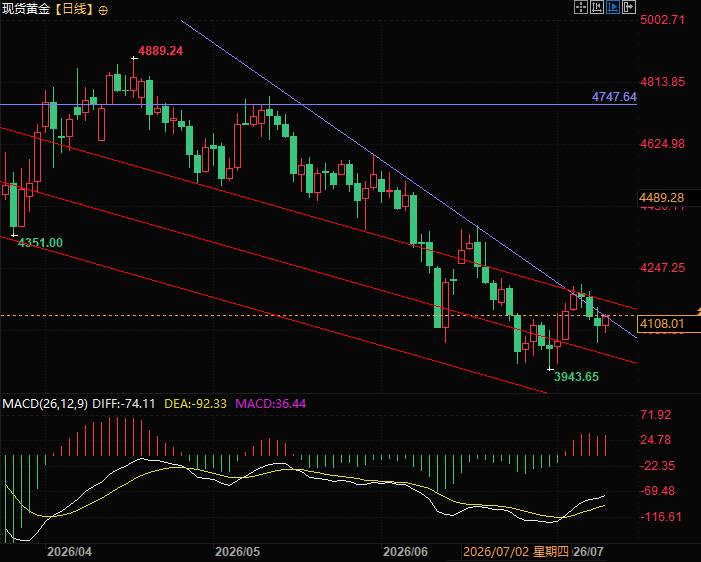
(Spot gold daily chart, source: FX678)
At 15:51 Beijing time, spot gold was trading at $4,108 per ounce.
Escalating tensions between the US and Iran continued to weigh on gold prices, but just an hour ago, the US president said that Iran had called earlier and wanted to reach an agreement, causing gold prices to rebound sharply from their lows.
The entire incident unfolded as Iran launched three consecutive attacks on cruise ships near the Gulf of Oman . Following Khamenei's funeral, the U.S. Central Command deployed air power to conduct a large-scale airstrike on Iranian territory , targeting and precisely striking a total of 90 military targets.
In response to the intense bombing by the U.S. military, the Iranian military quickly claimed responsibility and launched a cross-regional counterattack . For the first time, the targets of its retaliatory strikes were comprehensively upgraded, directly covering the three Gulf Arab states of Bahrain, Kuwait, and Qatar.
As geopolitical tensions continued to escalate, on the evening of July 8 local time in Iran, the U.S. Central Command announced that the U.S. military had launched a new round of strikes in response to Iran's retaliation.
Late on July 8 local time, explosions were heard in Bandar Abbas, the capital of Hormozgan province in southern Iran, and in the Sirik region. Fragments from munitions fired by the US military during its attack on Iran struck the Imam Ali Hospital in Chabahar. Two ports and a maritime traffic control tower in the southeastern coastal city of Chabahar were damaged. Three power transmission lines in Chabahar were interrupted, causing power outages in nearly half of the city.
According to a U.S. official who spoke to the media, the ongoing U.S. strikes against Iran are expected to be larger than the previous day's.
Mohsen Rezaei, military advisor to Iran's Supreme Leader, posted on social media that the aggressors and their accomplices will be severely punished.
US President Trump stated that he had just dealt a heavy blow to Iran, saying, "Our response was 20 times stronger than theirs. Whenever they attack us, we retaliate with 20 times the force."
The Hidden Restraint Under Maximum Pressure: Total War Is Not in Anyone's Interest
Despite the escalating conflict and Trump's strong rhetoric on social media (threatening to destroy Iranian power plants and desalination facilities, and even threatening to send troops to control its crude oil export hub, Kharg Island), the US and Iran have maintained a certain degree of restraint behind the fierce fighting—the Strait of Hormuz has not been closed again to this day.
From the perspective of rational game theory, reverting to full-scale hostility or blockading the strait is fundamentally not in the core interests of either side.
For Iran, nearly 90% of its crude oil exports rely entirely on Kharg Island and the Strait of Hormuz.
If the Strait of Hormuz is completely cut off, Iran will lose its vital oil sales channels and foreign exchange reserves, and its already fragile economy will face collapse.
Therefore, the pragmatists within the organization are still striving to restart peace agreement negotiations after Khamenei's burial ceremony.
For the United States: Although incumbent President Trump has made strong statements, the country's current political attention is highly focused on the domestic midterm elections.
A full-scale war that disrupts energy supply routes would drive up international oil prices and fuel inflation in the United States, a scenario the current US administration least wants to see before the election.
Trump also hinted in the morning that the US-Iran clashes "would not escalate into a long-term, protracted military conflict," and that the confrontation would be "quick in and quick out."
Elliot Hentov, chief macro policy strategist at State Street Global Advisors, pointed out that a renewed escalation of conflict in the Middle East is unlikely to fundamentally alter the long-term outlook for financial markets.
Hentov stated that since April, there have been few new developments regarding the parties' willingness to wage war or the possibility of a further escalation of the situation. In short, neither side is seeking a full return to hostilities, therefore the conflict is likely to eventually subside.
Institutional forecasts: In State Street Investment Management's spring war scenario forecast, the company assumes that Brent crude oil prices will remain around $80 per barrel for the remainder of the year, a price range that fully reflects the residual risks inherent in any ceasefire agreement.
The Federal Reserve's inflation concerns remain unresolved, while demand for artificial intelligence provides support.
Amidst the turbulent geopolitical landscape, the outlook for US monetary policy is also influencing gold prices.
According to Barclays' benchmark forecast, the Federal Reserve is expected to maintain its current high interest rate level until the end of 2027.
Barclays strategists still believe that the current macro risks are significantly tilted towards interest rate hikes.
Strategists point out that the latest minutes of the Federal Reserve's policy meeting highlight the growing concerns among officials about inflation, and the risk of persistently high inflation remains significant.
It is worth noting that, in addition to traditional economic variables, strong demand for artificial intelligence (AI) related investments has become a key factor supporting high interest rates.
The massive capital expenditures (CapEx) by tech giants on AI infrastructure have boosted the resilience of the U.S. economy and overall demand, making the path of inflation decline more volatile. Currently, there are still significant disagreements within the Federal Reserve regarding the future policy direction.
Risk aversion reverses: Trump releases positive signals for negotiations, US dollar index falls and gold price rebounds.
Just as the market was gripped by extreme panic due to Barclays' prediction of a "protracted war on high interest rates" and the ongoing conflict in the Middle East, the geopolitical situation saw a glimmer of hope this afternoon.
US President Trump recently stated publicly, "Iran called earlier, they want to reach a deal."
This significant statement confirms that the bilateral negotiation channels between the US and Iran have not been closed, and also demonstrates the tacit understanding between the two sides to "fight while negotiating" and not to slide into a full-scale war.
The market's tense nerves were instantly relieved by Trump's direct positive message of seeking negotiations.
The US dollar index retreated from its highs: Trump's statement quickly siphoned off the extreme safe-haven buying triggered by geopolitical conflicts, and market concerns about "widespread hyperinflation in the Middle East" also cooled, pushing the US dollar index down from its intraday highs.
For gold, while the decline in the US dollar has provided a respite, the more fundamental logic lies in the market's repricing of the macroeconomic environment.
Previously, gold prices were under short-term pressure due to expectations that the Federal Reserve might not cut interest rates for a long time or even raise them again (as Barclays stated); however, as geopolitical frictions have become "normalized" but the "bottom line has not been broken", coupled with the expectation that international crude oil prices will gradually return to around $80 per barrel as predicted by State Street, gold prices have continued to correct their pricing of inflation and interest rate hikes.
Gold prices have successfully stopped falling, directly catalyzed by a weakening dollar and declining oil prices. Gold prices are now awaiting the release of subsequent US air traffic data and the progress of the Strait of Hormuz dispute.
From a technical perspective, spot gold remains under pressure from the fan-shaped area formed by the downtrend line and the upper rail of the downtrend channel. Unless there are significant breakthroughs in the aforementioned interest rates, geopolitical factors, and inflation, it is not advisable to blindly chase the price higher.
(Spot gold daily chart, source: FX678)
At 15:51 Beijing time, spot gold was trading at $4,108 per ounce.
- Risk Warning and Disclaimer
- The market involves risk, and trading may not be suitable for all investors. This article is for reference only and does not constitute personal investment advice, nor does it take into account certain users’ specific investment objectives, financial situation, or other needs. Any investment decisions made based on this information are at your own risk.