US crude oil opened higher but then fell; Commerzbank warned that the market has misjudged Middle East risks.
2026-07-09 15:22:39
On Thursday (July 9) during the European session, US crude oil futures opened higher but then fell, after previously hitting a near two-week high of $75.13 per barrel, and are currently trading around $73.50 per barrel.
Commerzbank commodities analyst Turan Nguyen points out that the recent shift in US policy toward Iran has reversed market expectations of a rapid normalization of energy supplies in the Gulf, and the pricing logic of an oversupply of oil is being challenged.
With President Trump announcing that the US-Iran deal has been "canceled," the risks in the Middle East remain unresolved, which means that risk premiums in energy prices will return, and market volatility may rise again.
Nguyen noted that Commerzbank had been skeptical of the rapid decline in oil prices over the past few trading days. “Although shipping volumes in the Strait of Hormuz have rebounded somewhat, they remain far below pre-conflict levels,” Nguyen wrote. “However, the market seems to ignore this, already pricing in an oversupply in the oil market.”
This assessment reveals a crucial fact: the market's pricing logic shifted too quickly after the conflict to a "everything is normal" scenario, ignoring the fragility of shipping recovery and fundamental geopolitical uncertainties. The decline in oil prices from the conflict's peak may have overpriced the peace dividend while underestimating the risk of a resurgence.
Ruan pointed out that Washington's assessment of the oil supply situation has proven to be closer to Commerzbank's judgment than to the market's optimistic expectations.
“Washington believes that the normalization of energy supplies in the Gulf region is not progressing fast enough—nor smoothly enough,” she wrote. “Therefore, the US-Iran agreement has clearly been cancelled.”
Trump's decision to announce that the agreement was "cancelled" marks a clear shift in US policy toward Iran.
This means that the normalization of Gulf energy supply in the short term will no longer be considered the baseline scenario, and the previous market pricing logic of oversupply needs to be recalibrated.
However, Nguyen cautioned that the breakdown of the agreement does not necessarily mean an immediate escalation of tensions in the Middle East. “Trump’s harsh threats may simply be a strategic show of force aimed at compelling Iran to make concessions more quickly,” she noted. “Behind-the-scenes negotiations are likely still ongoing, and the final words are far from being spoken.”
For the energy market, the deeper meaning of this repeated policy is that the market can no longer regard the conflict as "over" as long as the two sides have not reached a final peaceful solution.
Nguyen emphasized that this incident sends a clear signal to the market: "The conflict cannot be considered over until all parties reach an agreement on a final peace agreement."
This means that market participants will have to reconsider risk premiums in their pricing decisions—not just in light of current geopolitical risks, but also in light of the possibility of further escalation.
Related to this will be a renewed increase in potential volatility in energy prices. Against the backdrop of renewed uncertainty, oil prices will no longer simply follow supply and demand fundamentals, but will instead reflect more the expansion and contraction of geopolitical risk premiums.
In summary, Commerzbank's analysis reveals a key turning point: the market's previous optimistic expectations for a rapid normalization of Gulf supplies are being revised. The shift in US policy toward the Iran deal signifies a return to Washington's pressure strategy toward Iran, forcing the energy market to confront a "no-deal" Middle East landscape.
In the short term, geopolitical uncertainty will be the main driver of crude oil prices. The market will shift from pricing in "supply surplus" to pricing in "supply disruption risk," and the return of risk premiums means that the floor support for oil prices will rise significantly.
However, Ruan also cautioned that the current tensions may not escalate linearly—the possibility of behind-the-scenes diplomacy remains, and any sign of de-escalation could trigger a rapid pullback in oil prices. In this highly uncertain environment, the risk of two-way volatility in the energy market has significantly increased. Traders need to be prepared to address both the upside risks from escalating tensions and the downside risks from diplomatic breakthroughs.
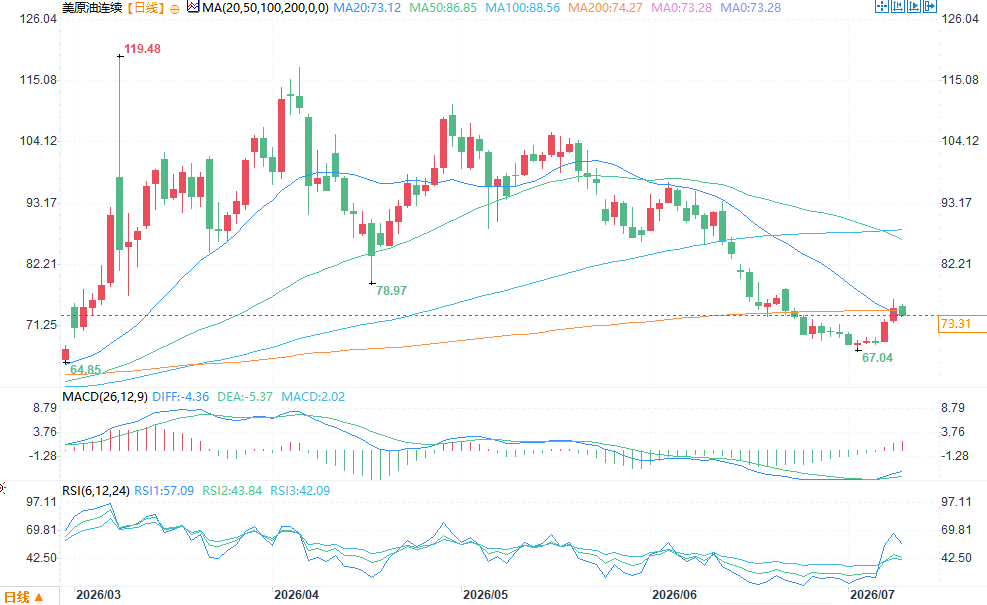
(US crude oil futures daily chart, source: FX678)
At 15:20 Beijing time on July 9, US crude oil futures were trading at $73.48 per barrel.
Commerzbank commodities analyst Turan Nguyen points out that the recent shift in US policy toward Iran has reversed market expectations of a rapid normalization of energy supplies in the Gulf, and the pricing logic of an oversupply of oil is being challenged.
With President Trump announcing that the US-Iran deal has been "canceled," the risks in the Middle East remain unresolved, which means that risk premiums in energy prices will return, and market volatility may rise again.
Commerzbank's early assessment: Shipping is recovering but far from normal.
Nguyen noted that Commerzbank had been skeptical of the rapid decline in oil prices over the past few trading days. “Although shipping volumes in the Strait of Hormuz have rebounded somewhat, they remain far below pre-conflict levels,” Nguyen wrote. “However, the market seems to ignore this, already pricing in an oversupply in the oil market.”
This assessment reveals a crucial fact: the market's pricing logic shifted too quickly after the conflict to a "everything is normal" scenario, ignoring the fragility of shipping recovery and fundamental geopolitical uncertainties. The decline in oil prices from the conflict's peak may have overpriced the peace dividend while underestimating the risk of a resurgence.
Washington's Shift: Deal Collapses, Supply Normalization Hindered
Ruan pointed out that Washington's assessment of the oil supply situation has proven to be closer to Commerzbank's judgment than to the market's optimistic expectations.
“Washington believes that the normalization of energy supplies in the Gulf region is not progressing fast enough—nor smoothly enough,” she wrote. “Therefore, the US-Iran agreement has clearly been cancelled.”
Trump's decision to announce that the agreement was "cancelled" marks a clear shift in US policy toward Iran.
This means that the normalization of Gulf energy supply in the short term will no longer be considered the baseline scenario, and the previous market pricing logic of oversupply needs to be recalibrated.
However, Nguyen cautioned that the breakdown of the agreement does not necessarily mean an immediate escalation of tensions in the Middle East. “Trump’s harsh threats may simply be a strategic show of force aimed at compelling Iran to make concessions more quickly,” she noted. “Behind-the-scenes negotiations are likely still ongoing, and the final words are far from being spoken.”
Market Implications: Risk premiums are returning, and volatility is expected to rise again.
For the energy market, the deeper meaning of this repeated policy is that the market can no longer regard the conflict as "over" as long as the two sides have not reached a final peaceful solution.
Nguyen emphasized that this incident sends a clear signal to the market: "The conflict cannot be considered over until all parties reach an agreement on a final peace agreement."
This means that market participants will have to reconsider risk premiums in their pricing decisions—not just in light of current geopolitical risks, but also in light of the possibility of further escalation.
Related to this will be a renewed increase in potential volatility in energy prices. Against the backdrop of renewed uncertainty, oil prices will no longer simply follow supply and demand fundamentals, but will instead reflect more the expansion and contraction of geopolitical risk premiums.
Outlook: Oil prices enter a phase of "risk premium repricing".
In summary, Commerzbank's analysis reveals a key turning point: the market's previous optimistic expectations for a rapid normalization of Gulf supplies are being revised. The shift in US policy toward the Iran deal signifies a return to Washington's pressure strategy toward Iran, forcing the energy market to confront a "no-deal" Middle East landscape.
In the short term, geopolitical uncertainty will be the main driver of crude oil prices. The market will shift from pricing in "supply surplus" to pricing in "supply disruption risk," and the return of risk premiums means that the floor support for oil prices will rise significantly.
However, Ruan also cautioned that the current tensions may not escalate linearly—the possibility of behind-the-scenes diplomacy remains, and any sign of de-escalation could trigger a rapid pullback in oil prices. In this highly uncertain environment, the risk of two-way volatility in the energy market has significantly increased. Traders need to be prepared to address both the upside risks from escalating tensions and the downside risks from diplomatic breakthroughs.
(US crude oil futures daily chart, source: FX678)
At 15:20 Beijing time on July 9, US crude oil futures were trading at $73.48 per barrel.
- Risk Warning and Disclaimer
- The market involves risk, and trading may not be suitable for all investors. This article is for reference only and does not constitute personal investment advice, nor does it take into account certain users’ specific investment objectives, financial situation, or other needs. Any investment decisions made based on this information are at your own risk.