A weaker dollar boosted silver prices, which may break through the downtrend line.
2026-07-09 15:28:52
Spot silver (XAG/USD) continued its rebound during Thursday's European trading session, rising more than 1% to around $59.40 per ounce . The rise in silver was mainly driven by a weaker dollar, with the dollar index (DXY) falling to around 100.80 , providing support for dollar-denominated precious metals. The dollar has recently faced some selling pressure, and although the market remains supported by multiple factors, including rising US inflation risks, changing expectations for Federal Reserve policy, and tensions in the Middle East, investors began to take profits after the dollar's consecutive gains.
From the perspective of the foreign exchange market, the US dollar generally weakened against major currencies, with a particularly significant drop against the New Zealand dollar. The decline in the US dollar index lowered the cost of purchasing non-US assets, thereby improving the short-term attractiveness of precious metals such as silver. At the same time, the rise in silver prices was also driven by rising global inflation risks. With the renewed escalation of the conflict between the US and Iran, market concerns about expanding energy supply risks led to a rapid rebound in international oil prices, further reinforcing expectations that energy prices would drive up inflation.
If crude oil prices continue to rise, it could increase global inflationary pressures and influence the future monetary policy paths of major central banks. Silver, possessing both precious metal and industrial attributes, has seen increased market attention amid rising inflation expectations and resilient demand from some industrial sectors. However, the minutes of the Federal Reserve's June monetary policy meeting, recently released, exerted some downward pressure on precious metals. The minutes showed that Fed officials generally believed that inflation risks remained the main challenge , with some policymakers suggesting that a more stringent monetary policy might be necessary to further reduce inflation.
This signal suggests that the Federal Reserve is likely to maintain a high-interest-rate environment in the short term. Since silver itself does not generate interest income, rising real interest rates typically reduce the attractiveness of holding precious metals for investors. The market focus will now shift to the US June Consumer Price Index (CPI) data. This data will be a crucial indicator of US inflation trends and the Fed's future policy direction. If inflation data is higher than expected, it could strengthen expectations of rising dollars and interest rates, putting pressure on silver; conversely, if inflation continues to cool, it could prompt the market to re-bet on a policy shift, providing support for precious metals.
From a technical perspective, spot silver has rebounded to around $59 , but it has not yet fully escaped the correction structure in the short term. On the daily chart, silver prices are still trading below the 20-day exponential moving average of $62.38 , indicating a weak short-term trend. The RSI (14) indicator is around 37, below the neutral level of 50 but not yet in the oversold zone , indicating that there is still selling pressure in the market, but the short sellers have not yet released their selling pressure to an extreme extent.
On the upside resistance level, the first thing to watch is the psychological level of $60.00 . A break above this level could lead to a further test of the 20-day moving average resistance around $62.38 . If silver prices regain a foothold in this area, the short-term technical structure may improve, opening up further upside potential. On the downside support level, the key level to watch is $55.63 , which corresponds to the low of June 24th. A break below this area could signal the start of a new round of declines, seeking even lower support levels.
From a four-hour chart perspective, silver's short-term trend has recovered somewhat, with prices gradually approaching a key resistance area after a continuous rebound. The MACD shows signs of recovery at low levels, indicating a weakening of short-term bearish momentum . However, if it fails to break through $60 , the market may maintain a weak and volatile pattern. If the US dollar continues to weaken and boosts risk appetite, silver prices could challenge the $62.38 resistance level; conversely, if expectations of a hawkish stance from the Federal Reserve strengthen, silver may fall back to test the $57 or even $55.63 support level.
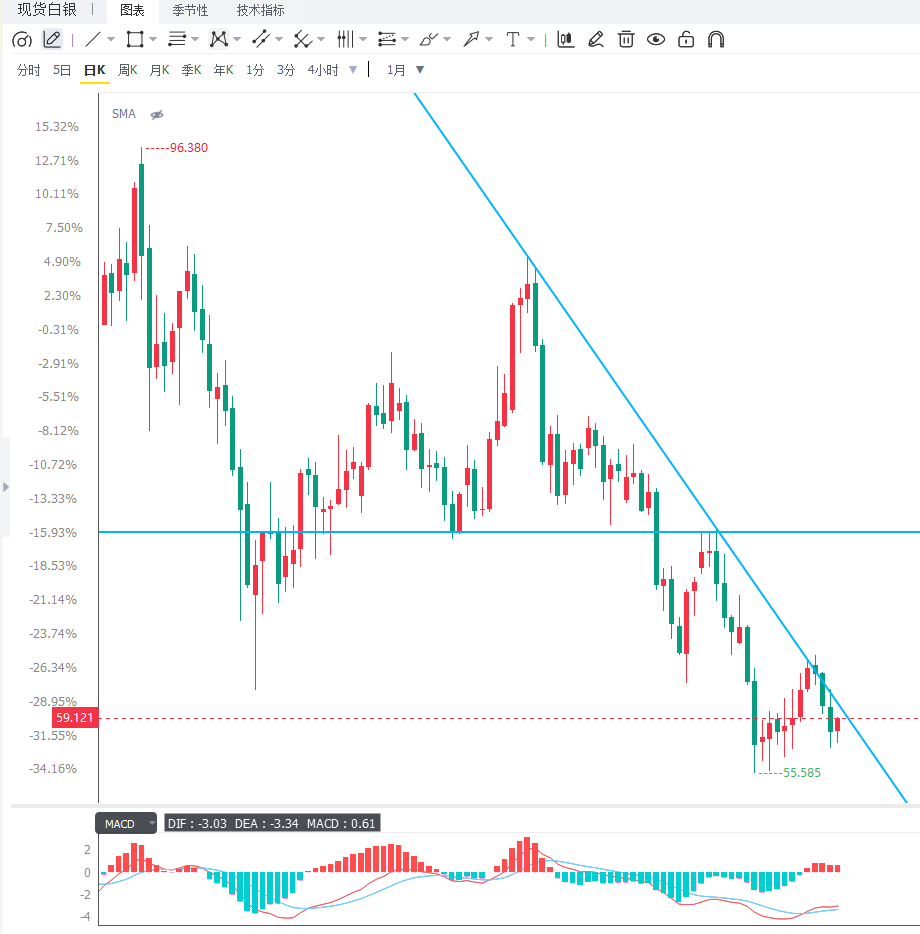
Editor's Summary : Silver's current rise is mainly driven by a weaker dollar, rising inflation risks, and improved safe-haven demand. However, expectations that the Federal Reserve will maintain its tightening policy continue to limit the upside potential of precious metals. In the short term, the market will find direction amidst the dollar's performance, US CPI data, and the situation in the Middle East. If inflationary pressures continue to rise and weaken expectations of interest rate cuts, silver may face downward pressure; if the dollar weakens further and safe-haven demand increases, silver prices still have a chance to continue testing key resistance areas. Investors should pay close attention to a breakout around $60, as this level will determine the short-term trend of silver.
From the perspective of the foreign exchange market, the US dollar generally weakened against major currencies, with a particularly significant drop against the New Zealand dollar. The decline in the US dollar index lowered the cost of purchasing non-US assets, thereby improving the short-term attractiveness of precious metals such as silver. At the same time, the rise in silver prices was also driven by rising global inflation risks. With the renewed escalation of the conflict between the US and Iran, market concerns about expanding energy supply risks led to a rapid rebound in international oil prices, further reinforcing expectations that energy prices would drive up inflation.
If crude oil prices continue to rise, it could increase global inflationary pressures and influence the future monetary policy paths of major central banks. Silver, possessing both precious metal and industrial attributes, has seen increased market attention amid rising inflation expectations and resilient demand from some industrial sectors. However, the minutes of the Federal Reserve's June monetary policy meeting, recently released, exerted some downward pressure on precious metals. The minutes showed that Fed officials generally believed that inflation risks remained the main challenge , with some policymakers suggesting that a more stringent monetary policy might be necessary to further reduce inflation.
This signal suggests that the Federal Reserve is likely to maintain a high-interest-rate environment in the short term. Since silver itself does not generate interest income, rising real interest rates typically reduce the attractiveness of holding precious metals for investors. The market focus will now shift to the US June Consumer Price Index (CPI) data. This data will be a crucial indicator of US inflation trends and the Fed's future policy direction. If inflation data is higher than expected, it could strengthen expectations of rising dollars and interest rates, putting pressure on silver; conversely, if inflation continues to cool, it could prompt the market to re-bet on a policy shift, providing support for precious metals.
From a technical perspective, spot silver has rebounded to around $59 , but it has not yet fully escaped the correction structure in the short term. On the daily chart, silver prices are still trading below the 20-day exponential moving average of $62.38 , indicating a weak short-term trend. The RSI (14) indicator is around 37, below the neutral level of 50 but not yet in the oversold zone , indicating that there is still selling pressure in the market, but the short sellers have not yet released their selling pressure to an extreme extent.
On the upside resistance level, the first thing to watch is the psychological level of $60.00 . A break above this level could lead to a further test of the 20-day moving average resistance around $62.38 . If silver prices regain a foothold in this area, the short-term technical structure may improve, opening up further upside potential. On the downside support level, the key level to watch is $55.63 , which corresponds to the low of June 24th. A break below this area could signal the start of a new round of declines, seeking even lower support levels.
From a four-hour chart perspective, silver's short-term trend has recovered somewhat, with prices gradually approaching a key resistance area after a continuous rebound. The MACD shows signs of recovery at low levels, indicating a weakening of short-term bearish momentum . However, if it fails to break through $60 , the market may maintain a weak and volatile pattern. If the US dollar continues to weaken and boosts risk appetite, silver prices could challenge the $62.38 resistance level; conversely, if expectations of a hawkish stance from the Federal Reserve strengthen, silver may fall back to test the $57 or even $55.63 support level.
Editor's Summary : Silver's current rise is mainly driven by a weaker dollar, rising inflation risks, and improved safe-haven demand. However, expectations that the Federal Reserve will maintain its tightening policy continue to limit the upside potential of precious metals. In the short term, the market will find direction amidst the dollar's performance, US CPI data, and the situation in the Middle East. If inflationary pressures continue to rise and weaken expectations of interest rate cuts, silver may face downward pressure; if the dollar weakens further and safe-haven demand increases, silver prices still have a chance to continue testing key resistance areas. Investors should pay close attention to a breakout around $60, as this level will determine the short-term trend of silver.
- Risk Warning and Disclaimer
- The market involves risk, and trading may not be suitable for all investors. This article is for reference only and does not constitute personal investment advice, nor does it take into account certain users’ specific investment objectives, financial situation, or other needs. Any investment decisions made based on this information are at your own risk.