Following Starmer's resignation, the political risk premium narrowed, and the pound received a double boost amid a weaker dollar.
2026-07-09 16:36:38
On Thursday (July 9) during the European session, the pound rose against the dollar, once approaching the high of 1.3433 since June 17, and is currently trading around 1.3420.
The significant easing of political uncertainty in the UK has provided support for the pound. Since Prime Minister Keir Starmer resigned in late June, political uncertainty in Britain has decreased substantially. The primary race to formally succeed Starmer began on July 9, with frontrunner Andy Burnham widely expected to take office as the new prime minister before July 20.
Meanwhile, the dollar remained defensive as the Fed minutes lacked any clear hawkish surprises, further supporting the pound's rise.
British politics have evolved rapidly over the past two weeks. Following Starmer's resignation in late June, the framework for the power transition within the Conservative Party has become clear. The formal leadership contest began on July 9th, with frontrunner Andy Burnham widely expected to assume the premiership by July 20th.
The market has reacted relatively positively to this political transition. Compared to previous political turmoil, the process of this power transfer is more standardized and the expectations are clearer, which reduces the "uncertainty discount" faced by the pound. Domestic political risks in the UK have been a significant factor suppressing the pound, but this factor is gradually fading as the transition process becomes clearer.
It is worth noting that although the new prime minister's policy direction remains to be seen, the market is currently more focused on the return of political stability itself, rather than specific policy details.
Before a new government is formed, the pound may continue to receive marginal support from the theme of "reduced political risk," but further gains will require support from fundamental factors, including changes in economic data and monetary policy expectations.
The GBP/USD pair rose to a high of 1.3657 on the daily chart before falling back, bottoming out at 1.3139 before rebounding and recovering. The current price is above key moving averages including the 20-day moving average (MA20) at 1.3299, the 50-day moving average (MA50), the 100-day moving average (MA100), and the 200-day moving average (M200).
In terms of indicators, the MACD is below the zero line, the DIFF crosses above the DEA to form a golden cross, and the red bars are gradually expanding, indicating that the bearish momentum has weakened significantly. The RSI1 has reached 75.64, which has entered the overbought zone, indicating that the short-term bullish power has been exhausted and the risk of a pullback and adjustment has increased.
From a technical perspective, 1.3139 is the key low point of this round of decline, and the price rebounded to near the MA100 before encountering resistance. 1.3420 is the short-term dividing line between bullish and bearish sentiment; a successful break above this level would likely lead to a further push towards 1.3512. If the price encounters resistance and falls back at this level, the MA20 at 1.3299 will be a significant support level.
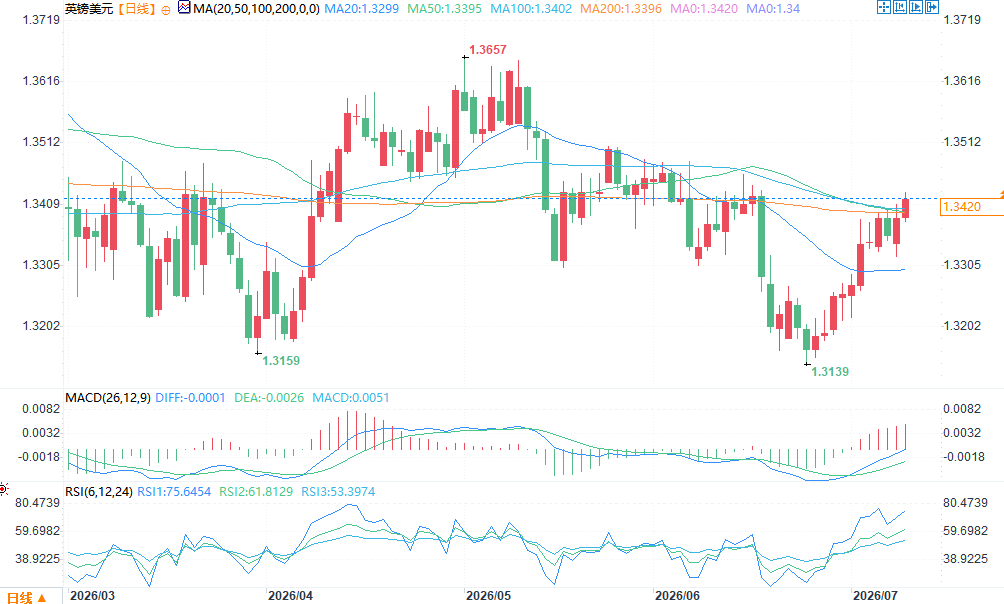
(GBP/USD daily chart, source: FX678)
While the easing of domestic political risks in the UK has provided support for the pound, external factors still pose potential risks. The continued escalation of the US-Iran conflict could boost the dollar through risk aversion, thus putting downward pressure on the pound against the dollar.
In addition, uncertainty surrounding the Federal Reserve's policy path—especially if subsequent US economic data is stronger than expected, which could reinvigorate expectations of interest rate hikes—is also a potential headwind for the pound.
From a fund flow perspective, recent CFTC data shows that long positions in the British pound have accumulated, meaning that some positive factors may have already been priced in by the market.
Therefore, although both technical and fundamental factors are favorable for the pound, further upside requires a new catalyst – which could be improved UK economic data, a further dovish shift in Federal Reserve policy expectations, or an unexpected easing of tensions in the Middle East.
Overall, both the technical and fundamental factors favor further upside for the British pound against the US dollar in the short term. The easing of political risks in the UK provides a relatively solid floor for the pound, while the US dollar is unlikely to gain strong upward momentum given the lack of surprises in the Fed minutes.
At 16:10 Beijing time on July 9, the British pound was trading at 1.3420/21 against the US dollar.
The significant easing of political uncertainty in the UK has provided support for the pound. Since Prime Minister Keir Starmer resigned in late June, political uncertainty in Britain has decreased substantially. The primary race to formally succeed Starmer began on July 9, with frontrunner Andy Burnham widely expected to take office as the new prime minister before July 20.
Meanwhile, the dollar remained defensive as the Fed minutes lacked any clear hawkish surprises, further supporting the pound's rise.
Fundamentals: Political risks in the UK have subsided, and a smooth transition to the new prime minister is expected.
British politics have evolved rapidly over the past two weeks. Following Starmer's resignation in late June, the framework for the power transition within the Conservative Party has become clear. The formal leadership contest began on July 9th, with frontrunner Andy Burnham widely expected to assume the premiership by July 20th.
The market has reacted relatively positively to this political transition. Compared to previous political turmoil, the process of this power transfer is more standardized and the expectations are clearer, which reduces the "uncertainty discount" faced by the pound. Domestic political risks in the UK have been a significant factor suppressing the pound, but this factor is gradually fading as the transition process becomes clearer.
It is worth noting that although the new prime minister's policy direction remains to be seen, the market is currently more focused on the return of political stability itself, rather than specific policy details.
Before a new government is formed, the pound may continue to receive marginal support from the theme of "reduced political risk," but further gains will require support from fundamental factors, including changes in economic data and monetary policy expectations.
Technical Analysis
The GBP/USD pair rose to a high of 1.3657 on the daily chart before falling back, bottoming out at 1.3139 before rebounding and recovering. The current price is above key moving averages including the 20-day moving average (MA20) at 1.3299, the 50-day moving average (MA50), the 100-day moving average (MA100), and the 200-day moving average (M200).
In terms of indicators, the MACD is below the zero line, the DIFF crosses above the DEA to form a golden cross, and the red bars are gradually expanding, indicating that the bearish momentum has weakened significantly. The RSI1 has reached 75.64, which has entered the overbought zone, indicating that the short-term bullish power has been exhausted and the risk of a pullback and adjustment has increased.
From a technical perspective, 1.3139 is the key low point of this round of decline, and the price rebounded to near the MA100 before encountering resistance. 1.3420 is the short-term dividing line between bullish and bearish sentiment; a successful break above this level would likely lead to a further push towards 1.3512. If the price encounters resistance and falls back at this level, the MA20 at 1.3299 will be a significant support level.
(GBP/USD daily chart, source: FX678)
Risk factors: The situation in the Middle East and the Federal Reserve's policies still require vigilance.
While the easing of domestic political risks in the UK has provided support for the pound, external factors still pose potential risks. The continued escalation of the US-Iran conflict could boost the dollar through risk aversion, thus putting downward pressure on the pound against the dollar.
In addition, uncertainty surrounding the Federal Reserve's policy path—especially if subsequent US economic data is stronger than expected, which could reinvigorate expectations of interest rate hikes—is also a potential headwind for the pound.
From a fund flow perspective, recent CFTC data shows that long positions in the British pound have accumulated, meaning that some positive factors may have already been priced in by the market.
Therefore, although both technical and fundamental factors are favorable for the pound, further upside requires a new catalyst – which could be improved UK economic data, a further dovish shift in Federal Reserve policy expectations, or an unexpected easing of tensions in the Middle East.
Overall, both the technical and fundamental factors favor further upside for the British pound against the US dollar in the short term. The easing of political risks in the UK provides a relatively solid floor for the pound, while the US dollar is unlikely to gain strong upward momentum given the lack of surprises in the Fed minutes.
At 16:10 Beijing time on July 9, the British pound was trading at 1.3420/21 against the US dollar.
- Risk Warning and Disclaimer
- The market involves risk, and trading may not be suitable for all investors. This article is for reference only and does not constitute personal investment advice, nor does it take into account certain users’ specific investment objectives, financial situation, or other needs. Any investment decisions made based on this information are at your own risk.