Why is the euro remaining indifferent to fuel prices amid the US-Iran conflict?
2026-07-09 16:33:43
On Thursday (July 9), the euro remained range-bound against the US dollar during the European session, currently trading around 1.1430.
Commerzbank currency analyst Turan Nguyen pointed out that the euro has been trading in a narrow range against the dollar recently, largely unaffected by news related to the US-Iran conflict, and the correlation between the exchange rate and oil prices has weakened significantly.
The key explanation for this phenomenon is that despite the significant fluctuations in oil prices, the market is still pricing in expectations of Fed rate hikes—this stems from a reassessment of the Fed's policy response function, rather than the traditional logic of oil price transmission.
In her report, Nguyen noted that the euro against the dollar was "largely unaffected by the latest developments in the Iranian conflict, continuing to trade within a relatively narrow range." She further added that Commerzbank had previously pointed out that "the correlation between exchange rates and oil prices has weakened significantly."
This observation challenges conventional market intuition—generally, Middle East geopolitical conflicts influence exchange rates by pushing up oil prices (rising oil prices benefit commodity currencies and harm energy-import-dependent economies). However, the current euro-dollar exchange rate's reaction to this transmission path is showing signs of dulling, suggesting that other, more powerful structural factors are dominating exchange rate pricing.
Ruan believes that the core reason why the market maintains its expectation of interest rate hikes despite a significant drop in oil prices is that "the market is reassessing the Fed's policies." This reassessment can be traced back to the first FOMC meeting under Warsh's leadership.
She pointed out two key signals. First, a significant number of FOMC members are inclined to raise interest rates—meaning that the Fed's policy preference has shifted from "wait-and-see" to "tightening-oriented." Second, the meeting minutes released Wednesday evening clearly showed that "participants generally believed that the information received during the meeting indicated that upside risks to price stability remained high, while downside risks to achieving full employment had eased." The minutes further noted that in a scenario of persistently high inflation, "almost all" participants holding this view indicated that "some policy tightening may be needed to bring inflation back to 2%."
These two signals point to the same conclusion: the market no longer believes that the Federal Reserve will easily shift to easing due to political pressure or a slight weakening of the labor market. The risk of "politically driven monetary policy easing" that the market previously worried about is receding, replaced by confidence that the Fed will stick to tightening to curb inflation.
Commerzbank's analysis has clear implications for the euro's movement against the dollar. If the market continues to price in a hawkish stance from the Federal Reserve—even if weak US economic data or geopolitical risks push up oil prices—the dollar will receive sustained support, thus limiting the euro's upside potential.
Previously, the market had believed that if the US labor market showed signs of weakness, the Federal Reserve might quickly turn to interest rate cuts, thereby weakening the dollar and benefiting the euro. However, the Fed under Warsh's leadership is sending a different signal: inflation remains the primary concern, and policymakers will not easily change their tightening stance based on a single data point. This shift in the "reaction function" makes it difficult for the euro to gain sustained upward momentum against the dollar, even in the context of weak US economic data.
In summary, Commerzbank's analysis reveals the core characteristics of the current euro-dollar exchange rate trend: the traditional link between the exchange rate and oil prices has been broken, replaced by a repricing of the market's response function to the Federal Reserve's policies. With a significant number of FOMC members favoring interest rate hikes and inflation risks remaining a primary concern, the structural support for the dollar is relatively solid.
For the euro against the dollar, this means a lack of strong momentum to break out of the current range in the short term. Even if geopolitical risks push up oil prices, the euro's upside will be limited by the Federal Reserve's hawkish stance; even if US economic data shows signs of weakness, the market will be more cautious about the prospect of interest rate cuts. The euro/dollar pair is likely to maintain a range-bound pattern at its current level, requiring a more decisive policy shift or economic data to break the current equilibrium.
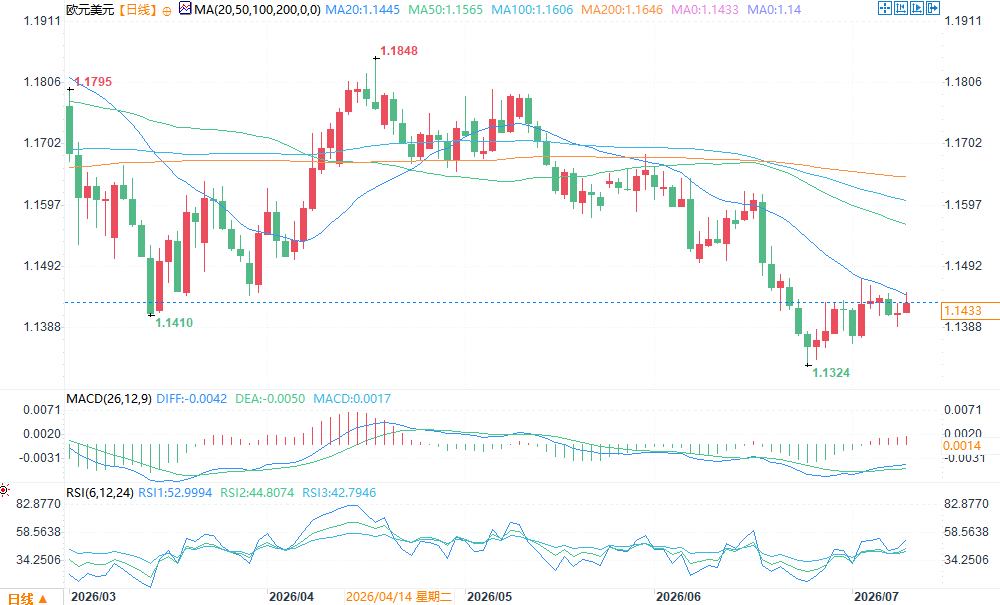
(Euro/USD daily chart, source: FX678)
At 15:57 Beijing time on July 9, the euro was trading at 1.1432/33 against the US dollar.
Commerzbank currency analyst Turan Nguyen pointed out that the euro has been trading in a narrow range against the dollar recently, largely unaffected by news related to the US-Iran conflict, and the correlation between the exchange rate and oil prices has weakened significantly.
The key explanation for this phenomenon is that despite the significant fluctuations in oil prices, the market is still pricing in expectations of Fed rate hikes—this stems from a reassessment of the Fed's policy response function, rather than the traditional logic of oil price transmission.
The US-Iran conflict has a limited impact on the euro, and the correlation between exchange rates and oil prices has weakened.
In her report, Nguyen noted that the euro against the dollar was "largely unaffected by the latest developments in the Iranian conflict, continuing to trade within a relatively narrow range." She further added that Commerzbank had previously pointed out that "the correlation between exchange rates and oil prices has weakened significantly."
This observation challenges conventional market intuition—generally, Middle East geopolitical conflicts influence exchange rates by pushing up oil prices (rising oil prices benefit commodity currencies and harm energy-import-dependent economies). However, the current euro-dollar exchange rate's reaction to this transmission path is showing signs of dulling, suggesting that other, more powerful structural factors are dominating exchange rate pricing.
Markets Reassess the Fed's Policy Logic
Ruan believes that the core reason why the market maintains its expectation of interest rate hikes despite a significant drop in oil prices is that "the market is reassessing the Fed's policies." This reassessment can be traced back to the first FOMC meeting under Warsh's leadership.
She pointed out two key signals. First, a significant number of FOMC members are inclined to raise interest rates—meaning that the Fed's policy preference has shifted from "wait-and-see" to "tightening-oriented." Second, the meeting minutes released Wednesday evening clearly showed that "participants generally believed that the information received during the meeting indicated that upside risks to price stability remained high, while downside risks to achieving full employment had eased." The minutes further noted that in a scenario of persistently high inflation, "almost all" participants holding this view indicated that "some policy tightening may be needed to bring inflation back to 2%."
These two signals point to the same conclusion: the market no longer believes that the Federal Reserve will easily shift to easing due to political pressure or a slight weakening of the labor market. The risk of "politically driven monetary policy easing" that the market previously worried about is receding, replaced by confidence that the Fed will stick to tightening to curb inflation.
Impact on the euro against the US dollar: Upside potential limited
Commerzbank's analysis has clear implications for the euro's movement against the dollar. If the market continues to price in a hawkish stance from the Federal Reserve—even if weak US economic data or geopolitical risks push up oil prices—the dollar will receive sustained support, thus limiting the euro's upside potential.
Previously, the market had believed that if the US labor market showed signs of weakness, the Federal Reserve might quickly turn to interest rate cuts, thereby weakening the dollar and benefiting the euro. However, the Fed under Warsh's leadership is sending a different signal: inflation remains the primary concern, and policymakers will not easily change their tightening stance based on a single data point. This shift in the "reaction function" makes it difficult for the euro to gain sustained upward momentum against the dollar, even in the context of weak US economic data.
Outlook: The euro lacks the momentum to break out and is expected to continue its range-bound trading pattern.
In summary, Commerzbank's analysis reveals the core characteristics of the current euro-dollar exchange rate trend: the traditional link between the exchange rate and oil prices has been broken, replaced by a repricing of the market's response function to the Federal Reserve's policies. With a significant number of FOMC members favoring interest rate hikes and inflation risks remaining a primary concern, the structural support for the dollar is relatively solid.
For the euro against the dollar, this means a lack of strong momentum to break out of the current range in the short term. Even if geopolitical risks push up oil prices, the euro's upside will be limited by the Federal Reserve's hawkish stance; even if US economic data shows signs of weakness, the market will be more cautious about the prospect of interest rate cuts. The euro/dollar pair is likely to maintain a range-bound pattern at its current level, requiring a more decisive policy shift or economic data to break the current equilibrium.
(Euro/USD daily chart, source: FX678)
At 15:57 Beijing time on July 9, the euro was trading at 1.1432/33 against the US dollar.
- Risk Warning and Disclaimer
- The market involves risk, and trading may not be suitable for all investors. This article is for reference only and does not constitute personal investment advice, nor does it take into account certain users’ specific investment objectives, financial situation, or other needs. Any investment decisions made based on this information are at your own risk.