After three consecutive days of decline, a technical rebound has occurred. How far can this rebound in silver go?
2026-07-09 16:34:31
On Thursday (July 9) during the European session, spot silver prices rebounded after three consecutive days of decline, and are currently trading above $59 per ounce.
However, this rebound is more of a technical correction after a short-term oversold condition than a signal of a trend reversal.
The escalating conflict between the US and Iran is fueling energy-driven inflation expectations, which will force the Federal Reserve to maintain high interest rates for an extended period—a strong macro headwind for non-interest-bearing silver.
Trump's statement that the interim US-Iran agreement has "formally ended," coupled with news of continued US military strikes against Iran, marks a significant deterioration in the geopolitical situation in the Middle East.
Trump's threats to launch a second airstrike and reimpose the naval blockade further fueled market concerns about supply disruptions.
The Strait of Hormuz is a vital passage for approximately one-fifth of the world's oil supply. Escalating military conflicts in the region directly threaten the security of energy transportation, driving up crude oil prices significantly.
Rising energy prices will be transmitted to the silver market through two pathways: first, rising inflation expectations will push up nominal interest rate expectations; second, the Federal Reserve may maintain a tight monetary policy to curb inflation, further pushing up real interest rates. Both of these factors put pressure on non-interest-bearing silver.
The minutes of the Federal Reserve’s June 16-17 meeting, released Wednesday, showed that a “minority of participants” believed there were reasons to raise interest rates at the June meeting, although they ultimately supported the decision to keep rates unchanged.
The minutes also reflect growing concerns among policymakers about inflation—price pressures have spread to a wider range of sectors, while concerns about the labor market have eased somewhat. This policy backdrop creates a bearish chain of logic for silver: geopolitical conflict → energy price concerns → rising inflation expectations → increased probability of interest rate hikes → pressure on non-interest-bearing assets.
Data from the CME Group's FedWatch tool clearly reflects this shift in expectations: swap traders are now pricing in a greater than 30% chance of a Fed rate hike at its next meeting, compared to less than 20% last Thursday. This rapid rise in rate hike expectations means the opportunity cost of holding silver is increasing, diminishing its appeal to investors.
According to the daily chart, spot silver experienced a deep decline after reaching a previous high of 96.38, with the overall market trending downwards. The price rebounded from a low of 55.59. The moving average system remains clearly bearish, with the 20-day (62.27), 50-day, and 100-day moving averages all trending downwards. Silver prices are below the 20-day moving average, indicating that the medium- to long-term downtrend has not reversed, and the moving averages above are providing strong resistance.
In terms of indicators, the MACD is running below the zero axis, and the DIFF line at -3.048 has slightly crossed the DEA line at -3.340 to form a golden cross. A small red bar has appeared, and the bearish momentum is gradually weakening. The RSI has rebounded from the oversold zone, with the RSI1 value at 38.547. It has not entered the 70 overbought zone, and there is still room for a slight recovery in the short term.
In terms of price structure, 55.59 is a key support level for this decline. The primary short-term resistance is the 20-day moving average (MA20) at 62.27; a decisive break above this level is needed to open up room for a rebound. Below, 55.59 is a key level separating bullish and bearish sentiment; a break below this level would likely lead to a continuation of the downtrend.
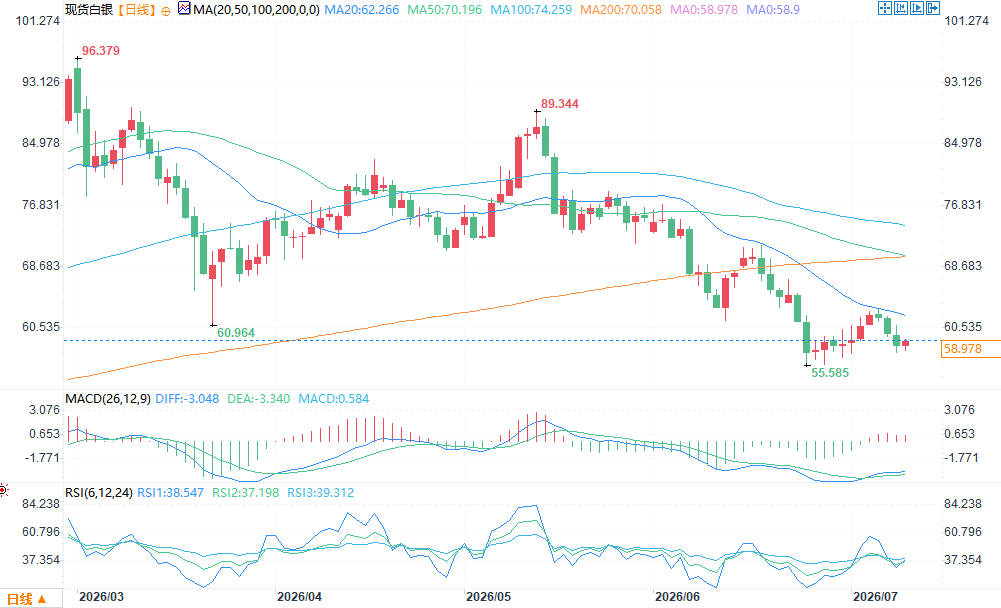
(Spot silver daily chart, source: EasyForex)
In summary, silver is currently under pressure from macroeconomic headwinds. Concerns about energy inflation stemming from the escalating US-Iran conflict are putting downward pressure on silver prices by increasing expectations of interest rate hikes. The hawkish tone revealed in the Fed minutes and the rising probability of a rate hike in the swap market further reinforce this bearish logic. A short-term technical rebound may encounter resistance above, and silver prices are likely to fluctuate within the $58-$60 range.
The key variables for the market outlook are: whether the situation in the Middle East will escalate further or a new diplomatic turning point will emerge; and whether US economic data can confirm the anti-inflationary trend, thereby weakening expectations of interest rate hikes. If the situation unexpectedly eases or economic data weakens, silver is expected to see a more sustainable rebound; if the conflict continues to escalate and pushes interest rate hike expectations higher, silver prices may face greater downward pressure. In the current highly volatile environment, silver's price movement will still be highly dependent on the interactive evolution of geopolitical and monetary policy expectations.
At 16:03 Beijing time on July 9, spot silver was trading at $59.17 per ounce.
However, this rebound is more of a technical correction after a short-term oversold condition than a signal of a trend reversal.
The escalating conflict between the US and Iran is fueling energy-driven inflation expectations, which will force the Federal Reserve to maintain high interest rates for an extended period—a strong macro headwind for non-interest-bearing silver.
Geopolitics: Ceasefire Agreement Ends, Energy Inflation Risks Reignite
Trump's statement that the interim US-Iran agreement has "formally ended," coupled with news of continued US military strikes against Iran, marks a significant deterioration in the geopolitical situation in the Middle East.
Trump's threats to launch a second airstrike and reimpose the naval blockade further fueled market concerns about supply disruptions.
The Strait of Hormuz is a vital passage for approximately one-fifth of the world's oil supply. Escalating military conflicts in the region directly threaten the security of energy transportation, driving up crude oil prices significantly.
Rising energy prices will be transmitted to the silver market through two pathways: first, rising inflation expectations will push up nominal interest rate expectations; second, the Federal Reserve may maintain a tight monetary policy to curb inflation, further pushing up real interest rates. Both of these factors put pressure on non-interest-bearing silver.
Federal Reserve policy expectations: The probability of a rate hike is rising, and real interest rates are putting downward pressure on silver.
The minutes of the Federal Reserve’s June 16-17 meeting, released Wednesday, showed that a “minority of participants” believed there were reasons to raise interest rates at the June meeting, although they ultimately supported the decision to keep rates unchanged.
The minutes also reflect growing concerns among policymakers about inflation—price pressures have spread to a wider range of sectors, while concerns about the labor market have eased somewhat. This policy backdrop creates a bearish chain of logic for silver: geopolitical conflict → energy price concerns → rising inflation expectations → increased probability of interest rate hikes → pressure on non-interest-bearing assets.
Data from the CME Group's FedWatch tool clearly reflects this shift in expectations: swap traders are now pricing in a greater than 30% chance of a Fed rate hike at its next meeting, compared to less than 20% last Thursday. This rapid rise in rate hike expectations means the opportunity cost of holding silver is increasing, diminishing its appeal to investors.
Technical Analysis
According to the daily chart, spot silver experienced a deep decline after reaching a previous high of 96.38, with the overall market trending downwards. The price rebounded from a low of 55.59. The moving average system remains clearly bearish, with the 20-day (62.27), 50-day, and 100-day moving averages all trending downwards. Silver prices are below the 20-day moving average, indicating that the medium- to long-term downtrend has not reversed, and the moving averages above are providing strong resistance.
In terms of indicators, the MACD is running below the zero axis, and the DIFF line at -3.048 has slightly crossed the DEA line at -3.340 to form a golden cross. A small red bar has appeared, and the bearish momentum is gradually weakening. The RSI has rebounded from the oversold zone, with the RSI1 value at 38.547. It has not entered the 70 overbought zone, and there is still room for a slight recovery in the short term.
In terms of price structure, 55.59 is a key support level for this decline. The primary short-term resistance is the 20-day moving average (MA20) at 62.27; a decisive break above this level is needed to open up room for a rebound. Below, 55.59 is a key level separating bullish and bearish sentiment; a break below this level would likely lead to a continuation of the downtrend.
(Spot silver daily chart, source: EasyForex)
Outlook: Macroeconomic headwinds dominate, silver awaits marginal changes.
In summary, silver is currently under pressure from macroeconomic headwinds. Concerns about energy inflation stemming from the escalating US-Iran conflict are putting downward pressure on silver prices by increasing expectations of interest rate hikes. The hawkish tone revealed in the Fed minutes and the rising probability of a rate hike in the swap market further reinforce this bearish logic. A short-term technical rebound may encounter resistance above, and silver prices are likely to fluctuate within the $58-$60 range.
The key variables for the market outlook are: whether the situation in the Middle East will escalate further or a new diplomatic turning point will emerge; and whether US economic data can confirm the anti-inflationary trend, thereby weakening expectations of interest rate hikes. If the situation unexpectedly eases or economic data weakens, silver is expected to see a more sustainable rebound; if the conflict continues to escalate and pushes interest rate hike expectations higher, silver prices may face greater downward pressure. In the current highly volatile environment, silver's price movement will still be highly dependent on the interactive evolution of geopolitical and monetary policy expectations.
At 16:03 Beijing time on July 9, spot silver was trading at $59.17 per ounce.
- Risk Warning and Disclaimer
- The market involves risk, and trading may not be suitable for all investors. This article is for reference only and does not constitute personal investment advice, nor does it take into account certain users’ specific investment objectives, financial situation, or other needs. Any investment decisions made based on this information are at your own risk.