Geopolitical conflicts are of limited intensity, but protracted conflict is becoming an option, leading to an oil price rebound.
2026-07-09 20:32:02
On Thursday (July 9), during the Asian and European sessions, international oil prices rebounded after hitting a low. Initially, oil prices fell after Trump said that Iran was still seeking negotiations. Later, after an explosion was heard in the Bushehr region of southern Iran, oil prices rebounded . Currently, WTI crude oil is trading around 73.89, up 0.5%.
Recently, the geopolitical situation around the Strait of Hormuz, a global energy chokepoint, has deteriorated sharply. The United States and Iran launched two-way military strikes for two consecutive days, and the core game over control of the strait has intensified, plunging the security order of the Middle East into turmoil once again.
As a strategic core waterway carrying a large volume of global oil and gas transportation, the Strait of Hormuz is a key focal point of geopolitical competition in the Middle East.
Since the joint military operation between the US and Israel triggered the conflict in February this year, disputes have frequently occurred in the Straits, which were originally free to navigate. Iran has always firmly claimed absolute control and sovereignty over the Straits, completely overturning the original navigation rules.
The temporary ceasefire agreement reached between the US and Iran has recently expired. Although the Trump administration has restarted military strikes and taken a hard line against Iran, it has not completely closed diplomatic negotiation channels.
The core objective of this round of US military action against Iran is to weaken Iran's ability to interfere with freedom of navigation in the Strait of Hormuz and attack commercial vessels.
The U.S. Central Command confirmed that it has precisely targeted more than 90 key military targets off the coast of Iran, including missile and drone storage facilities and military logistics supply sites, in an effort to undermine Iran's near-shore deterrence capabilities.
Iranian officials later disclosed that the US airstrikes had killed 14 people and injured 78 others, with 47 of the wounded still receiving treatment. The attack covered five Iranian provinces, damaging important facilities such as railway bridges in the northeast and military bases in Bushehr province. The Bushehr base is adjacent to Iran's only civilian nuclear power plant, and its strategic impact is far-reaching.
In addition, explosions were heard in several port cities in Iran, including Kish Island and Bandar Abbas, and power outages occurred in some areas. Military and civilian facilities in many parts of the country were also affected.
In response to the US airstrikes, Iran swiftly launched a reciprocal retaliation, with its military counterattack precisely targeting US military outposts in the Gulf.
The Iranian Islamic Revolutionary Guard Corps and Army have successively deployed one-way attack drones to strike multiple key US military bases in Kuwait, Bahrain, and Qatar, including Arifjan and Jufir.
On-site reports confirm that a massive explosion occurred in Manama, the capital of Bahrain. Kuwait's air defense system successfully intercepted multiple incoming missiles and drones. Conflicts have engulfed the interiors of several Gulf states, and the regional situation is further spiraling out of control.
The immediate trigger for this round of conflict was Iran's recent repeated attacks on commercial shipping vessels in the Strait of Hormuz, which prompted the United States to launch two large-scale airstrikes against Iran.
The US has adopted a tough stance and is fully prepared for war. Several US officials told Axios that the US military is fully prepared for sustained firefights and to deal with an escalation of the situation . The conflict could last from one or two days to several weeks, with the core objective being to force Iran to stop its attacks on ships and abandon its demands for control of the Strait.
The US stated that this action was intended to warn Iran, and the strength and duration of the subsequent response will depend entirely on Iran's next move.
Despite the escalating military confrontation, both the US and Iran have maintained a buffer zone in their game of strategy.
Trump publicly confirmed that Iran had taken the initiative to seek to restart negotiations and was eager to reach a new agreement, but he also questioned Iran's credibility in fulfilling its obligations, describing its actions as inconsistent and unpredictable.
In contrast, Iran's stance has become increasingly hardline. Iran's chief negotiator, Ghalibaf, has repeatedly and publicly countered the hegemonic behavior of the United States, emphasizing that the era of American bullying, pressure, and reneging on commitments is over. He stated that if the United States launches an attack, it will inevitably face a reciprocal response. At the same time, he clearly defined the bottom line: the Strait of Hormuz can only be opened to the outside world under Iran's control rules, and the US's deterrence cannot change the established pattern.
Since the outbreak of the conflict, Iran has insisted on controlling the entire Strait of Hormuz, plans to charge passage fees to passing ships, and warned that all ships that deviate from the designated routes will face military strikes.
The ongoing geopolitical conflict has directly impacted the global energy supply chain and crude oil market trends.
The shipping order in the Strait of Hormuz, which was briefly restored after the ceasefire between the US and Iran last month, has been completely disrupted. Since Wednesday of this week, affected by the uncertainty of the escalating situation, global shipowners and shipping operators have generally adopted a cautious wait-and-see attitude, and tanker transportation in the Strait of Hormuz has come to a complete standstill.
Nearly 6,000 seafarers remain stranded in the surrounding waters, paralyzing shipping and logistics.
Currently, we tend to have a more optimistic outlook. Since a blockade of the Straits is not in the interests of either the United States or Iran, coupled with a global economic slowdown, insufficient demand, and the diversification of crude oil supply, the physical factors will limit the rise in oil prices. Trump has also been continuously expressing the expectation that oil prices should not rise sharply, which has also alleviated the market's panic caused by pessimistic expectations of a surge in oil prices.
Iran is replicating Israel's logic, attempting to gain control of a territory through a state of continuous conflict and ultimately profit from it. If a VLCC carries 2 million barrels of crude oil, and only charges $1 per barrel, that's $2 million per ship. If 40 ships pass through a day, that's nearly $10 million in revenue. And the international community can't entirely blame Iran because it's the victim of aggression.
Technically, oil prices are currently under pressure from the 11-X line, with the next resistance level around 75.50 and support at 73.50, followed by the psychological level of 70.
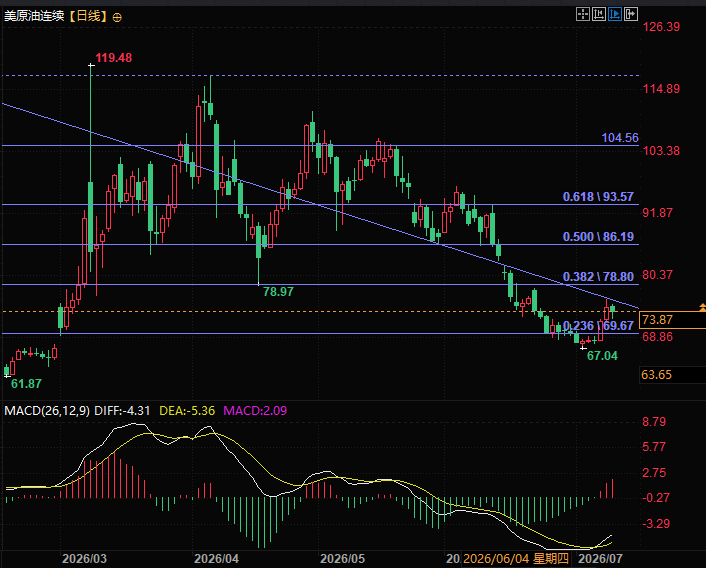
(WTI crude oil futures daily chart, source: FX678)
At 20:29 Beijing time, WTI crude oil futures were trading at $73.83 per barrel.
Recently, the geopolitical situation around the Strait of Hormuz, a global energy chokepoint, has deteriorated sharply. The United States and Iran launched two-way military strikes for two consecutive days, and the core game over control of the strait has intensified, plunging the security order of the Middle East into turmoil once again.
Strategic waterway rivalry intensifies, formally invalidating the US-Iran ceasefire agreement.
As a strategic core waterway carrying a large volume of global oil and gas transportation, the Strait of Hormuz is a key focal point of geopolitical competition in the Middle East.
Since the joint military operation between the US and Israel triggered the conflict in February this year, disputes have frequently occurred in the Straits, which were originally free to navigate. Iran has always firmly claimed absolute control and sovereignty over the Straits, completely overturning the original navigation rules.
The temporary ceasefire agreement reached between the US and Iran has recently expired. Although the Trump administration has restarted military strikes and taken a hard line against Iran, it has not completely closed diplomatic negotiation channels.
The large-scale US airstrikes on Iran have caused severe damage to facilities and heavy casualties in multiple provinces.
The core objective of this round of US military action against Iran is to weaken Iran's ability to interfere with freedom of navigation in the Strait of Hormuz and attack commercial vessels.
The U.S. Central Command confirmed that it has precisely targeted more than 90 key military targets off the coast of Iran, including missile and drone storage facilities and military logistics supply sites, in an effort to undermine Iran's near-shore deterrence capabilities.
Iranian officials later disclosed that the US airstrikes had killed 14 people and injured 78 others, with 47 of the wounded still receiving treatment. The attack covered five Iranian provinces, damaging important facilities such as railway bridges in the northeast and military bases in Bushehr province. The Bushehr base is adjacent to Iran's only civilian nuclear power plant, and its strategic impact is far-reaching.
In addition, explosions were heard in several port cities in Iran, including Kish Island and Bandar Abbas, and power outages occurred in some areas. Military and civilian facilities in many parts of the country were also affected.
Iran swiftly retaliated against attacks on US military bases in several Gulf states.
In response to the US airstrikes, Iran swiftly launched a reciprocal retaliation, with its military counterattack precisely targeting US military outposts in the Gulf.
The Iranian Islamic Revolutionary Guard Corps and Army have successively deployed one-way attack drones to strike multiple key US military bases in Kuwait, Bahrain, and Qatar, including Arifjan and Jufir.
On-site reports confirm that a massive explosion occurred in Manama, the capital of Bahrain. Kuwait's air defense system successfully intercepted multiple incoming missiles and drones. Conflicts have engulfed the interiors of several Gulf states, and the regional situation is further spiraling out of control.
The US has made its tough stance clear and is preparing for a prolonged escalation of the situation.
The immediate trigger for this round of conflict was Iran's recent repeated attacks on commercial shipping vessels in the Strait of Hormuz, which prompted the United States to launch two large-scale airstrikes against Iran.
The US has adopted a tough stance and is fully prepared for war. Several US officials told Axios that the US military is fully prepared for sustained firefights and to deal with an escalation of the situation . The conflict could last from one or two days to several weeks, with the core objective being to force Iran to stop its attacks on ships and abandon its demands for control of the Strait.
The US stated that this action was intended to warn Iran, and the strength and duration of the subsequent response will depend entirely on Iran's next move.
The US-Iran rivalry involves both hard and soft tactics, with Iran firmly upholding its sovereignty and control over the Taiwan Strait.
Despite the escalating military confrontation, both the US and Iran have maintained a buffer zone in their game of strategy.
Trump publicly confirmed that Iran had taken the initiative to seek to restart negotiations and was eager to reach a new agreement, but he also questioned Iran's credibility in fulfilling its obligations, describing its actions as inconsistent and unpredictable.
In contrast, Iran's stance has become increasingly hardline. Iran's chief negotiator, Ghalibaf, has repeatedly and publicly countered the hegemonic behavior of the United States, emphasizing that the era of American bullying, pressure, and reneging on commitments is over. He stated that if the United States launches an attack, it will inevitably face a reciprocal response. At the same time, he clearly defined the bottom line: the Strait of Hormuz can only be opened to the outside world under Iran's control rules, and the US's deterrence cannot change the established pattern.
Since the outbreak of the conflict, Iran has insisted on controlling the entire Strait of Hormuz, plans to charge passage fees to passing ships, and warned that all ships that deviate from the designated routes will face military strikes.
Shipping has come to a complete standstill, leaving a large number of seafarers stranded at sea.
The ongoing geopolitical conflict has directly impacted the global energy supply chain and crude oil market trends.
The shipping order in the Strait of Hormuz, which was briefly restored after the ceasefire between the US and Iran last month, has been completely disrupted. Since Wednesday of this week, affected by the uncertainty of the escalating situation, global shipowners and shipping operators have generally adopted a cautious wait-and-see attitude, and tanker transportation in the Strait of Hormuz has come to a complete standstill.
Nearly 6,000 seafarers remain stranded in the surrounding waters, paralyzing shipping and logistics.
Summary and Technical Analysis:
Currently, we tend to have a more optimistic outlook. Since a blockade of the Straits is not in the interests of either the United States or Iran, coupled with a global economic slowdown, insufficient demand, and the diversification of crude oil supply, the physical factors will limit the rise in oil prices. Trump has also been continuously expressing the expectation that oil prices should not rise sharply, which has also alleviated the market's panic caused by pessimistic expectations of a surge in oil prices.
Iran is replicating Israel's logic, attempting to gain control of a territory through a state of continuous conflict and ultimately profit from it. If a VLCC carries 2 million barrels of crude oil, and only charges $1 per barrel, that's $2 million per ship. If 40 ships pass through a day, that's nearly $10 million in revenue. And the international community can't entirely blame Iran because it's the victim of aggression.
Technically, oil prices are currently under pressure from the 11-X line, with the next resistance level around 75.50 and support at 73.50, followed by the psychological level of 70.
(WTI crude oil futures daily chart, source: FX678)
At 20:29 Beijing time, WTI crude oil futures were trading at $73.83 per barrel.
- Risk Warning and Disclaimer
- The market involves risk, and trading may not be suitable for all investors. This article is for reference only and does not constitute personal investment advice, nor does it take into account certain users’ specific investment objectives, financial situation, or other needs. Any investment decisions made based on this information are at your own risk.