Copper prices rebounded despite energy disturbances; which risk are funds reassessing?
2026-07-09 20:06:31
On Thursday, July 9th, LME copper quickly recovered its previous losses amid a general rebound in industrial metals. Three-month copper is currently trading above $13,400 per tonne, up 1.2% on the day, showing a significant rebound.
Recent escalation of conflict in the Gulf region has brought shipping risks along vital energy routes back into the realm of asset pricing. Brent crude is currently above $78 per barrel, with energy costs, shipping efficiency, and industrial demand expectations all being reassessed. However, copper prices have not continued their risk-averse decline; instead, they have rebounded along with equity assets and industrial metals, indicating that the market is temporarily viewing the conflict as a volatility amplifier rather than a systemic shock sufficient to immediately alter global manufacturing demand.
Current copper prices can be broken down into four pricing factors: global risk appetite, energy costs, inventory convenience gains, and the option value of supply disruptions. Escalating conflicts typically have a two-way impact. On the one hand, rising energy prices may compress manufacturing profits and increase mining, smelting, and logistics costs, constraining end-user demand. On the other hand, disruptions to key shipping routes may also affect the flow of fuel, sulfur, and related industrial raw materials, posing a supply risk to some hydrometallurgical copper production capacity.
The market rebounded rapidly, reflecting that short-term funds responded faster to the overall recovery in risk assets than to changes in real demand. Some analysts believe that rapid capital inflows have become a significant driver of intraday price fluctuations, while major Asian consumer markets still have restocking demand during price declines. The current market thus exhibits a typical "two-tiered structure": high-frequency capital determines intraday direction, while inventory levels, processing, and mining disturbances determine the strength of price support after the decline.
Copper is not a major commodity directly reliant on Gulf energy shipping routes, but its supply chain is highly energy-intensive. The impact of rising crude oil prices on copper is not simply bullish or bearish, but rather simultaneously alters the cost curve, inflation expectations, and end-user demand. The current rise in copper prices is more like a repricing of risk assets combined with supply elasticity, rather than simply incorporating a conflict premium.
Inventory data has been a key support for this rebound. Public warehouse receipts show that LME copper inventories fell from 401,000 tons on May 11 to 310,650 tons on July 8, a cumulative decrease of 90,350 tons, or approximately 22.5%; this is also a decrease of about 5.6% compared to 329,225 tons on June 30. Continued destocking means a narrowing of the buffer space for deliverable metals, thereby increasing the profitability of storage facilities.
However, a decline in inventory cannot be directly equated with a shortage in the spot market. Current inventory levels remain significantly higher than the approximately 175,000 tons at the end of January. More importantly, on July 8th, the LME copper cash settlement price was $13,090/ton, while the three-month price was $13,169/ton, resulting in a forward premium of approximately $79/ton. This structure indicates that a sustained price inversion has not yet formed in the spot market; while inventory reduction has improved support for prices, it has not yet evolved into a typical near-month squeeze.
The global supply and demand balance is also subject to disagreement. The latest forecasts suggest a slight surplus of approximately 96,000 tons in the refined copper market in 2026, with refined copper production projected to grow by 0.4% and consumption by 1.6%. This surplus is not substantial relative to global annual consumption; disruptions at South American mines, raw material shortages, or restrictions on hydrometallurgical production could quickly erode the theoretical buffer. Therefore, the current fundamentals do not indicate a clear shortage, but rather a fragile balance of "theoretical slight surplus, but low actual supply elasticity."
From a daily chart perspective, the Bollinger Band middle line is at $13,492.94/ton, the upper line is at $13,918.45/ton, and the lower line is at $13,067.43/ton. The price is approximately 0.56% lower than the middle line but approximately 2.68% higher than the lower line, indicating that the recovery after the low of $12,988 has been relatively thorough. The market has returned to the Bollinger Bands, but has not yet completely broken free from the resistance of the middle line.
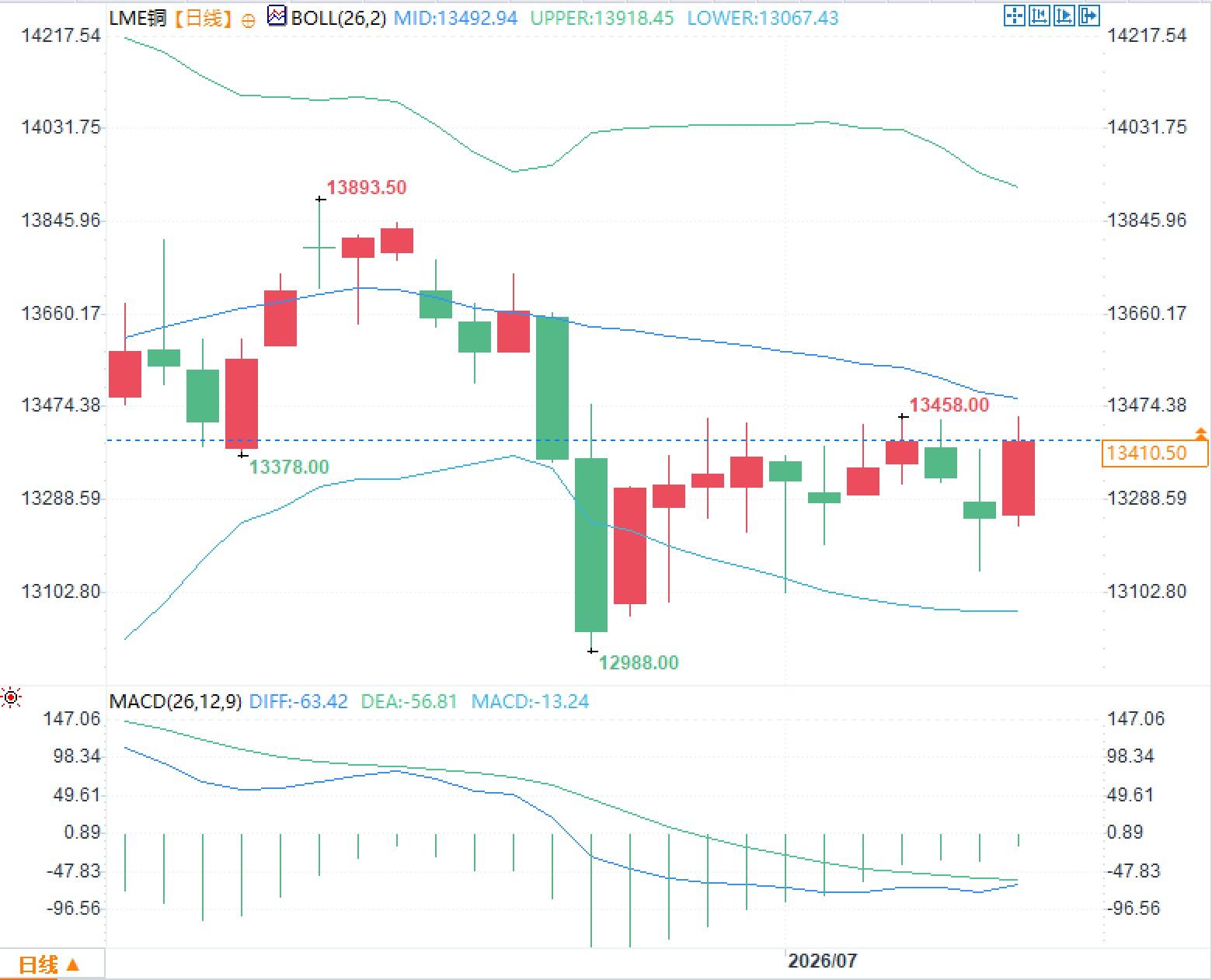
Recently, prices rebounded from $12,988 to around $13,450, a correction of approximately 3.6%. However, the MACD indicator shows the DIF at -63.42 and the DEA at -56.81, with the histogram still negative, indicating that short-term trend momentum has not yet reversed. The technical pattern is closer to mean reversion after an oversold condition than to the formation of a new one-sided upward structure.
Three-month copper futures touched a high of $14,527 per tonne this year, and are currently about 7.6% lower. Therefore, the rebound around $13,400 mainly corrected the recent risk discount, and further pricing will require continued inventory declines, a tightening of the spot term structure, and simultaneous improvement in technical momentum. A rapid rise driven by a single news item is insufficient to replace the continued validation of the supply-demand balance sheet and the spot market structure.
Recent escalation of conflict in the Gulf region has brought shipping risks along vital energy routes back into the realm of asset pricing. Brent crude is currently above $78 per barrel, with energy costs, shipping efficiency, and industrial demand expectations all being reassessed. However, copper prices have not continued their risk-averse decline; instead, they have rebounded along with equity assets and industrial metals, indicating that the market is temporarily viewing the conflict as a volatility amplifier rather than a systemic shock sufficient to immediately alter global manufacturing demand.
Rebound logic: Macro beta and physical constraints exert their effects simultaneously
Current copper prices can be broken down into four pricing factors: global risk appetite, energy costs, inventory convenience gains, and the option value of supply disruptions. Escalating conflicts typically have a two-way impact. On the one hand, rising energy prices may compress manufacturing profits and increase mining, smelting, and logistics costs, constraining end-user demand. On the other hand, disruptions to key shipping routes may also affect the flow of fuel, sulfur, and related industrial raw materials, posing a supply risk to some hydrometallurgical copper production capacity.
The market rebounded rapidly, reflecting that short-term funds responded faster to the overall recovery in risk assets than to changes in real demand. Some analysts believe that rapid capital inflows have become a significant driver of intraday price fluctuations, while major Asian consumer markets still have restocking demand during price declines. The current market thus exhibits a typical "two-tiered structure": high-frequency capital determines intraday direction, while inventory levels, processing, and mining disturbances determine the strength of price support after the decline.
Copper is not a major commodity directly reliant on Gulf energy shipping routes, but its supply chain is highly energy-intensive. The impact of rising crude oil prices on copper is not simply bullish or bearish, but rather simultaneously alters the cost curve, inflation expectations, and end-user demand. The current rise in copper prices is more like a repricing of risk assets combined with supply elasticity, rather than simply incorporating a conflict premium.
Inventory and Supply: Destocking is real, but a backlog of spot goods has not yet formed.
Inventory data has been a key support for this rebound. Public warehouse receipts show that LME copper inventories fell from 401,000 tons on May 11 to 310,650 tons on July 8, a cumulative decrease of 90,350 tons, or approximately 22.5%; this is also a decrease of about 5.6% compared to 329,225 tons on June 30. Continued destocking means a narrowing of the buffer space for deliverable metals, thereby increasing the profitability of storage facilities.
However, a decline in inventory cannot be directly equated with a shortage in the spot market. Current inventory levels remain significantly higher than the approximately 175,000 tons at the end of January. More importantly, on July 8th, the LME copper cash settlement price was $13,090/ton, while the three-month price was $13,169/ton, resulting in a forward premium of approximately $79/ton. This structure indicates that a sustained price inversion has not yet formed in the spot market; while inventory reduction has improved support for prices, it has not yet evolved into a typical near-month squeeze.
The global supply and demand balance is also subject to disagreement. The latest forecasts suggest a slight surplus of approximately 96,000 tons in the refined copper market in 2026, with refined copper production projected to grow by 0.4% and consumption by 1.6%. This surplus is not substantial relative to global annual consumption; disruptions at South American mines, raw material shortages, or restrictions on hydrometallurgical production could quickly erode the theoretical buffer. Therefore, the current fundamentals do not indicate a clear shortage, but rather a fragile balance of "theoretical slight surplus, but low actual supply elasticity."
Technical Structure: A rebound has occurred, but trend confirmation is still lacking one crucial element.
From a daily chart perspective, the Bollinger Band middle line is at $13,492.94/ton, the upper line is at $13,918.45/ton, and the lower line is at $13,067.43/ton. The price is approximately 0.56% lower than the middle line but approximately 2.68% higher than the lower line, indicating that the recovery after the low of $12,988 has been relatively thorough. The market has returned to the Bollinger Bands, but has not yet completely broken free from the resistance of the middle line.
Recently, prices rebounded from $12,988 to around $13,450, a correction of approximately 3.6%. However, the MACD indicator shows the DIF at -63.42 and the DEA at -56.81, with the histogram still negative, indicating that short-term trend momentum has not yet reversed. The technical pattern is closer to mean reversion after an oversold condition than to the formation of a new one-sided upward structure.
Three-month copper futures touched a high of $14,527 per tonne this year, and are currently about 7.6% lower. Therefore, the rebound around $13,400 mainly corrected the recent risk discount, and further pricing will require continued inventory declines, a tightening of the spot term structure, and simultaneous improvement in technical momentum. A rapid rise driven by a single news item is insufficient to replace the continued validation of the supply-demand balance sheet and the spot market structure.
- Risk Warning and Disclaimer
- The market involves risk, and trading may not be suitable for all investors. This article is for reference only and does not constitute personal investment advice, nor does it take into account certain users’ specific investment objectives, financial situation, or other needs. Any investment decisions made based on this information are at your own risk.