The weakness of the US dollar has fueled a continuous rebound in the euro, which may test the downward trendline resistance in the short term.
2026-07-10 13:44:13
The euro extended its gains against the dollar in early Asian trading on Friday, reaching around 1.1460, a new high for the week. The dollar continued to weaken due to the dovish stance of the Federal Reserve meeting minutes, becoming the main factor driving the EUR/USD rebound. The recently released Fed minutes showed a clear divergence of opinion among policymakers regarding the future direction of interest rates, reducing market expectations for further dollar strength. As investors reassessed the Fed's future policy path, the dollar index remained under pressure, providing room for the euro's rebound.

However, the dollar's downward trend remains limited. Global geopolitical uncertainties persist, particularly the potential for energy supply risks to impact inflation expectations and drive market funds back to safe-haven assets like the dollar. Therefore, despite the continuous rise in EUR/USD, further upward movement is somewhat constrained. From a technical perspective, EUR/USD is currently testing a key resistance area. The recent rebound has primarily stemmed from a correction of previous lows, and the price is currently attempting to break through the 23.6% Fibonacci retracement level of the April-June decline, but a valid breakout has not yet been achieved.
Furthermore, since rebounding from its year-to-date lows, EUR/USD has been trading along an upward-sloping channel, but this structure now shows signs of forming a bearish flag pattern, meaning the current rally may still be part of a mid-term correction rather than a full confirmation of a new uptrend. Technically, market momentum remains positive. The Relative Strength Index (RSI) is currently around 60, indicating increasing buying pressure but not yet entering overbought territory; the MACD indicator is above the zero line, and the histogram continues its moderate expansion, suggesting that short-term downward pressure has eased.
Currently, the price remains supported by the upward trend channel, with a key level around 1.1400. If this area holds as effective support, EUR/USD still has a chance to continue testing the upper resistance; however, a break below this level could lead to a return to a corrective trend.
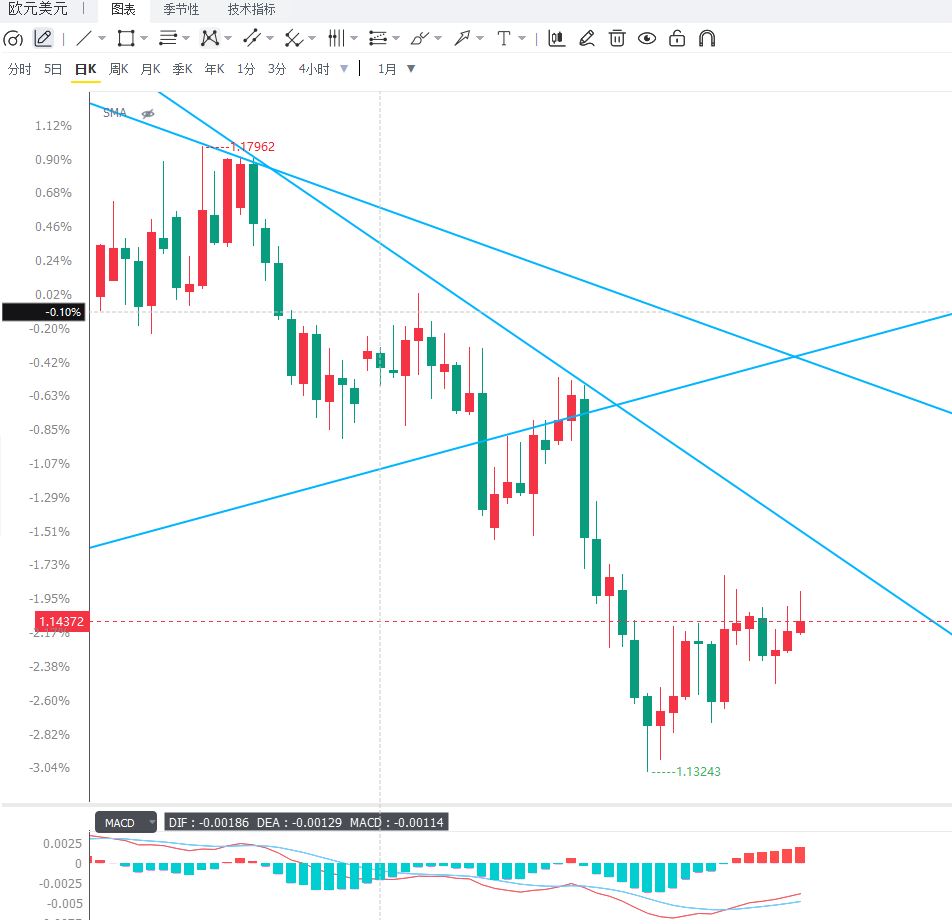
From a daily chart perspective, EUR/USD maintains its short-term rebound trend, with the price trading above short-term moving averages and market momentum gradually improving. The first resistance level to watch is the 1.1490-1.1500 area, which is also close to the 200-period exponential moving average and the upper channel line, making it a key battleground for bulls and bears in the short term. A decisive break and hold above this area could lead to further testing of the Fibonacci retracement targets near 1.1525 and 1.1585. On the downside, support is seen at 1.1400; a break below this level could lead to a further decline to around 1.1330.
From a 4-hour chart perspective, EUR/USD maintains its upward trend, with short-term moving averages continuing to rise, indicating that short-term buying pressure remains dominant. The RSI indicator remains in strong territory, and the MACD remains positive, suggesting that the upward momentum has not yet ended. However, the exchange rate is approaching the 1.1490 resistance area; if it fails to break through, short-term profit-taking may occur. If the price breaks through and confirms a hold above 1.1500, it may open up further upside potential; conversely, a break below 1.1400 will increase the risk of a pullback.
Editor's Summary
The recent rise in EUR/USD has been primarily driven by a weaker US dollar and cooling expectations for Federal Reserve policy, but the current movement is still in a technical correction phase and a trend reversal has not yet been fully confirmed. The 1.1490 to 1.1500 area will be a crucial level for determining the short-term direction. Going forward, the market will focus on Fed policy signals, changes in the US dollar index, and global risk sentiment. If the US dollar continues to be under pressure, the euro may continue its rebound and challenge higher resistance levels; however, if safe-haven demand rekindles, a dollar rebound may limit the upside potential of EUR/USD. Short-term traders should pay attention to whether the 1.1400 support level is breached and the 1.1500 resistance level is broken.
However, the dollar's downward trend remains limited. Global geopolitical uncertainties persist, particularly the potential for energy supply risks to impact inflation expectations and drive market funds back to safe-haven assets like the dollar. Therefore, despite the continuous rise in EUR/USD, further upward movement is somewhat constrained. From a technical perspective, EUR/USD is currently testing a key resistance area. The recent rebound has primarily stemmed from a correction of previous lows, and the price is currently attempting to break through the 23.6% Fibonacci retracement level of the April-June decline, but a valid breakout has not yet been achieved.
Furthermore, since rebounding from its year-to-date lows, EUR/USD has been trading along an upward-sloping channel, but this structure now shows signs of forming a bearish flag pattern, meaning the current rally may still be part of a mid-term correction rather than a full confirmation of a new uptrend. Technically, market momentum remains positive. The Relative Strength Index (RSI) is currently around 60, indicating increasing buying pressure but not yet entering overbought territory; the MACD indicator is above the zero line, and the histogram continues its moderate expansion, suggesting that short-term downward pressure has eased.
Currently, the price remains supported by the upward trend channel, with a key level around 1.1400. If this area holds as effective support, EUR/USD still has a chance to continue testing the upper resistance; however, a break below this level could lead to a return to a corrective trend.
From a daily chart perspective, EUR/USD maintains its short-term rebound trend, with the price trading above short-term moving averages and market momentum gradually improving. The first resistance level to watch is the 1.1490-1.1500 area, which is also close to the 200-period exponential moving average and the upper channel line, making it a key battleground for bulls and bears in the short term. A decisive break and hold above this area could lead to further testing of the Fibonacci retracement targets near 1.1525 and 1.1585. On the downside, support is seen at 1.1400; a break below this level could lead to a further decline to around 1.1330.
From a 4-hour chart perspective, EUR/USD maintains its upward trend, with short-term moving averages continuing to rise, indicating that short-term buying pressure remains dominant. The RSI indicator remains in strong territory, and the MACD remains positive, suggesting that the upward momentum has not yet ended. However, the exchange rate is approaching the 1.1490 resistance area; if it fails to break through, short-term profit-taking may occur. If the price breaks through and confirms a hold above 1.1500, it may open up further upside potential; conversely, a break below 1.1400 will increase the risk of a pullback.
Editor's Summary
The recent rise in EUR/USD has been primarily driven by a weaker US dollar and cooling expectations for Federal Reserve policy, but the current movement is still in a technical correction phase and a trend reversal has not yet been fully confirmed. The 1.1490 to 1.1500 area will be a crucial level for determining the short-term direction. Going forward, the market will focus on Fed policy signals, changes in the US dollar index, and global risk sentiment. If the US dollar continues to be under pressure, the euro may continue its rebound and challenge higher resistance levels; however, if safe-haven demand rekindles, a dollar rebound may limit the upside potential of EUR/USD. Short-term traders should pay attention to whether the 1.1400 support level is breached and the 1.1500 resistance level is broken.
- Risk Warning and Disclaimer
- The market involves risk, and trading may not be suitable for all investors. This article is for reference only and does not constitute personal investment advice, nor does it take into account certain users’ specific investment objectives, financial situation, or other needs. Any investment decisions made based on this information are at your own risk.