Japan's finance minister announced plans to guide pension funds to significantly increase their holdings of domestic assets, causing the yen and Japanese government bonds to surge.
2026-07-10 14:02:25
On Friday (July 10), Japanese Finance Minister Satsuki Katayama officially stated at a regular press conference that the Japanese government will introduce special measures to guide various pension reserve funds, including the Government Pension Investment Fund (GPIF), the world's largest pension fund, to significantly increase their holdings of domestic financial assets.
Boosted by this news, the market anticipates that hundreds of billions of dollars will flow back to the Japanese market, causing the yen, which had been under pressure, to rebound rapidly, and Japanese government bond yields to fall sharply, bringing a temporary boost to the Japanese financial market.
At the press conference, Katayama Satsuki clearly stated that the government will promote the implementation of relevant policies and encourage pension funds to increase their allocation to domestic financial assets.
This statement has drawn market attention to the Government Pension Investment Fund (GPIF), which managed assets of 293.6 trillion yen (equivalent to 1.8 trillion US dollars) at the end of March. The adjustment of its asset allocation strategy will have a significant ripple effect on global financial markets.
Investors reacted swiftly to policy signals, betting that massive pension funds would gradually flow back to the Japanese domestic market. This followed months of sustained selling of the yen, which hit a 40-year low last week.
Following the announcement, the yen rebounded quickly in the short term, rising by 0.6%, with the exchange rate once reaching 161.44 yen to the US dollar; the yield on the benchmark 10-year Japanese government bond saw its largest single-day drop in a month, falling 10 basis points to 2.775%, indicating a significant influx of funds into domestic assets.
The long-term weakness of the yen has become a major challenge for Japanese policymakers. The continued depreciation has not only significantly increased the cost of Japan's imported raw materials, but also, coupled with the US-Iran conflict pushing up international energy prices, further exacerbated the operating cost pressures on Japanese households and businesses, and significantly impacted domestic livelihoods and economic development.
Currently, the Government Pension Investment Fund (GPIF) maintains a nearly equal allocation across four asset classes: domestic stocks, overseas stocks, domestic bonds, and overseas bonds. In 2020, the fund adjusted its asset allocation, increasing its overseas bond allocation from 15% to 25% while decreasing its domestic bond allocation from 35% to 25%. This policy guidance may prompt the fund to further adjust its asset structure, shifting its focus towards domestic assets. As of now, a spokesperson for the GPIF stated that they are aware of the relevant statements but have not yet provided further comment.
Katayama Satsuki added that the Japanese economy is gradually transitioning to a growth-driven model, and the country has now officially entered a positive interest rate cycle, with the stock market also experiencing a recovery. She emphasized that the core purpose of the government's relevant guiding policies is to enable ordinary Japanese residents to directly share in the asset appreciation benefits brought about by economic growth, thereby genuinely enhancing their sense of well-being.
It is worth noting that just before this statement, market concerns about the Japanese cabinet's expansionary fiscal policy intensified, coupled with fears of government intervention in monetary policy. This led to a concentrated sell-off of Japanese government bonds, pushing yields to multi-decade highs. This policy signal guiding pension funds to increase their holdings of domestic assets is also intended to stabilize confidence in the domestic financial market and alleviate market volatility pressures.
Overall, the Japanese government's guidance for pension funds to increase their holdings of domestic assets is both an emergency measure to address the yen's depreciation and stabilize the financial market, and a long-term strategy to promote economic transformation and allow residents to share in the benefits of development. The asset allocation adjustments of government pension investment funds are expected to inject hundreds of billions of yen into the Japanese domestic market, providing short-term benefits to the yen and government bonds. In the long term, whether this move can sustainably stabilize market confidence and support Japan's economic transformation remains to be seen, depending on the implementation of subsequent supporting policies and the actual pace of fund adjustments.
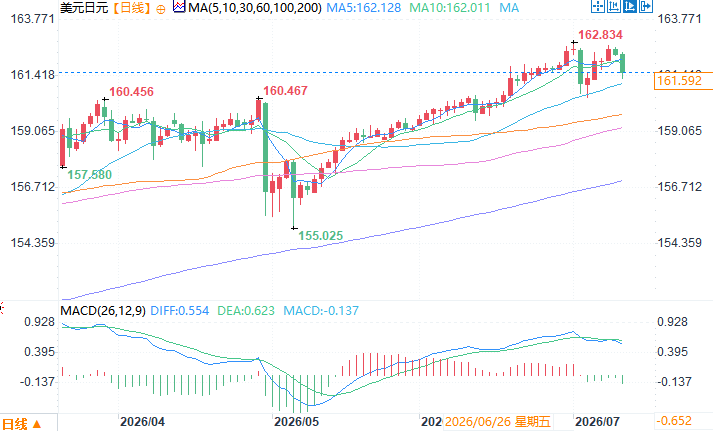
USD/JPY Daily Chart Source: EasyForex
At 14:01 Beijing time on July 10, the USD/JPY exchange rate was 161.50/51.
Boosted by this news, the market anticipates that hundreds of billions of dollars will flow back to the Japanese market, causing the yen, which had been under pressure, to rebound rapidly, and Japanese government bond yields to fall sharply, bringing a temporary boost to the Japanese financial market.
The policy statement sent a clear signal, and market funds responded quickly.
At the press conference, Katayama Satsuki clearly stated that the government will promote the implementation of relevant policies and encourage pension funds to increase their allocation to domestic financial assets.
This statement has drawn market attention to the Government Pension Investment Fund (GPIF), which managed assets of 293.6 trillion yen (equivalent to 1.8 trillion US dollars) at the end of March. The adjustment of its asset allocation strategy will have a significant ripple effect on global financial markets.
Investors reacted swiftly to policy signals, betting that massive pension funds would gradually flow back to the Japanese domestic market. This followed months of sustained selling of the yen, which hit a 40-year low last week.
Following the announcement, the yen rebounded quickly in the short term, rising by 0.6%, with the exchange rate once reaching 161.44 yen to the US dollar; the yield on the benchmark 10-year Japanese government bond saw its largest single-day drop in a month, falling 10 basis points to 2.775%, indicating a significant influx of funds into domestic assets.
The yen remains under long-term pressure, making policy adjustments imperative.
The long-term weakness of the yen has become a major challenge for Japanese policymakers. The continued depreciation has not only significantly increased the cost of Japan's imported raw materials, but also, coupled with the US-Iran conflict pushing up international energy prices, further exacerbated the operating cost pressures on Japanese households and businesses, and significantly impacted domestic livelihoods and economic development.
Currently, the Government Pension Investment Fund (GPIF) maintains a nearly equal allocation across four asset classes: domestic stocks, overseas stocks, domestic bonds, and overseas bonds. In 2020, the fund adjusted its asset allocation, increasing its overseas bond allocation from 15% to 25% while decreasing its domestic bond allocation from 35% to 25%. This policy guidance may prompt the fund to further adjust its asset structure, shifting its focus towards domestic assets. As of now, a spokesperson for the GPIF stated that they are aware of the relevant statements but have not yet provided further comment.
Against the backdrop of economic transformation, policy efforts are benefiting people's livelihoods.
Katayama Satsuki added that the Japanese economy is gradually transitioning to a growth-driven model, and the country has now officially entered a positive interest rate cycle, with the stock market also experiencing a recovery. She emphasized that the core purpose of the government's relevant guiding policies is to enable ordinary Japanese residents to directly share in the asset appreciation benefits brought about by economic growth, thereby genuinely enhancing their sense of well-being.
It is worth noting that just before this statement, market concerns about the Japanese cabinet's expansionary fiscal policy intensified, coupled with fears of government intervention in monetary policy. This led to a concentrated sell-off of Japanese government bonds, pushing yields to multi-decade highs. This policy signal guiding pension funds to increase their holdings of domestic assets is also intended to stabilize confidence in the domestic financial market and alleviate market volatility pressures.
Summarize
Overall, the Japanese government's guidance for pension funds to increase their holdings of domestic assets is both an emergency measure to address the yen's depreciation and stabilize the financial market, and a long-term strategy to promote economic transformation and allow residents to share in the benefits of development. The asset allocation adjustments of government pension investment funds are expected to inject hundreds of billions of yen into the Japanese domestic market, providing short-term benefits to the yen and government bonds. In the long term, whether this move can sustainably stabilize market confidence and support Japan's economic transformation remains to be seen, depending on the implementation of subsequent supporting policies and the actual pace of fund adjustments.
USD/JPY Daily Chart Source: EasyForex
At 14:01 Beijing time on July 10, the USD/JPY exchange rate was 161.50/51.
- Risk Warning and Disclaimer
- The market involves risk, and trading may not be suitable for all investors. This article is for reference only and does not constitute personal investment advice, nor does it take into account certain users’ specific investment objectives, financial situation, or other needs. Any investment decisions made based on this information are at your own risk.