The ongoing geopolitical tensions between the US and Iran continue to support oil prices in the Middle East.
2026-07-10 16:26:08
On Friday (July 10), during the Asian and European trading sessions, international oil prices continued to decline. WTI crude oil is currently down 0.86%, trading at $71.50.
Recently, the shipping conflict in the Strait of Hormuz has continued to escalate, and the geopolitical standoff between the US and Iran has completely broken the previous brief ceasefire balance, presenting a complex two-pronged pattern of high-intensity military confrontation, diplomatic leeway, and mediation by multiple countries.
On one hand, the continuous military strikes and countermeasures by both sides are constantly pushing up the geopolitical risk premium in the Middle East; on the other hand, many countries in the region are taking the initiative to intervene in mediation, reserving a diplomatic window for restarting US-Iran nuclear negotiations. The overall situation presents typical game characteristics of "fighting while talking, and promoting talks through fighting," and the direction of the situation is highly uncertain.
The core trigger for this round of escalation in US-Iran tensions was Iran's attack on merchant ships targeting shipping lanes in the Strait of Hormuz, which was led by the US.
Following the incident, US President Trump adopted an increasingly aggressive and hardline stance, showing extremely low tolerance for Iran's various provocations and completely abandoning the moderate diplomatic approach of the previous months. His strategy toward Iran began to shift.
Trump publicly announced this week that he believes the three-month ceasefire agreement reached between the US and Iran, as well as the recently signed bilateral memorandum of understanding, are now defunct, and the brief period of détente between the two sides has changed.
In his public statements, Trump displayed an extremely tough unilateral stance, not only using extremely negative language to criticize the Iranian leadership, but also declaring that the US would retaliate with twenty times the force for every provocation Iran makes against the US and international shipping.
He publicly declared that the US had achieved a phased military victory, that Iran's military strength had declined significantly and its battlefield situation had continued to deteriorate, and that Iran had a strong desire for peace . However, the US was highly skeptical of Iran's commitment to fulfilling its obligations and maintained a cautious and condescending attitude toward restarting negotiations.
Overall, the US decision to escalate military action against Iran in this round is marked by emotional and radical elements, and is a direct result of Trump's inability to tolerate Iran's continued provocations and his change of heart.
Following Trump's radical statements, the US quickly launched multiple rounds of military strikes.
The U.S. military has launched precision airstrikes against targets in Iran for several consecutive nights, with a focus on destroying a railway bridge near the Turkmen border, directly cutting off Iran's core land transport route connecting it to China and Russia, and putting pressure on Iran from all aspects of logistics and trade.
During the military pressure campaign, the US maintained a strategic pace that "left room for maneuver." After completing its phased strikes, the US military took the initiative to briefly suspend operations, deliberately avoiding a complete loss of control of the situation and preserving ample space for diplomatic mediation.
At the same time, the US military has never relaxed its preparations for war. The USS Abraham Lincoln aircraft carrier deployed in the Arabian Sea has entered a state of high combat readiness. Its carrier-based aircraft have completed weapons loading and live-fire exercises and can restart a new round of military strikes at any time. The US has always reserved the military option of escalating the conflict at any time.
In addition, U.S. officials denied rumors of additional strikes that evening, but made it clear that the situation was constantly changing and both sides had the option to open fire.
Faced with military and media pressure from the United States, Iran has launched a strong and reciprocal countermeasure.
On July 9, Iran's Islamic Revolutionary Guard Corps launched the second phase of its counterattack, using 10 ballistic missiles to precisely strike key military targets, including the U.S. command and control center in West Asia and the Azraq Air Base in Jordan.
Iran simultaneously issued a stern warning, stating that if the US military continues its military aggression, Iran will launch a fierce attack on all US military bases in the Middle East. Previously, Iran had already launched missiles and drones at US military facilities in Kuwait, Qatar, Bahrain, Jordan, and other countries, retaliating against US military actions in a comprehensive manner, adhering to the bottom line of "responding to every attack" and refusing to compromise with US military threats.
Amid the escalating military conflict between the US and Iran, many countries in the Middle East and surrounding regions have proactively stepped in to mediate, becoming a key force in stabilizing the regional situation.
Qatar, Pakistan, Turkey, Egypt, Saudi Arabia, and other regional countries held intensive talks with the US and Iran this Wednesday. Their primary focus was on pushing for a ceasefire and de-escalation to ease the current tense standoff. Further efforts will be made to gradually advance the involvement of technical teams from both sides.
They coordinated to finalize the specific timing for a new round of nuclear negotiations, aiming to bring the US-Iran situation back from military confrontation to the track of diplomatic negotiations.
While exerting strong military pressure, the US has not completely closed its diplomatic doors, forming a dual strategy of "military pressure + diplomatic probing".
U.S. officials have made it clear that the Trump administration remains committed to finding a solution to the situation, and technical-level consultations between the two sides continue.
However, it cannot be ignored that the differences between the US and Iran on core issues such as the Iranian nuclear issue, the lifting of US sanctions, and control of the Strait of Hormuz are deeply rooted. Coupled with Trump's formal denial of the ceasefire agreement's validity, the final prospects of this round of multinational mediation remain uncertain.
Multiple analyses indicate that the success of this mediation hinges on two key variables: first, whether Iran can exercise restraint and send conciliatory signals under US military pressure; and second, whether the US is willing to make appropriate concessions and adjust its hardline stance on its core demands.
Based on the current actions of both sides, the statements of their leaders, and the external mediating forces, the future situation between the US and Iran is likely to remain in a medium- to long-term pattern of high volatility, low intensity, and ongoing negotiations.
In the short term, sporadic military frictions, targeted strikes, and countermeasures between the two sides will continue. Trump's aggressive governing style and low tolerance mean that the US will not tolerate any provocative actions by Iran, military deterrence will remain in place, and the geopolitical risk premium in the Middle East will remain high.
However, from the perspective of long-term strategic competition, neither the US nor Iran has the intention of a full-scale war: the US aims to exert maximum pressure and promote dialogue through conflict, while maintaining diplomatic channels and restraining itself from escalating the conflict.
Iran's strong counterattack is aimed at holding its ground and gaining leverage in negotiations, with no intention of escalating the conflict completely.
Coupled with external constraints from the continued mediation of multiple countries, the subsequent situation will revolve around "military friction and escalating diplomatic competition." It is highly likely that a ceasefire and stabilization will be gradually achieved, and multiple rounds of technical negotiations will be restarted. However, due to differences in core interests, it will be difficult to reach a substantial reconciliation in the short term, and the underlying pattern of the US-Iran confrontation will continue.
Technically, WTI oil prices have pulled back after encountering the X-line and are currently approaching support around 70. Given the possibility of further escalation of tensions between the US and Iran over the weekend, the downside potential for oil prices is limited.
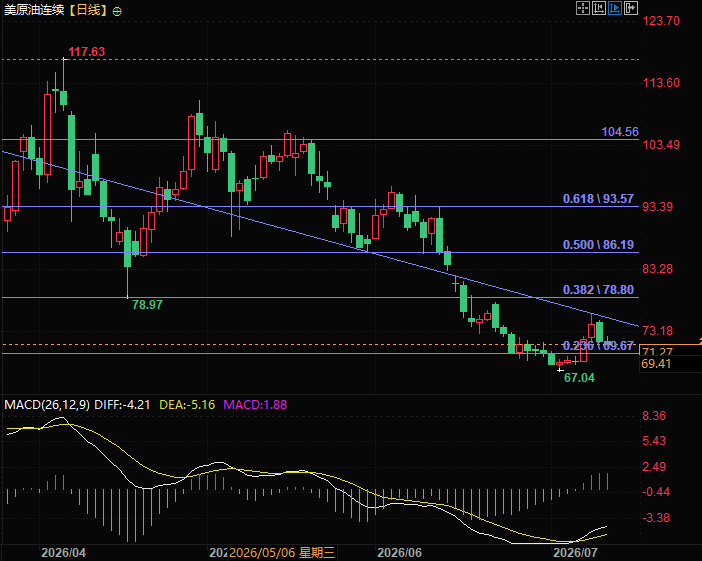
(WTI crude oil futures daily chart, source: EasyForex)
At 16:02 Beijing time, WTI crude oil futures were trading at $71.55 per ounce.
Recently, the shipping conflict in the Strait of Hormuz has continued to escalate, and the geopolitical standoff between the US and Iran has completely broken the previous brief ceasefire balance, presenting a complex two-pronged pattern of high-intensity military confrontation, diplomatic leeway, and mediation by multiple countries.
On one hand, the continuous military strikes and countermeasures by both sides are constantly pushing up the geopolitical risk premium in the Middle East; on the other hand, many countries in the region are taking the initiative to intervene in mediation, reserving a diplomatic window for restarting US-Iran nuclear negotiations. The overall situation presents typical game characteristics of "fighting while talking, and promoting talks through fighting," and the direction of the situation is highly uncertain.
Conflict Escalates: Trump's Stance Becomes More Radical, Reversal of De-escalation
The core trigger for this round of escalation in US-Iran tensions was Iran's attack on merchant ships targeting shipping lanes in the Strait of Hormuz, which was led by the US.
Following the incident, US President Trump adopted an increasingly aggressive and hardline stance, showing extremely low tolerance for Iran's various provocations and completely abandoning the moderate diplomatic approach of the previous months. His strategy toward Iran began to shift.
Trump publicly announced this week that he believes the three-month ceasefire agreement reached between the US and Iran, as well as the recently signed bilateral memorandum of understanding, are now defunct, and the brief period of détente between the two sides has changed.
Trump's core statement: tough unilateral pressure, dominating the game with a high-pressure approach.
In his public statements, Trump displayed an extremely tough unilateral stance, not only using extremely negative language to criticize the Iranian leadership, but also declaring that the US would retaliate with twenty times the force for every provocation Iran makes against the US and international shipping.
He publicly declared that the US had achieved a phased military victory, that Iran's military strength had declined significantly and its battlefield situation had continued to deteriorate, and that Iran had a strong desire for peace . However, the US was highly skeptical of Iran's commitment to fulfilling its obligations and maintained a cautious and condescending attitude toward restarting negotiations.
Overall, the US decision to escalate military action against Iran in this round is marked by emotional and radical elements, and is a direct result of Trump's inability to tolerate Iran's continued provocations and his change of heart.
The US is employing precision strikes and is prepared for war across the entire spectrum, but is deliberately preserving diplomatic space.
Following Trump's radical statements, the US quickly launched multiple rounds of military strikes.
The U.S. military has launched precision airstrikes against targets in Iran for several consecutive nights, with a focus on destroying a railway bridge near the Turkmen border, directly cutting off Iran's core land transport route connecting it to China and Russia, and putting pressure on Iran from all aspects of logistics and trade.
During the military pressure campaign, the US maintained a strategic pace that "left room for maneuver." After completing its phased strikes, the US military took the initiative to briefly suspend operations, deliberately avoiding a complete loss of control of the situation and preserving ample space for diplomatic mediation.
At the same time, the US military has never relaxed its preparations for war. The USS Abraham Lincoln aircraft carrier deployed in the Arabian Sea has entered a state of high combat readiness. Its carrier-based aircraft have completed weapons loading and live-fire exercises and can restart a new round of military strikes at any time. The US has always reserved the military option of escalating the conflict at any time.
In addition, U.S. officials denied rumors of additional strikes that evening, but made it clear that the situation was constantly changing and both sides had the option to open fire.
Iran retaliates in kind: precise ballistic missile strikes, upholding the bottom line of confrontation.
Faced with military and media pressure from the United States, Iran has launched a strong and reciprocal countermeasure.
On July 9, Iran's Islamic Revolutionary Guard Corps launched the second phase of its counterattack, using 10 ballistic missiles to precisely strike key military targets, including the U.S. command and control center in West Asia and the Azraq Air Base in Jordan.
Iran simultaneously issued a stern warning, stating that if the US military continues its military aggression, Iran will launch a fierce attack on all US military bases in the Middle East. Previously, Iran had already launched missiles and drones at US military facilities in Kuwait, Qatar, Bahrain, Jordan, and other countries, retaliating against US military actions in a comprehensive manner, adhering to the bottom line of "responding to every attack" and refusing to compromise with US military threats.
Multiple countries intervened to mediate: pushing for de-escalation and restarting nuclear negotiations.
Amid the escalating military conflict between the US and Iran, many countries in the Middle East and surrounding regions have proactively stepped in to mediate, becoming a key force in stabilizing the regional situation.
Qatar, Pakistan, Turkey, Egypt, Saudi Arabia, and other regional countries held intensive talks with the US and Iran this Wednesday. Their primary focus was on pushing for a ceasefire and de-escalation to ease the current tense standoff. Further efforts will be made to gradually advance the involvement of technical teams from both sides.
They coordinated to finalize the specific timing for a new round of nuclear negotiations, aiming to bring the US-Iran situation back from military confrontation to the track of diplomatic negotiations.
Current state of diplomatic maneuvering: The window for negotiation remains, but core differences are difficult to bridge.
While exerting strong military pressure, the US has not completely closed its diplomatic doors, forming a dual strategy of "military pressure + diplomatic probing".
U.S. officials have made it clear that the Trump administration remains committed to finding a solution to the situation, and technical-level consultations between the two sides continue.
However, it cannot be ignored that the differences between the US and Iran on core issues such as the Iranian nuclear issue, the lifting of US sanctions, and control of the Strait of Hormuz are deeply rooted. Coupled with Trump's formal denial of the ceasefire agreement's validity, the final prospects of this round of multinational mediation remain uncertain.
Multiple analyses indicate that the success of this mediation hinges on two key variables: first, whether Iran can exercise restraint and send conciliatory signals under US military pressure; and second, whether the US is willing to make appropriate concessions and adjust its hardline stance on its core demands.
Summary and Technical Analysis:
Based on the current actions of both sides, the statements of their leaders, and the external mediating forces, the future situation between the US and Iran is likely to remain in a medium- to long-term pattern of high volatility, low intensity, and ongoing negotiations.
In the short term, sporadic military frictions, targeted strikes, and countermeasures between the two sides will continue. Trump's aggressive governing style and low tolerance mean that the US will not tolerate any provocative actions by Iran, military deterrence will remain in place, and the geopolitical risk premium in the Middle East will remain high.
However, from the perspective of long-term strategic competition, neither the US nor Iran has the intention of a full-scale war: the US aims to exert maximum pressure and promote dialogue through conflict, while maintaining diplomatic channels and restraining itself from escalating the conflict.
Iran's strong counterattack is aimed at holding its ground and gaining leverage in negotiations, with no intention of escalating the conflict completely.
Coupled with external constraints from the continued mediation of multiple countries, the subsequent situation will revolve around "military friction and escalating diplomatic competition." It is highly likely that a ceasefire and stabilization will be gradually achieved, and multiple rounds of technical negotiations will be restarted. However, due to differences in core interests, it will be difficult to reach a substantial reconciliation in the short term, and the underlying pattern of the US-Iran confrontation will continue.
Technically, WTI oil prices have pulled back after encountering the X-line and are currently approaching support around 70. Given the possibility of further escalation of tensions between the US and Iran over the weekend, the downside potential for oil prices is limited.
(WTI crude oil futures daily chart, source: EasyForex)
At 16:02 Beijing time, WTI crude oil futures were trading at $71.55 per ounce.
- Risk Warning and Disclaimer
- The market involves risk, and trading may not be suitable for all investors. This article is for reference only and does not constitute personal investment advice, nor does it take into account certain users’ specific investment objectives, financial situation, or other needs. Any investment decisions made based on this information are at your own risk.