Easing tensions between the US and Iran dampened safe-haven buying, causing the dollar to fall to a three-week low – will next week's CPI become a "lifeline" for bulls?
2026-07-10 16:38:28
On Friday (July 10) during the Asian session, the US dollar index continued its previous decline, once touching a three-week low of around 100.60, and is currently trading around 100.80.
The continued weakening of the dollar was mainly driven by signs of easing tensions between the US and Iran – US officials said Washington remains committed to the memorandum of understanding with Iran and technical negotiations are still underway, even though Trump had previously declared the agreement “over.”
This signal weakened safe-haven buying of the dollar. Previously, the escalation of the US-Iran military conflict had fueled market concerns about geopolitical risks, thus supporting the dollar. However, with signals that diplomatic channels were not completely closed, market sentiment improved, and the safe-haven demand for the dollar correspondingly subsided.
The US dollar index's movement this week was highly synchronized with the evolution of the US-Iran situation. At the beginning of the week, the US launched a new round of strikes against Iran in retaliation for Iran's attack on merchant ships in the Strait of Hormuz, escalating geopolitical risks and initially providing support for the dollar through safe-haven buying. However, as the situation evolved, market sentiment shifted significantly.
The Times of Israel reported that a U.S. official stated Washington remains committed to the memorandum of understanding with Iran, and technical negotiations are still underway. This signal contrasts subtly with Trump's earlier statement that "the agreement is over," indicating that diplomatic channels between the U.S. and Iran have not been completely closed.
In addition, Trump said on Wednesday that Iran had called to seek a deal, but added, "I just don't know if they're worth a deal"—a statement that, while not completely ruling out the possibility of diplomacy, also suggests that the road to negotiations will not be smooth.
For the US dollar, signs of easing tensions between the US and Iran have diminished its safe-haven appeal. The dollar index fell for the third consecutive trading day, dropping to a three-week low of 100.60, which directly reflects this logic.
While signs of easing tensions between the US and Iran have dampened safe-haven buying of the dollar, its downside potential may be limited by inflation expectations. Although tensions in the Strait of Hormuz have eased somewhat, concerns about energy supply disruptions have not completely dissipated, and oil prices remain relatively high.
High oil prices support the dollar through two pathways: first, rising energy prices boost overall inflation expectations, reducing the likelihood of the Federal Reserve cutting interest rates; second, rising inflation expectations make Fed officials more cautious when considering rate cuts. As the material points out, "higher inflation expectations make it less likely that Fed officials will lower interest rates"—meaning that while the dollar's interest rate advantage has weakened marginally, it has not disappeared.
Furthermore, the market's repricing of the Federal Reserve's policy path is also a key factor. Although the minutes of the June FOMC meeting revealed internal divisions within the decision-making body, the statements that "a considerable number of FOMC members are inclined to raise interest rates" and that "upside risks to inflation remain high" indicate that the structural support for the US dollar has not completely collapsed. The 100.50-100.60 area may become a significant short-term support zone for the US dollar index.
Phil Orlando, chief market strategist at Federated Hermes, said the market's concerns about a Fed rate hike in July are excessive, and he believes it is unlikely to happen.
Orlando expects the Federal Reserve to ignore the energy price shock caused by the current Middle East conflict—he tends to characterize it as a temporary disturbance and keep interest rates unchanged.
SEB Chief Strategist Jussi Hiljanen pointed out that the Fed's June meeting minutes highlighted the central bank's unease about inflation, but also indicated that immediate tightening would only provide limited support, thus the Fed was reluctant to raise interest rates amid increasing growth uncertainty. The core message of the minutes was that the threshold for raising interest rates remains relatively high, and policymakers need more evidence before taking further action.
Hiljanen further stated that this policy stance implies that the door to interest rate cuts will be opened once inflation improves and labor market weakness becomes more apparent. Given the current balance of risks, the SEB believes that the market's current pricing in approximately 1.5 rate hikes is reasonable, reflecting both inflationary anxieties and concerns about downside risks to growth.
At the monetary policy framework level, Federal Reserve Chairman Warsh, as promised in the June policy statement, announced the members of five working groups. These working groups will focus on the following areas: communication strategy, balance sheet policy, quality and timeliness of economic data, productivity and employment, and the development of an inflation framework.
This move signifies that the Federal Reserve, under Warsh's leadership, is systematically advancing reforms to its policy framework. The establishment of five working groups covers multiple key areas, from policy communication to economic data monitoring, indicating that the Fed is attempting to establish a more systematic and transparent policy decision-making mechanism.
While the specific recommendations of these working groups will take some time to be released, their very establishment sends a signal to the market that the Federal Reserve is committed to improving its policy framework—which could influence market expectations of the Fed's policy path in the medium term.
In summary, the US dollar index is currently influenced by multiple factors. Easing tensions between the US and Iran have weakened safe-haven buying of the dollar, pushing it down for the third consecutive trading day to a three-week low. However, inflation expectations supported by high energy prices have limited the dollar's downside – high oil prices mean the Federal Reserve is unlikely to signal a clear interest rate cut in the short term, thus providing a floor for the dollar.
From a technical perspective, the 100.50-100.60 area is a key short-term support zone for the US dollar index. If there are clear signs of further easing tensions between the US and Iran (such as substantial progress in technical negotiations), the dollar may test the psychological level of 100.00. Conversely, if the situation deteriorates again, a return of safe-haven demand could push the dollar back above 101.00.
Looking ahead, the dollar's trajectory will continue to be driven by three major variables: the evolution of the US-Iran situation (diplomatic breakthrough or escalation of conflict), the revision of inflation expectations based on next week's US CPI data, and the potential impact of the Federal Reserve's policy framework reforms on market expectations. In an environment where uncertainty remains high, the dollar index is likely to fluctuate within the 100.50-101.50 range in the short term, with the direction of any breakout depending on the development of the aforementioned variables.
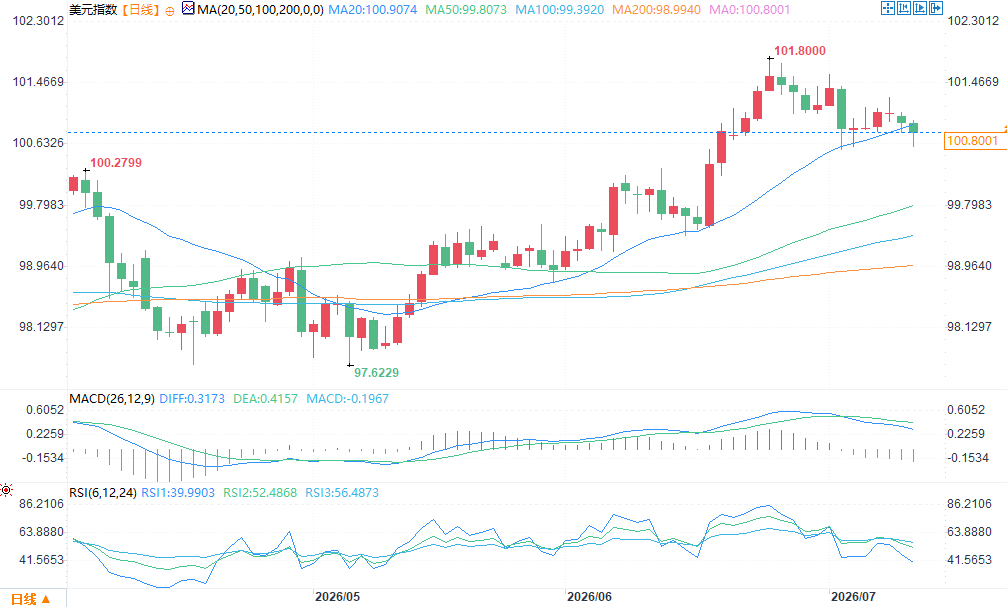
(US Dollar Index Daily Chart, Source: FX678)
At 15:55 Beijing time on July 10, the US dollar index was 100.81.
The continued weakening of the dollar was mainly driven by signs of easing tensions between the US and Iran – US officials said Washington remains committed to the memorandum of understanding with Iran and technical negotiations are still underway, even though Trump had previously declared the agreement “over.”
This signal weakened safe-haven buying of the dollar. Previously, the escalation of the US-Iran military conflict had fueled market concerns about geopolitical risks, thus supporting the dollar. However, with signals that diplomatic channels were not completely closed, market sentiment improved, and the safe-haven demand for the dollar correspondingly subsided.
US-Iran tensions: Signals of easing tensions suppress demand for the US dollar as a safe haven
The US dollar index's movement this week was highly synchronized with the evolution of the US-Iran situation. At the beginning of the week, the US launched a new round of strikes against Iran in retaliation for Iran's attack on merchant ships in the Strait of Hormuz, escalating geopolitical risks and initially providing support for the dollar through safe-haven buying. However, as the situation evolved, market sentiment shifted significantly.
The Times of Israel reported that a U.S. official stated Washington remains committed to the memorandum of understanding with Iran, and technical negotiations are still underway. This signal contrasts subtly with Trump's earlier statement that "the agreement is over," indicating that diplomatic channels between the U.S. and Iran have not been completely closed.
In addition, Trump said on Wednesday that Iran had called to seek a deal, but added, "I just don't know if they're worth a deal"—a statement that, while not completely ruling out the possibility of diplomacy, also suggests that the road to negotiations will not be smooth.
For the US dollar, signs of easing tensions between the US and Iran have diminished its safe-haven appeal. The dollar index fell for the third consecutive trading day, dropping to a three-week low of 100.60, which directly reflects this logic.
Inflation expectations: High energy prices limit the downside potential of the US dollar.
While signs of easing tensions between the US and Iran have dampened safe-haven buying of the dollar, its downside potential may be limited by inflation expectations. Although tensions in the Strait of Hormuz have eased somewhat, concerns about energy supply disruptions have not completely dissipated, and oil prices remain relatively high.
High oil prices support the dollar through two pathways: first, rising energy prices boost overall inflation expectations, reducing the likelihood of the Federal Reserve cutting interest rates; second, rising inflation expectations make Fed officials more cautious when considering rate cuts. As the material points out, "higher inflation expectations make it less likely that Fed officials will lower interest rates"—meaning that while the dollar's interest rate advantage has weakened marginally, it has not disappeared.
Furthermore, the market's repricing of the Federal Reserve's policy path is also a key factor. Although the minutes of the June FOMC meeting revealed internal divisions within the decision-making body, the statements that "a considerable number of FOMC members are inclined to raise interest rates" and that "upside risks to inflation remain high" indicate that the structural support for the US dollar has not completely collapsed. The 100.50-100.60 area may become a significant short-term support zone for the US dollar index.
Strategist's View
Phil Orlando, chief market strategist at Federated Hermes, said the market's concerns about a Fed rate hike in July are excessive, and he believes it is unlikely to happen.
Orlando expects the Federal Reserve to ignore the energy price shock caused by the current Middle East conflict—he tends to characterize it as a temporary disturbance and keep interest rates unchanged.
SEB Chief Strategist Jussi Hiljanen pointed out that the Fed's June meeting minutes highlighted the central bank's unease about inflation, but also indicated that immediate tightening would only provide limited support, thus the Fed was reluctant to raise interest rates amid increasing growth uncertainty. The core message of the minutes was that the threshold for raising interest rates remains relatively high, and policymakers need more evidence before taking further action.
Hiljanen further stated that this policy stance implies that the door to interest rate cuts will be opened once inflation improves and labor market weakness becomes more apparent. Given the current balance of risks, the SEB believes that the market's current pricing in approximately 1.5 rate hikes is reasonable, reflecting both inflationary anxieties and concerns about downside risks to growth.
Federal Reserve Reform: Warsh Announces List of Members of Five Working Groups
At the monetary policy framework level, Federal Reserve Chairman Warsh, as promised in the June policy statement, announced the members of five working groups. These working groups will focus on the following areas: communication strategy, balance sheet policy, quality and timeliness of economic data, productivity and employment, and the development of an inflation framework.
This move signifies that the Federal Reserve, under Warsh's leadership, is systematically advancing reforms to its policy framework. The establishment of five working groups covers multiple key areas, from policy communication to economic data monitoring, indicating that the Fed is attempting to establish a more systematic and transparent policy decision-making mechanism.
While the specific recommendations of these working groups will take some time to be released, their very establishment sends a signal to the market that the Federal Reserve is committed to improving its policy framework—which could influence market expectations of the Fed's policy path in the medium term.
Outlook: The US dollar is under short-term pressure but has limited downside potential.
In summary, the US dollar index is currently influenced by multiple factors. Easing tensions between the US and Iran have weakened safe-haven buying of the dollar, pushing it down for the third consecutive trading day to a three-week low. However, inflation expectations supported by high energy prices have limited the dollar's downside – high oil prices mean the Federal Reserve is unlikely to signal a clear interest rate cut in the short term, thus providing a floor for the dollar.
From a technical perspective, the 100.50-100.60 area is a key short-term support zone for the US dollar index. If there are clear signs of further easing tensions between the US and Iran (such as substantial progress in technical negotiations), the dollar may test the psychological level of 100.00. Conversely, if the situation deteriorates again, a return of safe-haven demand could push the dollar back above 101.00.
Looking ahead, the dollar's trajectory will continue to be driven by three major variables: the evolution of the US-Iran situation (diplomatic breakthrough or escalation of conflict), the revision of inflation expectations based on next week's US CPI data, and the potential impact of the Federal Reserve's policy framework reforms on market expectations. In an environment where uncertainty remains high, the dollar index is likely to fluctuate within the 100.50-101.50 range in the short term, with the direction of any breakout depending on the development of the aforementioned variables.
(US Dollar Index Daily Chart, Source: FX678)
At 15:55 Beijing time on July 10, the US dollar index was 100.81.
- Risk Warning and Disclaimer
- The market involves risk, and trading may not be suitable for all investors. This article is for reference only and does not constitute personal investment advice, nor does it take into account certain users’ specific investment objectives, financial situation, or other needs. Any investment decisions made based on this information are at your own risk.