US-Iran technical negotiations "stay afloat," rupee rebounds – high oil prices remain the biggest obstacle.
2026-07-10 16:39:08
On Friday (July 10) during the European session, the US dollar fell further against the Indian rupee to around 95.30, continuing the downward trend from Thursday.
The US dollar index (DXY) fell about 0.1% on the day, trading around 100.80, and is on track for its third consecutive day of decline. The broad weakening of the dollar provided general support for non-US currencies, including the rupee.
The core catalyst for the rupee's strength stems from subtle shifts in the US-Iran situation. According to the Times of Israel, a US official confirmed that although Trump has announced the memorandum of understanding with Iran "has ended," technical negotiations between the US and Iran are still ongoing. Trump also stated Wednesday evening that Iran remains very keen to reach an agreement, but he is unsure whether Iran will "abide by the agreement."
This signal indicates that diplomatic channels between the US and Iran have not been completely closed, and there are signs of marginal easing of geopolitical risks, thereby weakening safe-haven buying of the US dollar.
However, investors still need to remain vigilant. On Thursday evening, Iranian state media confirmed that the US military had launched a new round of strikes against multiple locations along the Iranian coast. Amid the ongoing military conflict, market concerns about energy supply disruptions remain high.
For the Indian rupee, oil prices are one of the most critical external variables. As the world's third-largest oil importer, India relies heavily on imports for the vast majority of its energy needs, therefore oil price trends have a direct and significant impact on the rupee.
Oil prices experienced a sharp correction on Thursday, but WTI crude futures (expiring July 20) rebounded strongly on Friday, rising more than 1.1% and approaching 6,930 rupees per barrel. The rebound reflects continued market concerns about the potential disruption to global energy supplies caused by the Middle East conflict.
With oil prices remaining high, currencies of major oil-importing countries like India tend to weaken. This means that while signs of easing tensions between the US and Iran have provided short-term support for the rupee, the high oil price environment is creating a persistent structural headwind for the rupee – one of the fundamental reasons why the rupee's gains may be limited.
Another factor worth noting is the change in fund flows of foreign institutional investors (FIIs). Throughout the trading days from July 3rd to 8th, FIIs were net buyers of Indian stocks, but this trend reversed on Thursday – FIIs became net sellers, dumping approximately 5.3286 billion rupees worth of Indian shares.
This shift may be related to the start of India's earnings season for the first quarter of fiscal year 2026-27. Indian tech giant Tata Consultancy Services (TCS) released its quarterly results on Thursday. The earnings season typically involves investors reassessing their holdings, and foreign capital flows may experience periodic fluctuations.
Looking ahead, investors need to be prepared for a divergence in overseas sentiment toward the Indian stock market – earnings season may bring opportunities at the individual stock level, but it may also trigger overall portfolio adjustments by foreign investors, thus indirectly affecting the rupee exchange rate.
From a technical perspective, the USD/INR pair is currently trading around 95.30, but remains above the 20-day exponential moving average (95.11), maintaining a mildly bullish bias overall.
The Relative Strength Index (RSI) has been hovering in the 40.00-60.00 range for an extended period and has shown signs of weakness after breaking out of the descending triangle, suggesting a possible corrective move in the near term.
Support levels: First support is located near the 20-day moving average at 94.84; if this level is broken, the next support is near the previous downtrend line breakout point at 94.69; further support is at the low of 94.03 on May 7.
Resistance above: A more meaningful resistance level remains near the original downtrend line anchor point of 97.02 – only a sustained break above this area can open up stronger bullish extension potential.
The Indian rupee is currently caught in a confluence of multiple forces. The overall weakening of the US dollar and signals of easing tensions between the US and Iran have provided short-term support for the rupee, pushing the USD/RUB exchange rate down to around 95.30. However, the high oil price environment poses a persistent structural headwind for India's currency, a major oil importer, while the shift from net buying to net selling by foreign investment indices (FIIs) suggests a potential period of divergence in foreign investor sentiment.
Overall, the USD/RUB pair may face further downward pressure in the short term, but given high oil prices and unresolved geopolitical uncertainties, the rupee's upside potential may be limited. The 95.00 level is a key support level in the near term; a decisive break below this level could open up downside potential towards 94.70. Conversely, if oil prices continue to rise or geopolitical tensions worsen again, the exchange rate may rebound to test the 95.50-95.80 area.
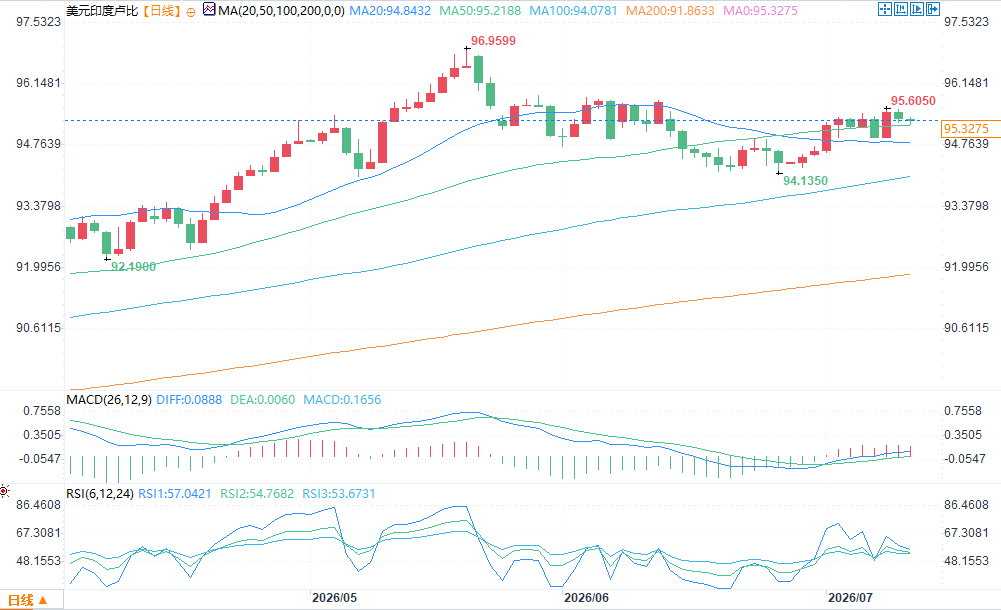
(USD/INR daily chart, source: FX678)
At 16:17 Beijing time on July 10, the US dollar was trading at 95.33/34 against the Indian rupee.
The US dollar index (DXY) fell about 0.1% on the day, trading around 100.80, and is on track for its third consecutive day of decline. The broad weakening of the dollar provided general support for non-US currencies, including the rupee.
Geopolitics: Technical negotiations between the US and Iran are still progressing, but the risk of conflict remains.
The core catalyst for the rupee's strength stems from subtle shifts in the US-Iran situation. According to the Times of Israel, a US official confirmed that although Trump has announced the memorandum of understanding with Iran "has ended," technical negotiations between the US and Iran are still ongoing. Trump also stated Wednesday evening that Iran remains very keen to reach an agreement, but he is unsure whether Iran will "abide by the agreement."
This signal indicates that diplomatic channels between the US and Iran have not been completely closed, and there are signs of marginal easing of geopolitical risks, thereby weakening safe-haven buying of the US dollar.
However, investors still need to remain vigilant. On Thursday evening, Iranian state media confirmed that the US military had launched a new round of strikes against multiple locations along the Iranian coast. Amid the ongoing military conflict, market concerns about energy supply disruptions remain high.
High oil prices: Structural headwinds for the rupee
For the Indian rupee, oil prices are one of the most critical external variables. As the world's third-largest oil importer, India relies heavily on imports for the vast majority of its energy needs, therefore oil price trends have a direct and significant impact on the rupee.
Oil prices experienced a sharp correction on Thursday, but WTI crude futures (expiring July 20) rebounded strongly on Friday, rising more than 1.1% and approaching 6,930 rupees per barrel. The rebound reflects continued market concerns about the potential disruption to global energy supplies caused by the Middle East conflict.
With oil prices remaining high, currencies of major oil-importing countries like India tend to weaken. This means that while signs of easing tensions between the US and Iran have provided short-term support for the rupee, the high oil price environment is creating a persistent structural headwind for the rupee – one of the fundamental reasons why the rupee's gains may be limited.
Foreign capital flows: FIIs turned from continuous buying to net selling
Another factor worth noting is the change in fund flows of foreign institutional investors (FIIs). Throughout the trading days from July 3rd to 8th, FIIs were net buyers of Indian stocks, but this trend reversed on Thursday – FIIs became net sellers, dumping approximately 5.3286 billion rupees worth of Indian shares.
This shift may be related to the start of India's earnings season for the first quarter of fiscal year 2026-27. Indian tech giant Tata Consultancy Services (TCS) released its quarterly results on Thursday. The earnings season typically involves investors reassessing their holdings, and foreign capital flows may experience periodic fluctuations.
Looking ahead, investors need to be prepared for a divergence in overseas sentiment toward the Indian stock market – earnings season may bring opportunities at the individual stock level, but it may also trigger overall portfolio adjustments by foreign investors, thus indirectly affecting the rupee exchange rate.
Technical Analysis: USD/RUB is sliding towards the 20-day moving average, increasing the risk of a short-term correction.
From a technical perspective, the USD/INR pair is currently trading around 95.30, but remains above the 20-day exponential moving average (95.11), maintaining a mildly bullish bias overall.
The Relative Strength Index (RSI) has been hovering in the 40.00-60.00 range for an extended period and has shown signs of weakness after breaking out of the descending triangle, suggesting a possible corrective move in the near term.
Support levels: First support is located near the 20-day moving average at 94.84; if this level is broken, the next support is near the previous downtrend line breakout point at 94.69; further support is at the low of 94.03 on May 7.
Resistance above: A more meaningful resistance level remains near the original downtrend line anchor point of 97.02 – only a sustained break above this area can open up stronger bullish extension potential.
Summarize
The Indian rupee is currently caught in a confluence of multiple forces. The overall weakening of the US dollar and signals of easing tensions between the US and Iran have provided short-term support for the rupee, pushing the USD/RUB exchange rate down to around 95.30. However, the high oil price environment poses a persistent structural headwind for India's currency, a major oil importer, while the shift from net buying to net selling by foreign investment indices (FIIs) suggests a potential period of divergence in foreign investor sentiment.
Overall, the USD/RUB pair may face further downward pressure in the short term, but given high oil prices and unresolved geopolitical uncertainties, the rupee's upside potential may be limited. The 95.00 level is a key support level in the near term; a decisive break below this level could open up downside potential towards 94.70. Conversely, if oil prices continue to rise or geopolitical tensions worsen again, the exchange rate may rebound to test the 95.50-95.80 area.
(USD/INR daily chart, source: FX678)
At 16:17 Beijing time on July 10, the US dollar was trading at 95.33/34 against the Indian rupee.
- Risk Warning and Disclaimer
- The market involves risk, and trading may not be suitable for all investors. This article is for reference only and does not constitute personal investment advice, nor does it take into account certain users’ specific investment objectives, financial situation, or other needs. Any investment decisions made based on this information are at your own risk.