Can the euro hold above 1.1440? ING offers a cautious assessment.
2026-07-10 15:51:04
On Friday (July 10) during the European session, the euro rose slightly against the US dollar and is currently trading around 1.1440, with the exchange rate poised for its third consecutive day of gains.
ING FX strategist Francisco Pesole noted that the renewed escalation of military conflict in the Middle East "has prompted a moderate tightening of short-term euro-dollar swap spreads."
Over a two-year period (which is typically the period most correlated with exchange rate movements), this change is roughly equivalent to 10 basis points.
Although the magnitude of this interest rate spread change is limited, its direction is important—it indicates that the market is repricing the policy divergence between the ECB and the Fed.
The Middle East conflict has driven up energy prices, exacerbating inflationary pressures in the Eurozone and increasing the necessity for the European Central Bank to raise interest rates. This has marginally supported previously waning expectations of a September ECB rate hike.
However, Pessolet emphasized the importance of the relatively limited interest rate spread. He pointed out that the current spread is "still 50 basis points wider than the April peak"—when the market heavily bet on ECB tightening but less on Fed tightening—and "only 15 basis points wider than pre-war levels."
This interest rate differential reveals the structural constraints facing the euro. At its peak in April, market expectations of policy divergence between the ECB and the Fed reached extreme levels, and the euro rose against the dollar accordingly.
However, while the current interest rate spread has widened compared to pre-war levels, it is still quite far from the peak in April.
This means that the market's pricing in the policy divergence between the ECB and the Fed is far from reaching previous extreme levels—for the euro to return to its April highs against the dollar, a more significant expansion of the interest rate differential is needed.
Pesole expects the euro to stabilize against the dollar on Friday – market participants may want to wait for further clarity on the situation before the weekend and are reluctant to establish large new positions in an environment of high uncertainty. This assessment is consistent with the current market's cautious attitude towards conflicting signals from the US-Iran situation.
However, he also warned that downside risks remain – “The risk still points to a possible retest of 1.1400.” If there are further signs of easing tensions in the Middle East (such as progress in diplomatic negotiations), or if next week’s US CPI data is stronger than expected and reignites expectations of a Fed rate hike, the euro may face downward pressure against the dollar.
In summary, ING's analysis suggests that the euro is currently in a "supported but lacking momentum" phase against the US dollar.
The renewed tensions in the Middle East have marginally supported expectations of an ECB rate hike and provided buying support for the euro through interest rate differentials.
However, the current interest rate differential is far below the peak in April—meaning that for the euro to return to its previous high levels, a greater expansion of expectations regarding policy divergence is needed.
In the short term, 1.1400 is a key support level; if it is breached, the price may fall further.
On the upside, 1.1450-1.1470 remains a resistance zone in the near term, and a successful breakout would require stronger policy signals or data catalysts—possibly lower-than-expected US CPI data next week, or a further deterioration in the Middle East situation pushing up energy prices.
In the current environment, the euro's exchange rate against the US dollar will continue to be highly dependent on expectations of policy divergence among global central banks and the evolution of the geopolitical situation in the Middle East.
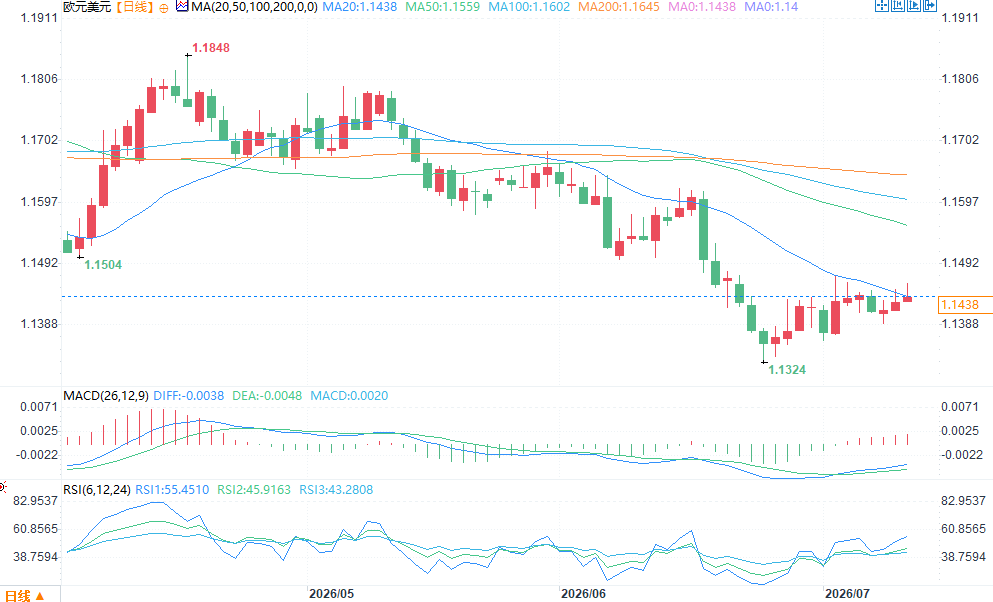
(Euro/USD daily chart, source: FX678)
At 15:37 Beijing time on July 10, the euro was trading at 1.1438/39 against the US dollar.
Interest rate spread changes: Renewed tensions in the Middle East support ECB rate hike expectations
ING FX strategist Francisco Pesole noted that the renewed escalation of military conflict in the Middle East "has prompted a moderate tightening of short-term euro-dollar swap spreads."
Over a two-year period (which is typically the period most correlated with exchange rate movements), this change is roughly equivalent to 10 basis points.
Although the magnitude of this interest rate spread change is limited, its direction is important—it indicates that the market is repricing the policy divergence between the ECB and the Fed.
The Middle East conflict has driven up energy prices, exacerbating inflationary pressures in the Eurozone and increasing the necessity for the European Central Bank to raise interest rates. This has marginally supported previously waning expectations of a September ECB rate hike.
Upside potential limited: Interest rate spreads remain far below wartime peaks
However, Pessolet emphasized the importance of the relatively limited interest rate spread. He pointed out that the current spread is "still 50 basis points wider than the April peak"—when the market heavily bet on ECB tightening but less on Fed tightening—and "only 15 basis points wider than pre-war levels."
This interest rate differential reveals the structural constraints facing the euro. At its peak in April, market expectations of policy divergence between the ECB and the Fed reached extreme levels, and the euro rose against the dollar accordingly.
However, while the current interest rate spread has widened compared to pre-war levels, it is still quite far from the peak in April.
This means that the market's pricing in the policy divergence between the ECB and the Fed is far from reaching previous extreme levels—for the euro to return to its April highs against the dollar, a more significant expansion of the interest rate differential is needed.
Outlook Assessment: Stability and Downside Risks Coexist
Pesole expects the euro to stabilize against the dollar on Friday – market participants may want to wait for further clarity on the situation before the weekend and are reluctant to establish large new positions in an environment of high uncertainty. This assessment is consistent with the current market's cautious attitude towards conflicting signals from the US-Iran situation.
However, he also warned that downside risks remain – “The risk still points to a possible retest of 1.1400.” If there are further signs of easing tensions in the Middle East (such as progress in diplomatic negotiations), or if next week’s US CPI data is stronger than expected and reignites expectations of a Fed rate hike, the euro may face downward pressure against the dollar.
Conclusion: The euro's upside potential is narrow, with 1.1400 being a key support level.
In summary, ING's analysis suggests that the euro is currently in a "supported but lacking momentum" phase against the US dollar.
The renewed tensions in the Middle East have marginally supported expectations of an ECB rate hike and provided buying support for the euro through interest rate differentials.
However, the current interest rate differential is far below the peak in April—meaning that for the euro to return to its previous high levels, a greater expansion of expectations regarding policy divergence is needed.
In the short term, 1.1400 is a key support level; if it is breached, the price may fall further.
On the upside, 1.1450-1.1470 remains a resistance zone in the near term, and a successful breakout would require stronger policy signals or data catalysts—possibly lower-than-expected US CPI data next week, or a further deterioration in the Middle East situation pushing up energy prices.
In the current environment, the euro's exchange rate against the US dollar will continue to be highly dependent on expectations of policy divergence among global central banks and the evolution of the geopolitical situation in the Middle East.
(Euro/USD daily chart, source: FX678)
At 15:37 Beijing time on July 10, the euro was trading at 1.1438/39 against the US dollar.
- Risk Warning and Disclaimer
- The market involves risk, and trading may not be suitable for all investors. This article is for reference only and does not constitute personal investment advice, nor does it take into account certain users’ specific investment objectives, financial situation, or other needs. Any investment decisions made based on this information are at your own risk.