













Silver Outlook: $59.44-$58.53 becomes the focus for bulls and bears; July 14th CPI will be a turning point.
2026-07-10 19:53:56
Spot silver prices were under pressure and fluctuated throughout the week, falling slightly to around $59 on Friday (July 10th), with a cumulative weekly decline of over $2, continuing the wide-range fluctuation pattern of late June. This represents a significant drop from last week's closing price of $62.40. Current silver price movements are driven by three core variables: expectations of Federal Reserve policy, Middle East geopolitical tensions, and US inflation data. The June CPI data released on July 14th will be a key turning point signal breaking the short-term stalemate between bulls and bears.
I. Macroeconomic Core: The fluctuating expectations of a Fed rate hike are suppressing a rebound in silver prices.
The minutes of the June FOMC meeting revealed significant internal divisions within the Federal Reserve, with nine members supporting a rate hike and eight advocating for maintaining the current benchmark interest rate at 4.25%-4.50%. The minutes also raised inflation expectations, confirming that the difficulty and uncertainty of inflation falling back to the 2% target far exceeded expectations, resulting in an overall hawkish tone.
Market expectations for a September rate hike have fluctuated wildly. In early July, the significantly weaker-than-expected US June non-farm payroll data briefly lowered the probability of a September rate hike to above 50%, pushing silver prices to a temporary rebound above $62. However, with the release of hawkish meeting minutes and escalating tensions in the Middle East fueling inflation concerns, the probability of a September rate hike rose to 63%-65% by July 10th, with the market pricing in at least one rate hike this year at a high 85%. New Fed Chairman Warsh has adopted a hawkish stance, maintaining the 2% inflation target. This volatile policy expectation has made the silver rebound lack sustainability, and there is currently no basis for a sustained upward trend.
II. Geopolitical Disturbances: Middle East Conflicts Suppress Silver Prices
In early July, geopolitical conflicts in the Middle East continued to escalate, with the US and Iran engaging in mutual military strikes. Trump's statements were inconsistent, causing market risk aversion to fluctuate repeatedly. This round of geopolitical crisis significantly boosted oil prices and intensified concerns about sticky inflation, but it did not bring safe-haven benefits to silver; instead, it exerted downward pressure.
The market logic is clear: rising oil prices exacerbate inflationary pressures, supporting the Federal Reserve's continued tightening policy, pushing up real yields on US Treasury bonds and the US dollar index, which directly negatively impacts non-interest-bearing precious metals. This is also the core reason for the surge in oil prices and the simultaneous decline in silver prices on July 8th; geopolitical risks ultimately become a significant factor suppressing silver prices through policy expectations.
III. Short-term key: June CPI will determine the short-term trend of silver.
The US June CPI data on July 14th is currently the core focus of the market. The high May CPI of 4.2% year-on-year directly triggered a hawkish shift at the Federal Reserve's June meeting, sufficiently demonstrating the decisive role of inflation data in precious metals prices.
There are currently two trading scenarios in the market: If the June CPI remains above 4.0% year-on-year, expectations of an interest rate hike will rise again, strengthening the US dollar and US Treasury yields, completely locking up any potential rebound in silver; if inflation data cools down as energy prices decline, it will weaken the Fed's motivation to raise interest rates, triggering short covering and opening up a phase of recovery for silver. A short-term rebound in silver does not require a large influx of new buying; a easing of interest rate hike expectations is sufficient to drive prices higher.
IV. Technical Analysis: The $59.44-$58.53 range is the core battleground between bulls and bears.
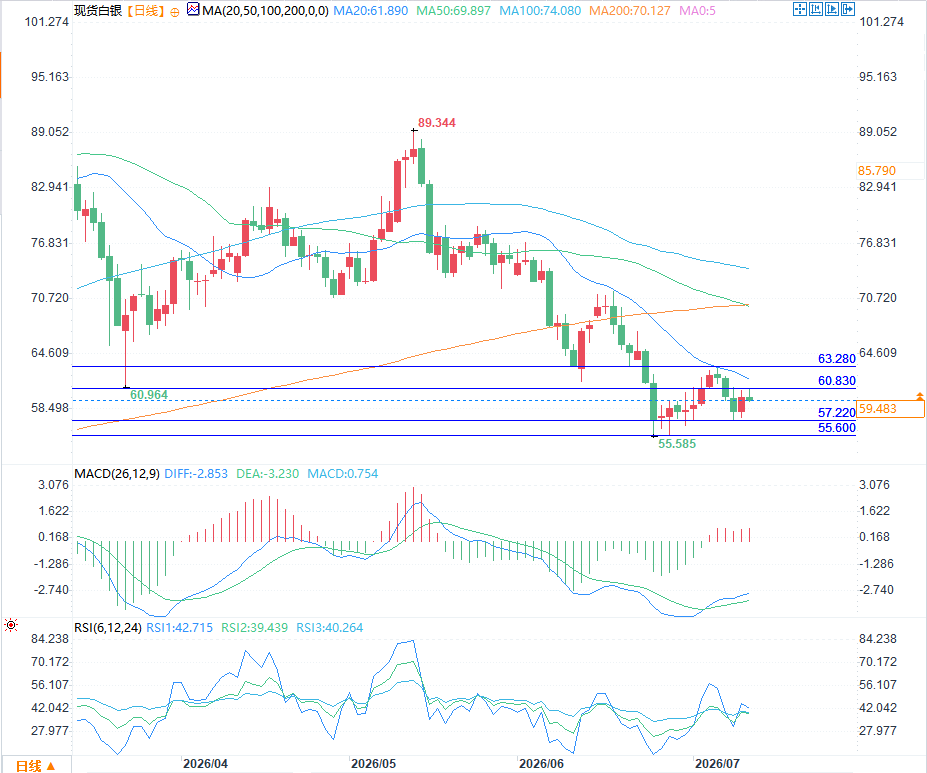
(Spot silver daily chart source: EasyTrade)
On the daily chart, silver is in an overall downtrend, and technical indicators suggest that selling on rallies is the dominant strategy. Silver prices previously fell from $71.56 to $55.60, then rebounded to $63.28 before encountering resistance and failing to break through the key retracement level, which has now been established as a short-term swing high.
The $59.44-$58.53 retracement range of the upward wave from $55.60 to $63.28 is currently the core area of contention between bulls and bears. Bulls are using this range to establish long positions at lower levels, attempting to establish a bottom with a stop-loss at $55.60; bears, on the other hand, continue to exert pressure, trying to break below these lows and extend the decline. This range also coincides with the upper edge of silver's long-term value range, and this current struggle may trigger a larger-scale market movement. The only potential risk is insufficient market volume, which could cause the support level to fail.
Regarding key price levels, the resistance levels are $60.83, $63.28, and $63.58; the core trading range is $59.44-$58.53; the key support level is $57.22, and the strong support level is $55.60. Holding above the core range could see silver prices rebound and challenge the upper resistance levels; a break below $57.22 would resume the downtrend.
V. Fundamentals: Long-term supply-demand gap solidifies value bottom
Short-term price movements are driven by macroeconomic sentiment, but silver's medium- to long-term fundamentals remain solid. According to data from the Silver Institute, global silver will experience a supply-demand gap for the sixth consecutive year in 2026, reaching a deficit of 46.3 million troy ounces. Silver possesses both industrial and monetary attributes; 58% of demand comes from high-growth industrial sectors such as photovoltaics, semiconductors, and new energy vehicles, demonstrating strong demand resilience. The remaining investment demand is highly sensitive to interest rates, which is the core reason why silver's decline has outpaced gold's in a hawkish environment.
The current gold-silver ratio is around 70, higher than the 50-year historical average of 60, indicating that silver is undervalued relative to gold, and there are no structural negative factors in the market. Meanwhile, the global trend of de-dollarization continues, with the People's Bank of China making net purchases of gold for 20 consecutive months, and the June purchase reaching a new high in recent years. This global trend of central bank reserve diversification provides long-term bottom support for precious metals and silver.
VI. Institutional Outlook and Market Summary
Institutional forecasts for silver prices in 2026 are widely divergent. LBMA data shows a median forecast of $79.57 for the average silver price for the year, with a range of $42-$165, reflecting the interplay between short-term policy pressures and long-term supply and demand benefits. While institutions such as JPMorgan Chase and Bank of America have lowered their short-term target prices for silver, their long-term bullish outlook remains unchanged, believing that short-term monetary tightening cannot reverse the structurally tight supply and demand situation in the silver market.
Overall, the short-term price action for silver is focused on the core range of $59.44-$58.53, with the July 14th CPI data being crucial for a short-term breakout. The market has largely priced in the Fed's policy decisions from the end of July, and the outcome of the September rate hike is the key focus in the medium term. In the long term, a persistent supply-demand gap, stable industrial demand growth, and the global central bank gold-buying spree provide a solid value floor for silver. From a trading perspective, short-term focus should be on monitoring price fluctuations and fund flows within the core range, awaiting inflation data to clarify the market direction.
I. Macroeconomic Core: The fluctuating expectations of a Fed rate hike are suppressing a rebound in silver prices.
The minutes of the June FOMC meeting revealed significant internal divisions within the Federal Reserve, with nine members supporting a rate hike and eight advocating for maintaining the current benchmark interest rate at 4.25%-4.50%. The minutes also raised inflation expectations, confirming that the difficulty and uncertainty of inflation falling back to the 2% target far exceeded expectations, resulting in an overall hawkish tone.
Market expectations for a September rate hike have fluctuated wildly. In early July, the significantly weaker-than-expected US June non-farm payroll data briefly lowered the probability of a September rate hike to above 50%, pushing silver prices to a temporary rebound above $62. However, with the release of hawkish meeting minutes and escalating tensions in the Middle East fueling inflation concerns, the probability of a September rate hike rose to 63%-65% by July 10th, with the market pricing in at least one rate hike this year at a high 85%. New Fed Chairman Warsh has adopted a hawkish stance, maintaining the 2% inflation target. This volatile policy expectation has made the silver rebound lack sustainability, and there is currently no basis for a sustained upward trend.
II. Geopolitical Disturbances: Middle East Conflicts Suppress Silver Prices
In early July, geopolitical conflicts in the Middle East continued to escalate, with the US and Iran engaging in mutual military strikes. Trump's statements were inconsistent, causing market risk aversion to fluctuate repeatedly. This round of geopolitical crisis significantly boosted oil prices and intensified concerns about sticky inflation, but it did not bring safe-haven benefits to silver; instead, it exerted downward pressure.
The market logic is clear: rising oil prices exacerbate inflationary pressures, supporting the Federal Reserve's continued tightening policy, pushing up real yields on US Treasury bonds and the US dollar index, which directly negatively impacts non-interest-bearing precious metals. This is also the core reason for the surge in oil prices and the simultaneous decline in silver prices on July 8th; geopolitical risks ultimately become a significant factor suppressing silver prices through policy expectations.
III. Short-term key: June CPI will determine the short-term trend of silver.
The US June CPI data on July 14th is currently the core focus of the market. The high May CPI of 4.2% year-on-year directly triggered a hawkish shift at the Federal Reserve's June meeting, sufficiently demonstrating the decisive role of inflation data in precious metals prices.
There are currently two trading scenarios in the market: If the June CPI remains above 4.0% year-on-year, expectations of an interest rate hike will rise again, strengthening the US dollar and US Treasury yields, completely locking up any potential rebound in silver; if inflation data cools down as energy prices decline, it will weaken the Fed's motivation to raise interest rates, triggering short covering and opening up a phase of recovery for silver. A short-term rebound in silver does not require a large influx of new buying; a easing of interest rate hike expectations is sufficient to drive prices higher.
IV. Technical Analysis: The $59.44-$58.53 range is the core battleground between bulls and bears.
(Spot silver daily chart source: EasyTrade)
On the daily chart, silver is in an overall downtrend, and technical indicators suggest that selling on rallies is the dominant strategy. Silver prices previously fell from $71.56 to $55.60, then rebounded to $63.28 before encountering resistance and failing to break through the key retracement level, which has now been established as a short-term swing high.
The $59.44-$58.53 retracement range of the upward wave from $55.60 to $63.28 is currently the core area of contention between bulls and bears. Bulls are using this range to establish long positions at lower levels, attempting to establish a bottom with a stop-loss at $55.60; bears, on the other hand, continue to exert pressure, trying to break below these lows and extend the decline. This range also coincides with the upper edge of silver's long-term value range, and this current struggle may trigger a larger-scale market movement. The only potential risk is insufficient market volume, which could cause the support level to fail.
Regarding key price levels, the resistance levels are $60.83, $63.28, and $63.58; the core trading range is $59.44-$58.53; the key support level is $57.22, and the strong support level is $55.60. Holding above the core range could see silver prices rebound and challenge the upper resistance levels; a break below $57.22 would resume the downtrend.
V. Fundamentals: Long-term supply-demand gap solidifies value bottom
Short-term price movements are driven by macroeconomic sentiment, but silver's medium- to long-term fundamentals remain solid. According to data from the Silver Institute, global silver will experience a supply-demand gap for the sixth consecutive year in 2026, reaching a deficit of 46.3 million troy ounces. Silver possesses both industrial and monetary attributes; 58% of demand comes from high-growth industrial sectors such as photovoltaics, semiconductors, and new energy vehicles, demonstrating strong demand resilience. The remaining investment demand is highly sensitive to interest rates, which is the core reason why silver's decline has outpaced gold's in a hawkish environment.
The current gold-silver ratio is around 70, higher than the 50-year historical average of 60, indicating that silver is undervalued relative to gold, and there are no structural negative factors in the market. Meanwhile, the global trend of de-dollarization continues, with the People's Bank of China making net purchases of gold for 20 consecutive months, and the June purchase reaching a new high in recent years. This global trend of central bank reserve diversification provides long-term bottom support for precious metals and silver.
VI. Institutional Outlook and Market Summary
Institutional forecasts for silver prices in 2026 are widely divergent. LBMA data shows a median forecast of $79.57 for the average silver price for the year, with a range of $42-$165, reflecting the interplay between short-term policy pressures and long-term supply and demand benefits. While institutions such as JPMorgan Chase and Bank of America have lowered their short-term target prices for silver, their long-term bullish outlook remains unchanged, believing that short-term monetary tightening cannot reverse the structurally tight supply and demand situation in the silver market.
Overall, the short-term price action for silver is focused on the core range of $59.44-$58.53, with the July 14th CPI data being crucial for a short-term breakout. The market has largely priced in the Fed's policy decisions from the end of July, and the outcome of the September rate hike is the key focus in the medium term. In the long term, a persistent supply-demand gap, stable industrial demand growth, and the global central bank gold-buying spree provide a solid value floor for silver. From a trading perspective, short-term focus should be on monitoring price fluctuations and fund flows within the core range, awaiting inflation data to clarify the market direction.
- Risk Warning and Disclaimer
- The market involves risk, and trading may not be suitable for all investors. This article is for reference only and does not constitute personal investment advice, nor does it take into account certain users’ specific investment objectives, financial situation, or other needs. Any investment decisions made based on this information are at your own risk.

