Recurring geopolitical tensions coupled with expectations of a Federal Reserve interest rate hike are putting downward pressure on gold prices, which are now returning to range-bound trading in the short term.
2026-07-13 09:38:33
On Monday during Asian trading hours, spot gold continued its downward trend, falling back to around $4080 per ounce . Despite escalating military tensions between the US and Iran and increased risk aversion in the market, rising energy prices exacerbated inflation concerns, prompting investors to reassess the Federal Reserve's future monetary policy path, thus putting downward pressure on gold.

U.S. Central Command launched another military strike against Iranian targets on Sunday evening, aimed at further weakening Iran's ability to attack civilian vessels transiting the Strait of Hormuz. Meanwhile, ongoing missile strikes between the U.S. and Iran have reignited tensions in the Middle East. The Strait of Hormuz handles approximately 20% of global seaborne oil transport ; escalating geopolitical risks have kept international oil prices high, also raising renewed concerns about future energy supplies and global inflationary pressures. Rising energy prices often drive up transportation and production costs, increasing global inflation stickiness, which also leads markets to expect the Federal Reserve to maintain a relatively tight monetary policy in the short term.
Since gold itself does not generate interest income, the opportunity cost of holding gold increases when the market expects interest rates to remain high for an extended period. Consequently, some funds flow to higher-yielding dollar assets and US Treasury bonds, putting downward pressure on gold prices. The recent relatively high yields on US Treasury bonds have also limited the upside potential for gold. This week, the market's focus will be on the US June Consumer Price Index (CPI) data. The market expects the overall CPI month-on-month rate to be -0.1% , while the core CPI month-on-month rate is expected to increase by 0.3% . If the actual data is lower than market expectations, it may indicate that US inflationary pressures have eased, thereby weakening the dollar's performance and increasing market expectations for the Fed's future policy adjustments, providing upward momentum for gold. Conversely, if inflation data continues to be resilient, it may further strengthen expectations of high interest rates, putting continued pressure on gold.
In addition to inflation data, investors will also be watching speeches by Federal Reserve officials, US retail sales data, and this week's Producer Price Index (PPI) to further assess the outlook for the US economy and monetary policy. Meanwhile, developments in the Middle East remain a significant variable influencing market risk aversion; any further escalation of military action could lead to significantly increased volatility in gold prices.
From a technical perspective, spot gold is still consolidating at high levels on the daily chart. Prices have temporarily retreated to near major moving averages. While the bullish trend remains intact, upward momentum has slowed. The MACD indicator's red bars continue to shorten, and the two lines show signs of converging further. The RSI has fallen to near the neutral zone, indicating a slight increase in short-term market caution. If gold prices regain a foothold above $4100 , they are expected to further test the resistance areas of $4135 and $4160 . On the downside, key support levels to watch are $4050 and $4015 . A break below these levels could lead to a further pullback to the $4000 psychological level.
From a 4-hour chart perspective, gold prices are trading near short-term moving averages, the MACD remains near the zero line with the red bars continuing to narrow, and the RSI is around 50, indicating a near balance between bullish and bearish forces in the short term. If US CPI data falls short of market expectations, gold may rebound due to a weakening dollar; if the data is stronger than expected, gold prices may continue to test the $4050 support level or even lower, with significantly increased short-term volatility expected.
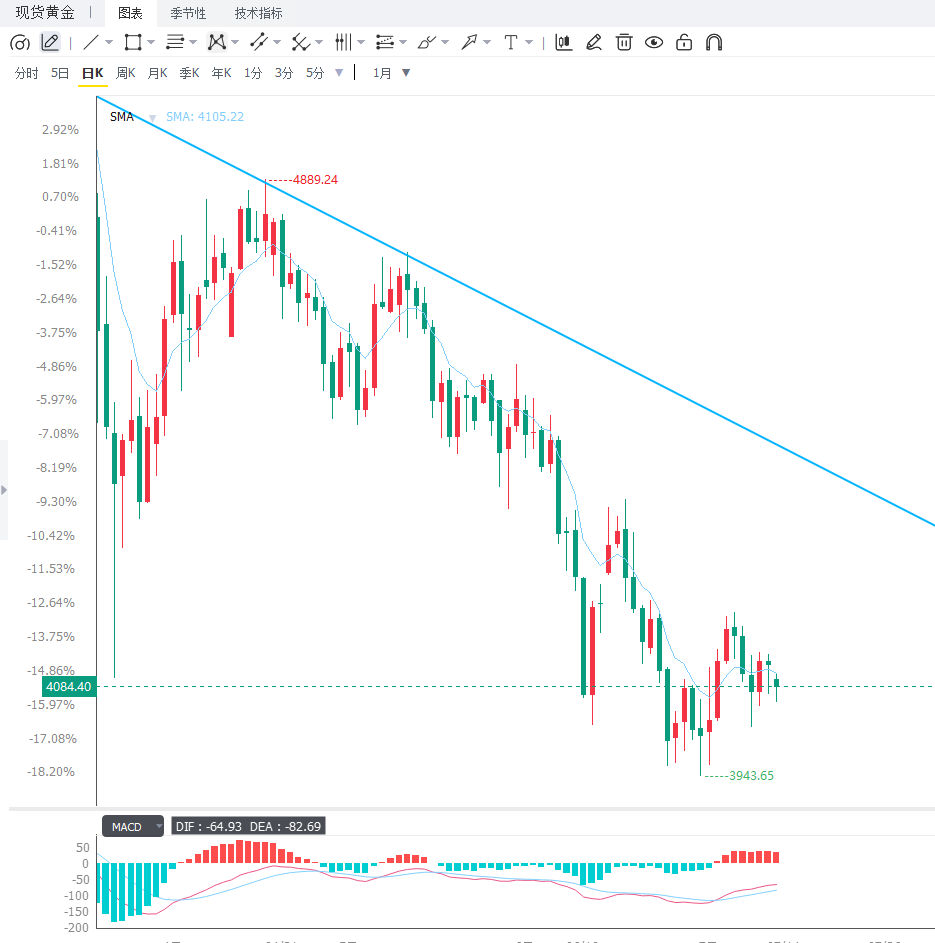
Editor's Summary : The gold market is currently influenced by both safe-haven demand and expectations of high interest rates. While geopolitical risks continue to support safe-haven sentiment, rising energy prices and resulting inflationary pressures have further strengthened market expectations that the Federal Reserve will maintain its high-interest-rate policy , becoming a significant factor limiting gold price increases. This week's US June CPI data will be a key variable for gold's short-term trend. If inflation continues to cool, gold prices may have a chance to rebound; if inflation is strong, the dollar and US Treasury yields may remain high, and gold will still face some downward pressure in the short term.
U.S. Central Command launched another military strike against Iranian targets on Sunday evening, aimed at further weakening Iran's ability to attack civilian vessels transiting the Strait of Hormuz. Meanwhile, ongoing missile strikes between the U.S. and Iran have reignited tensions in the Middle East. The Strait of Hormuz handles approximately 20% of global seaborne oil transport ; escalating geopolitical risks have kept international oil prices high, also raising renewed concerns about future energy supplies and global inflationary pressures. Rising energy prices often drive up transportation and production costs, increasing global inflation stickiness, which also leads markets to expect the Federal Reserve to maintain a relatively tight monetary policy in the short term.
Since gold itself does not generate interest income, the opportunity cost of holding gold increases when the market expects interest rates to remain high for an extended period. Consequently, some funds flow to higher-yielding dollar assets and US Treasury bonds, putting downward pressure on gold prices. The recent relatively high yields on US Treasury bonds have also limited the upside potential for gold. This week, the market's focus will be on the US June Consumer Price Index (CPI) data. The market expects the overall CPI month-on-month rate to be -0.1% , while the core CPI month-on-month rate is expected to increase by 0.3% . If the actual data is lower than market expectations, it may indicate that US inflationary pressures have eased, thereby weakening the dollar's performance and increasing market expectations for the Fed's future policy adjustments, providing upward momentum for gold. Conversely, if inflation data continues to be resilient, it may further strengthen expectations of high interest rates, putting continued pressure on gold.
In addition to inflation data, investors will also be watching speeches by Federal Reserve officials, US retail sales data, and this week's Producer Price Index (PPI) to further assess the outlook for the US economy and monetary policy. Meanwhile, developments in the Middle East remain a significant variable influencing market risk aversion; any further escalation of military action could lead to significantly increased volatility in gold prices.
From a technical perspective, spot gold is still consolidating at high levels on the daily chart. Prices have temporarily retreated to near major moving averages. While the bullish trend remains intact, upward momentum has slowed. The MACD indicator's red bars continue to shorten, and the two lines show signs of converging further. The RSI has fallen to near the neutral zone, indicating a slight increase in short-term market caution. If gold prices regain a foothold above $4100 , they are expected to further test the resistance areas of $4135 and $4160 . On the downside, key support levels to watch are $4050 and $4015 . A break below these levels could lead to a further pullback to the $4000 psychological level.
From a 4-hour chart perspective, gold prices are trading near short-term moving averages, the MACD remains near the zero line with the red bars continuing to narrow, and the RSI is around 50, indicating a near balance between bullish and bearish forces in the short term. If US CPI data falls short of market expectations, gold may rebound due to a weakening dollar; if the data is stronger than expected, gold prices may continue to test the $4050 support level or even lower, with significantly increased short-term volatility expected.
Editor's Summary : The gold market is currently influenced by both safe-haven demand and expectations of high interest rates. While geopolitical risks continue to support safe-haven sentiment, rising energy prices and resulting inflationary pressures have further strengthened market expectations that the Federal Reserve will maintain its high-interest-rate policy , becoming a significant factor limiting gold price increases. This week's US June CPI data will be a key variable for gold's short-term trend. If inflation continues to cool, gold prices may have a chance to rebound; if inflation is strong, the dollar and US Treasury yields may remain high, and gold will still face some downward pressure in the short term.
- Risk Warning and Disclaimer
- The market involves risk, and trading may not be suitable for all investors. This article is for reference only and does not constitute personal investment advice, nor does it take into account certain users’ specific investment objectives, financial situation, or other needs. Any investment decisions made based on this information are at your own risk.