A new round of conflict between the US and Iran is boosting demand for safe-haven assets, potentially ending a four-day losing streak for the US dollar against the Canadian dollar.
2026-07-13 11:11:16
On Monday (July 13) during the Asian session, the US dollar gained upward momentum against the Canadian dollar, trading around 1.4160, and is expected to end its previous four-day losing streak.
The strengthening of the US dollar is mainly supported by the continued escalation of geopolitical tensions in the Middle East—the US military launched a new round of strikes against Iran aimed at "weakening" Iran's ability to interfere with commercial ships in the Strait of Hormuz, while the Iranian Revolutionary Guard launched retaliatory attacks on several US allies in the Middle East, and geopolitical safe-haven demand pushed up the dollar.
The escalating military standoff between the US and Iran is the core driver of the strengthening dollar. Last weekend, the US military launched strikes against multiple targets within Iran, explicitly stating its aim was to "weaken" Iran's ability to interfere with commercial vessels in the Strait of Hormuz.
Iran's Revolutionary Guard subsequently launched retaliatory drone and missile attacks against U.S. allies in the Middle East, targeting countries including Kuwait, Jordan, Qatar, and Bahrain. Last weekend, Iran announced the closure of the Strait of Hormuz "until further notice."
The escalating tensions in the Middle East are impacting the USD/CAD exchange rate through two channels: first, rising geopolitical risks are directly increasing demand for the US dollar as a safe haven; second, tensions in the Strait of Hormuz are pushing up oil prices, which should theoretically support the Canadian dollar (as the currency of a major oil-exporting country), but the market currently seems to favor trading on a safe-haven logic—that is, safe-haven buying of the US dollar outweighs the positive effect of rising oil prices on the Canadian dollar.
Despite geopolitical factors putting pressure on the Canadian dollar, the June employment data released last Friday provided fundamental support for the Canadian dollar.
Data shows that Canada added 18,200 jobs in June, a significant slowdown from May's 87,800, but still far exceeding market expectations of 10,000. The unemployment rate fell from 6.6% to 6.5%, also better than the expected 6.6%.
This data indicates that the Canadian labor market remains resilient, although the growth rate has slowed compared to the previous month. The better-than-expected employment data provided marginal support for the Canadian dollar, limiting the upside potential of the USD/CAD pair – which is one reason why the USD/CAD gains have been relatively modest amid widespread safe-haven demand for the US dollar.
Market focus has shifted to the Bank of Canada's interest rate decision on Wednesday. Media surveys show that economists generally expect the Bank of Canada to keep the overnight rate unchanged at 2.25% at its July policy meeting and maintain that rate level for a considerable period into next year. The rationale is that price pressures are largely under control and the economy is gradually recovering.
The expectation that the Bank of Canada will hold rates steady contrasts with the marginal cooling of expectations for a Federal Reserve rate hike, but both are in a "wait-and-see" mode. With the two central banks' policy paths converging, exchange rate movements will be driven more by geopolitical factors and differences in short-term economic data.
Looking ahead, the USD/CAD pair is currently at a critical juncture, with both bulls and bears vying for control around 1.4160.
On the upside, if the conflict between the US and Iran continues to escalate, safe-haven buying of the US dollar could further push the exchange rate to the 1.4200 or even 1.4250 area.
On the downside, if the strong performance of Canadian employment data continues, or if the market refocuses on the positive impact of rising oil prices on the Canadian dollar, the exchange rate may retest the 1.4100 level.
Key catalysts this week include: Tuesday's US June CPI data (a stronger-than-expected figure would reignite expectations of a Fed rate hike, benefiting the US dollar), Wednesday's Bank of Canada interest rate decision (a surprisingly hawkish signal could boost the Canadian dollar), and any further developments in the Middle East. Given the current highly uncertain geopolitical environment, short-term volatility in the USD/CAD pair is expected to remain high.
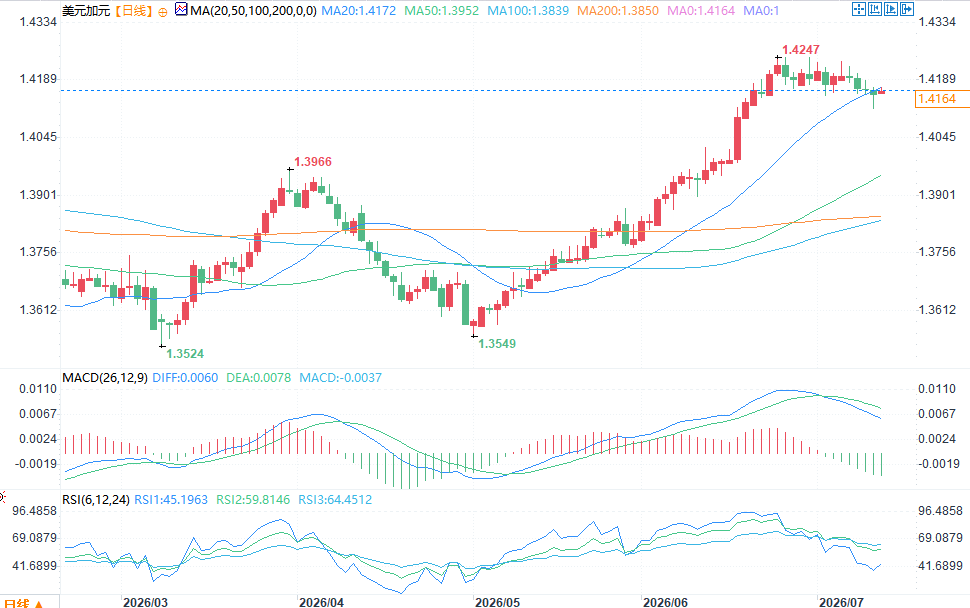
(USD/CAD daily chart, source: EasyForex)
At 11:10 AM Beijing time on July 13, the USD/CAD exchange rate was 1.4168/69.
The strengthening of the US dollar is mainly supported by the continued escalation of geopolitical tensions in the Middle East—the US military launched a new round of strikes against Iran aimed at "weakening" Iran's ability to interfere with commercial ships in the Strait of Hormuz, while the Iranian Revolutionary Guard launched retaliatory attacks on several US allies in the Middle East, and geopolitical safe-haven demand pushed up the dollar.
Geopolitics: Escalating US-Iran conflict drives up safe-haven demand for the US dollar.
The escalating military standoff between the US and Iran is the core driver of the strengthening dollar. Last weekend, the US military launched strikes against multiple targets within Iran, explicitly stating its aim was to "weaken" Iran's ability to interfere with commercial vessels in the Strait of Hormuz.
Iran's Revolutionary Guard subsequently launched retaliatory drone and missile attacks against U.S. allies in the Middle East, targeting countries including Kuwait, Jordan, Qatar, and Bahrain. Last weekend, Iran announced the closure of the Strait of Hormuz "until further notice."
The escalating tensions in the Middle East are impacting the USD/CAD exchange rate through two channels: first, rising geopolitical risks are directly increasing demand for the US dollar as a safe haven; second, tensions in the Strait of Hormuz are pushing up oil prices, which should theoretically support the Canadian dollar (as the currency of a major oil-exporting country), but the market currently seems to favor trading on a safe-haven logic—that is, safe-haven buying of the US dollar outweighs the positive effect of rising oil prices on the Canadian dollar.
Canadian economic data: Better-than-expected jobs report provides support for the Canadian dollar.
Despite geopolitical factors putting pressure on the Canadian dollar, the June employment data released last Friday provided fundamental support for the Canadian dollar.
Data shows that Canada added 18,200 jobs in June, a significant slowdown from May's 87,800, but still far exceeding market expectations of 10,000. The unemployment rate fell from 6.6% to 6.5%, also better than the expected 6.6%.
This data indicates that the Canadian labor market remains resilient, although the growth rate has slowed compared to the previous month. The better-than-expected employment data provided marginal support for the Canadian dollar, limiting the upside potential of the USD/CAD pair – which is one reason why the USD/CAD gains have been relatively modest amid widespread safe-haven demand for the US dollar.
Central Bank Policy: The Bank of Canada is expected to keep interest rates unchanged on Wednesday.
Market focus has shifted to the Bank of Canada's interest rate decision on Wednesday. Media surveys show that economists generally expect the Bank of Canada to keep the overnight rate unchanged at 2.25% at its July policy meeting and maintain that rate level for a considerable period into next year. The rationale is that price pressures are largely under control and the economy is gradually recovering.
The expectation that the Bank of Canada will hold rates steady contrasts with the marginal cooling of expectations for a Federal Reserve rate hike, but both are in a "wait-and-see" mode. With the two central banks' policy paths converging, exchange rate movements will be driven more by geopolitical factors and differences in short-term economic data.
Outlook: Tug-of-war between bulls and bears around 1.4160
Looking ahead, the USD/CAD pair is currently at a critical juncture, with both bulls and bears vying for control around 1.4160.
On the upside, if the conflict between the US and Iran continues to escalate, safe-haven buying of the US dollar could further push the exchange rate to the 1.4200 or even 1.4250 area.
On the downside, if the strong performance of Canadian employment data continues, or if the market refocuses on the positive impact of rising oil prices on the Canadian dollar, the exchange rate may retest the 1.4100 level.
Key catalysts this week include: Tuesday's US June CPI data (a stronger-than-expected figure would reignite expectations of a Fed rate hike, benefiting the US dollar), Wednesday's Bank of Canada interest rate decision (a surprisingly hawkish signal could boost the Canadian dollar), and any further developments in the Middle East. Given the current highly uncertain geopolitical environment, short-term volatility in the USD/CAD pair is expected to remain high.
(USD/CAD daily chart, source: EasyForex)
At 11:10 AM Beijing time on July 13, the USD/CAD exchange rate was 1.4168/69.
- Risk Warning and Disclaimer
- The market involves risk, and trading may not be suitable for all investors. This article is for reference only and does not constitute personal investment advice, nor does it take into account certain users’ specific investment objectives, financial situation, or other needs. Any investment decisions made based on this information are at your own risk.