Hormuz tensions threaten Japan's energy security, and the continued interest rate differential between the US and Japan puts downward pressure on the yen.
2026-07-13 12:07:06
On Monday (July 13) during the Asian session, the US dollar received strong buying support against the Japanese yen, and the exchange rate has returned above the 162.00 level. It is currently trading around 162.08, up about 0.22%, recovering most of the losses from last Friday.
Multiple factors contributed to the weakening of the yen: the escalating conflict between the US and Iran—Iran announced the closure of the Strait of Hormuz, the US launched a new round of strikes, and Iran retaliated with missiles against US military bases in the Gulf—posing a serious threat to the Japanese economy, which relies on the strait for over 90% of its crude oil imports; the large interest rate differential of approximately 250-275 basis points between the US and Japan continued to drive active carry trades; in addition, geopolitical conflicts pushed up oil prices, strengthened inflation concerns, and solidified expectations of a Fed rate hike, further supporting the US dollar.

The escalating conflict between the US and Iran is putting unique pressure on the yen. Japan relies on the Strait of Hormuz for more than 90% of its crude oil imports, and any obstruction to the waterway directly threatens Japan's energy security and economic stability.
Iran's announcement of the closure of the Strait of Hormuz (despite US denial), a new round of US strikes against Iran, and Iran's retaliatory missile strikes against US military bases in the Gulf region—these events have plunged the global energy market into a state of high uncertainty.
For the Japanese yen, the transmission path of geopolitical risks is twofold: on the one hand, the rise in global risk aversion should have been beneficial to the yen, but as an energy import-dependent economy, the direct impact of tensions in the Strait of Hormuz on the Japanese economy is offsetting the yen's safe-haven attributes; on the other hand, rising oil prices have pushed up global inflation expectations, further solidifying expectations that the Federal Reserve will maintain a tight stance, thus putting additional pressure on the yen through interest rate differentials.
The huge interest rate differential between the US and Japan remains the core factor driving the structural weakening of the yen.
The Federal Reserve is currently maintaining its benchmark interest rate in a target range of 3.50%-3.75%, while the Bank of Japan, although it has raised its policy rate to 1.0% (the highest since 1995), still maintains a gap of approximately 250-275 basis points between the two. This interest rate differential is sufficient to sustain active carry trades—investors continue to borrow low-interest yen and invest in high-interest dollar assets.
Despite the Bank of Japan raising interest rates to a 31-year high of 1.0% in June, the yen's interest rate disadvantage relative to the Federal Reserve's interest rate level has not been substantially improved.
The structural weakness of the yen is unlikely to be fundamentally reversed until the interest rate differential between the US and Japan narrows significantly.
Regarding the US dollar, escalating geopolitical risks are driving up demand for it as a safe haven. Escalating tensions between the US and Iran, uncertainty surrounding the passage of goods through the Strait of Hormuz, and rising oil prices exacerbating inflation concerns are all providing buying support for the dollar.
The market is currently pricing in at least one more rate hike by the Federal Reserve in 2026, an expectation that has been further solidified against the backdrop of rising energy prices.
Key catalysts this week include the US June CPI data released on Tuesday and Federal Reserve Chairman Warsh's first testimony before Congress. If inflation data is stronger than expected or Warsh releases hawkish signals, the dollar could strengthen further, pushing the USD/JPY pair towards the 163.00 level.
Despite multiple headwinds facing the yen, the market remains highly vigilant about the possibility of renewed intervention by Japanese authorities in the foreign exchange market. The Ministry of Finance spent a record 11.73 trillion yen on interventions in April and May, and the current exchange rate remains above the Ministry's known "pain threshold." This risk of intervention is limiting the willingness of yen short sellers to establish large new positions, and is one of the reasons why the USD/JPY pair failed to rise significantly further after hitting a 40-year high earlier this month.
Some FOMC members will speak on Monday, but the market's main focus remains on the US CPI data and Walsh's testimony before Congress later this week.
In summary, the USD/JPY pair is expected to maintain a relatively strong position in the short term due to a confluence of positive factors. The unique impact of geopolitical risks on the Japanese economy, the persistent interest rate differential between the US and Japan, and the increased demand for the US dollar as a safe haven all contribute to the logic behind the yen's weakening.
However, the 162.50-163.00 area remains a significant resistance zone, and the looming risk of intervention may limit the bullish sentiment of yen bears. If US CPI data is stronger than expected or Warsh releases hawkish signals, USD/JPY may test 163.00 or even higher; conversely, if inflation data is weaker or Warsh's rhetoric is cautious, coupled with intervention concerns, the exchange rate may retest the 161.50-162.00 area. In the current highly uncertain geopolitical environment, the risk of both two-way volatility in USD/JPY cannot be ignored.
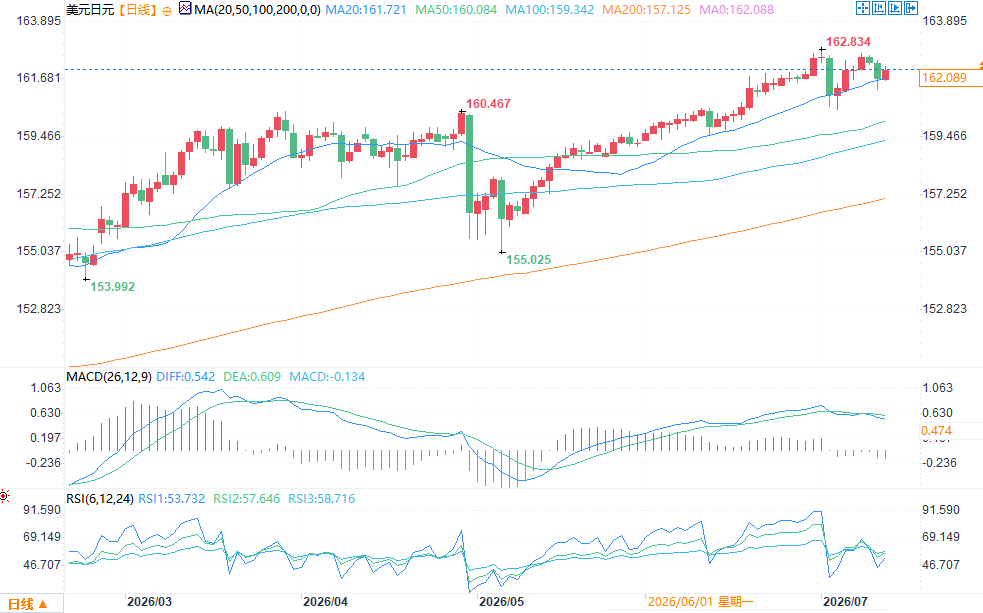
(USD/JPY daily chart, source: FX678)
At 12:06 Beijing time on July 13, the USD/JPY exchange rate was 162.08/09.
Multiple factors contributed to the weakening of the yen: the escalating conflict between the US and Iran—Iran announced the closure of the Strait of Hormuz, the US launched a new round of strikes, and Iran retaliated with missiles against US military bases in the Gulf—posing a serious threat to the Japanese economy, which relies on the strait for over 90% of its crude oil imports; the large interest rate differential of approximately 250-275 basis points between the US and Japan continued to drive active carry trades; in addition, geopolitical conflicts pushed up oil prices, strengthened inflation concerns, and solidified expectations of a Fed rate hike, further supporting the US dollar.
Geopolitics: The unique threat of the Hormuz tensions to the Japanese economy
The escalating conflict between the US and Iran is putting unique pressure on the yen. Japan relies on the Strait of Hormuz for more than 90% of its crude oil imports, and any obstruction to the waterway directly threatens Japan's energy security and economic stability.
Iran's announcement of the closure of the Strait of Hormuz (despite US denial), a new round of US strikes against Iran, and Iran's retaliatory missile strikes against US military bases in the Gulf region—these events have plunged the global energy market into a state of high uncertainty.
For the Japanese yen, the transmission path of geopolitical risks is twofold: on the one hand, the rise in global risk aversion should have been beneficial to the yen, but as an energy import-dependent economy, the direct impact of tensions in the Strait of Hormuz on the Japanese economy is offsetting the yen's safe-haven attributes; on the other hand, rising oil prices have pushed up global inflation expectations, further solidifying expectations that the Federal Reserve will maintain a tight stance, thus putting additional pressure on the yen through interest rate differentials.
Interest rate differentials: Divergence in US-Japan monetary policies sustains yen weakness
The huge interest rate differential between the US and Japan remains the core factor driving the structural weakening of the yen.
The Federal Reserve is currently maintaining its benchmark interest rate in a target range of 3.50%-3.75%, while the Bank of Japan, although it has raised its policy rate to 1.0% (the highest since 1995), still maintains a gap of approximately 250-275 basis points between the two. This interest rate differential is sufficient to sustain active carry trades—investors continue to borrow low-interest yen and invest in high-interest dollar assets.
Despite the Bank of Japan raising interest rates to a 31-year high of 1.0% in June, the yen's interest rate disadvantage relative to the Federal Reserve's interest rate level has not been substantially improved.
The structural weakness of the yen is unlikely to be fundamentally reversed until the interest rate differential between the US and Japan narrows significantly.
The dollar strengthened due to safe-haven demand coupled with expectations of interest rate hikes.
Regarding the US dollar, escalating geopolitical risks are driving up demand for it as a safe haven. Escalating tensions between the US and Iran, uncertainty surrounding the passage of goods through the Strait of Hormuz, and rising oil prices exacerbating inflation concerns are all providing buying support for the dollar.
The market is currently pricing in at least one more rate hike by the Federal Reserve in 2026, an expectation that has been further solidified against the backdrop of rising energy prices.
Key catalysts this week include the US June CPI data released on Tuesday and Federal Reserve Chairman Warsh's first testimony before Congress. If inflation data is stronger than expected or Warsh releases hawkish signals, the dollar could strengthen further, pushing the USD/JPY pair towards the 163.00 level.
Risk factors: Intervention risk limits short yen bets
Despite multiple headwinds facing the yen, the market remains highly vigilant about the possibility of renewed intervention by Japanese authorities in the foreign exchange market. The Ministry of Finance spent a record 11.73 trillion yen on interventions in April and May, and the current exchange rate remains above the Ministry's known "pain threshold." This risk of intervention is limiting the willingness of yen short sellers to establish large new positions, and is one of the reasons why the USD/JPY pair failed to rise significantly further after hitting a 40-year high earlier this month.
Some FOMC members will speak on Monday, but the market's main focus remains on the US CPI data and Walsh's testimony before Congress later this week.
Outlook: Short-term bias is bullish, but intervention risks limit upside potential.
In summary, the USD/JPY pair is expected to maintain a relatively strong position in the short term due to a confluence of positive factors. The unique impact of geopolitical risks on the Japanese economy, the persistent interest rate differential between the US and Japan, and the increased demand for the US dollar as a safe haven all contribute to the logic behind the yen's weakening.
However, the 162.50-163.00 area remains a significant resistance zone, and the looming risk of intervention may limit the bullish sentiment of yen bears. If US CPI data is stronger than expected or Warsh releases hawkish signals, USD/JPY may test 163.00 or even higher; conversely, if inflation data is weaker or Warsh's rhetoric is cautious, coupled with intervention concerns, the exchange rate may retest the 161.50-162.00 area. In the current highly uncertain geopolitical environment, the risk of both two-way volatility in USD/JPY cannot be ignored.
(USD/JPY daily chart, source: FX678)
At 12:06 Beijing time on July 13, the USD/JPY exchange rate was 162.08/09.
- Risk Warning and Disclaimer
- The market involves risk, and trading may not be suitable for all investors. This article is for reference only and does not constitute personal investment advice, nor does it take into account certain users’ specific investment objectives, financial situation, or other needs. Any investment decisions made based on this information are at your own risk.