Geopolitical conflicts drive up oil prices, oil prices drive up inflation, and inflation drives up interest rates—the triple positive logic for the US dollar index.
2026-07-13 11:35:37
On Monday (July 13) during Asian trading hours, the US dollar index strengthened for the second consecutive trading day, currently trading around 101.15, up about 0.18%, having reached a high of 101.22 during the session, a new high in three trading days. The dollar's rise was mainly driven by safe-haven demand triggered by the continued escalation of geopolitical tensions in the Middle East.
The core driver of the continued strength of the US dollar index stems from the ongoing escalation of geopolitical risks in the Middle East. The US Central Command launched a new round of strikes Sunday night, explicitly stating its aim was to weaken Iran's ability to attack civilian vessels in the Strait of Hormuz. Over the past three nights, the US military has struck more than 300 Iranian targets—approximately 140 targets were attacked on Saturday alone.
The Iranian Revolutionary Guard launched retaliatory strikes against several U.S. allies in the Middle East.
Bahrain sounded air raid sirens again early this morning (July 13) local time. According to Iranian media reports, drones and missiles launched from different regions within Iran in a large-scale retaliatory attack against US military targets in the Gulf region—targets identified following the latest US military movements within the past 48 hours.
More concerning is the significant deterioration of the geopolitical outlook. Iran has made it clear that it will not resume further negotiations until Washington fully fulfills its previous commitments regarding shipping safety and the normalization of Iranian oil exports. This stalemate means that the possibility of easing the conflict through diplomatic means in the short term is declining, and the geopolitical risk premium will remain at a high level.
For the US dollar, the continued tensions in the Middle East are beneficial in two ways: first, the decline in global risk appetite has directly boosted the demand for the dollar as a safe haven; second, tensions in the Strait of Hormuz have pushed up oil prices, exacerbated inflation concerns, and further solidified market expectations that the Federal Reserve will maintain its tightening stance.
Another factor supporting the dollar's strength comes from market pricing in the Federal Reserve's policy path. The market is still anticipating at least one more rate hike by the Fed before the end of the year. This expectation is further solidified against the backdrop of rising oil prices due to the US-Iran conflict—rising energy prices could spill over into broader inflation, forcing the Fed to maintain its tightening stance.
The US June CPI data, to be released on Tuesday, is the most important economic data event this week. The market expects the overall CPI to decline by 0.1% month-on-month, while the core CPI is expected to rise by 0.3% month-on-month.
If the data is stronger than expected, it will further strengthen the urgency for the Federal Reserve to raise interest rates, providing additional upward momentum for the dollar; conversely, if inflation data is weak, it may put short-term pressure on the dollar.
On the same day, Federal Reserve Chairman Warsh will make his first formal appearance before Congress. The market will be closely watching his assessment of the impact of the US-Iran conflict on the inflation outlook, as well as any hints he may give regarding the future policy path. If Warsh releases hawkish signals—for example, emphasizing the upside risks to inflation from rising oil prices—the dollar may strengthen further; if he prefers to remain on the sidelines, it could put marginal pressure on the dollar.
Overall, the US dollar index is expected to maintain a relatively strong position in the short term, supported by both geopolitical safe-haven demand and expectations of interest rate hikes. The continued escalation of the US-Iran conflict—especially the uncertainty surrounding the passage through the Strait of Hormuz—will continue to provide safe-haven buying support for the dollar, while rising oil prices and strengthened inflation expectations further solidify the dollar's attractiveness in terms of interest rate differentials.
From a technical perspective, 101.00 has become a recent support level. If this level holds, the US dollar index is expected to further test the 101.50-101.70 area. If there are unexpected signs of easing tensions in the Middle East, or if CPI data is significantly lower than expected, the dollar may retest the 100.50-100.60 area.
Key variables this week include: whether the US-Iran conflict will escalate further or signal a diplomatic breakthrough; the direction of the revision of inflation expectations based on Tuesday's US CPI data; and the policy signals released by Warsh during his congressional testimony. In the current highly uncertain environment, the volatility of the US dollar index is expected to remain high.
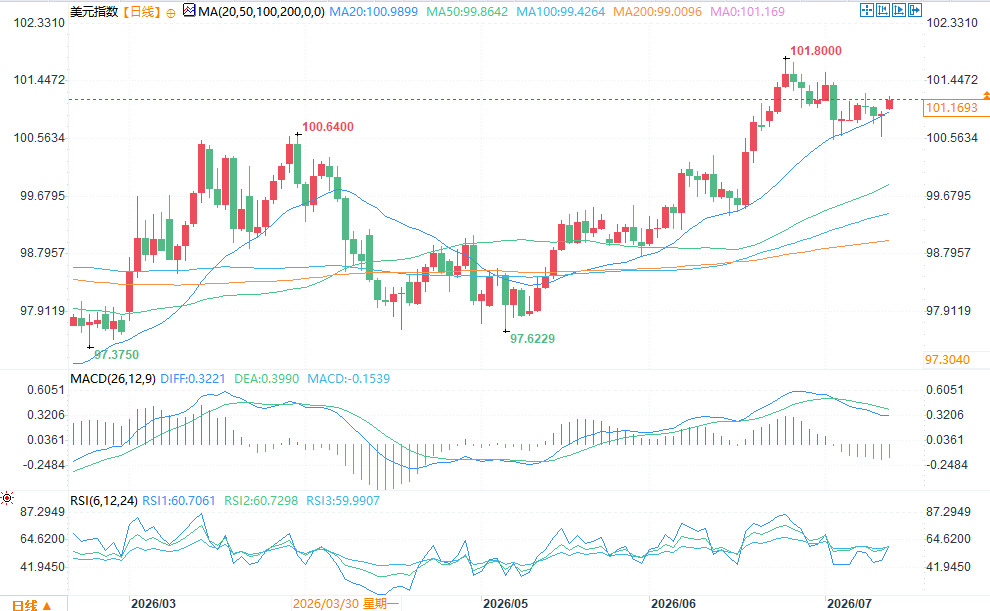
(US Dollar Index Daily Chart, Source: FX678)
At 11:33 AM Beijing time on July 13, the US dollar index was at 101.13.
Geopolitics: Escalating US-Iran conflict fuels safe-haven demand for the US dollar.
The core driver of the continued strength of the US dollar index stems from the ongoing escalation of geopolitical risks in the Middle East. The US Central Command launched a new round of strikes Sunday night, explicitly stating its aim was to weaken Iran's ability to attack civilian vessels in the Strait of Hormuz. Over the past three nights, the US military has struck more than 300 Iranian targets—approximately 140 targets were attacked on Saturday alone.
The Iranian Revolutionary Guard launched retaliatory strikes against several U.S. allies in the Middle East.
Bahrain sounded air raid sirens again early this morning (July 13) local time. According to Iranian media reports, drones and missiles launched from different regions within Iran in a large-scale retaliatory attack against US military targets in the Gulf region—targets identified following the latest US military movements within the past 48 hours.
More concerning is the significant deterioration of the geopolitical outlook. Iran has made it clear that it will not resume further negotiations until Washington fully fulfills its previous commitments regarding shipping safety and the normalization of Iranian oil exports. This stalemate means that the possibility of easing the conflict through diplomatic means in the short term is declining, and the geopolitical risk premium will remain at a high level.
For the US dollar, the continued tensions in the Middle East are beneficial in two ways: first, the decline in global risk appetite has directly boosted the demand for the dollar as a safe haven; second, tensions in the Strait of Hormuz have pushed up oil prices, exacerbated inflation concerns, and further solidified market expectations that the Federal Reserve will maintain its tightening stance.
Monetary Policy: Interest Rate Hike Expectations and CPI Data are the Two Key Focuses
Another factor supporting the dollar's strength comes from market pricing in the Federal Reserve's policy path. The market is still anticipating at least one more rate hike by the Fed before the end of the year. This expectation is further solidified against the backdrop of rising oil prices due to the US-Iran conflict—rising energy prices could spill over into broader inflation, forcing the Fed to maintain its tightening stance.
The US June CPI data, to be released on Tuesday, is the most important economic data event this week. The market expects the overall CPI to decline by 0.1% month-on-month, while the core CPI is expected to rise by 0.3% month-on-month.
If the data is stronger than expected, it will further strengthen the urgency for the Federal Reserve to raise interest rates, providing additional upward momentum for the dollar; conversely, if inflation data is weak, it may put short-term pressure on the dollar.
On the same day, Federal Reserve Chairman Warsh will make his first formal appearance before Congress. The market will be closely watching his assessment of the impact of the US-Iran conflict on the inflation outlook, as well as any hints he may give regarding the future policy path. If Warsh releases hawkish signals—for example, emphasizing the upside risks to inflation from rising oil prices—the dollar may strengthen further; if he prefers to remain on the sidelines, it could put marginal pressure on the dollar.
Outlook: The US dollar is biased towards strength in the short term, with 101.00 becoming a key support level.
Overall, the US dollar index is expected to maintain a relatively strong position in the short term, supported by both geopolitical safe-haven demand and expectations of interest rate hikes. The continued escalation of the US-Iran conflict—especially the uncertainty surrounding the passage through the Strait of Hormuz—will continue to provide safe-haven buying support for the dollar, while rising oil prices and strengthened inflation expectations further solidify the dollar's attractiveness in terms of interest rate differentials.
From a technical perspective, 101.00 has become a recent support level. If this level holds, the US dollar index is expected to further test the 101.50-101.70 area. If there are unexpected signs of easing tensions in the Middle East, or if CPI data is significantly lower than expected, the dollar may retest the 100.50-100.60 area.
Key variables this week include: whether the US-Iran conflict will escalate further or signal a diplomatic breakthrough; the direction of the revision of inflation expectations based on Tuesday's US CPI data; and the policy signals released by Warsh during his congressional testimony. In the current highly uncertain environment, the volatility of the US dollar index is expected to remain high.
(US Dollar Index Daily Chart, Source: FX678)
At 11:33 AM Beijing time on July 13, the US dollar index was at 101.13.
- Risk Warning and Disclaimer
- The market involves risk, and trading may not be suitable for all investors. This article is for reference only and does not constitute personal investment advice, nor does it take into account certain users’ specific investment objectives, financial situation, or other needs. Any investment decisions made based on this information are at your own risk.