Gold Trading Alert: Resurgence of Conflict in the Middle East Pushes Up Oil Prices! Interest Rate Hike Expectations Rise Sharply, Gold Prices Plunge Nearly 3%; Focus on US CPI
2026-07-14 07:50:10
On Monday (July 13), spot gold prices fell sharply for the second consecutive trading day, closing at $4,000.80 per ounce, a drop of nearly 3%, after hitting a low of $3,986.51, the lowest since July 1. US gold futures also declined, closing down 2.6% at $4,005.7. This trend contrasts sharply with the previous pattern of gold fluctuating at high levels. The core driving factor behind this is the sharp escalation of the situation in the Middle East, particularly the US's reinstatement of the naval blockade against Iran, which directly ignited concerns in the global energy market and spread to expectations regarding monetary policy. On Tuesday (July 14) in early Asian trading, spot gold fluctuated narrowly, currently trading around $3,997 per ounce. 
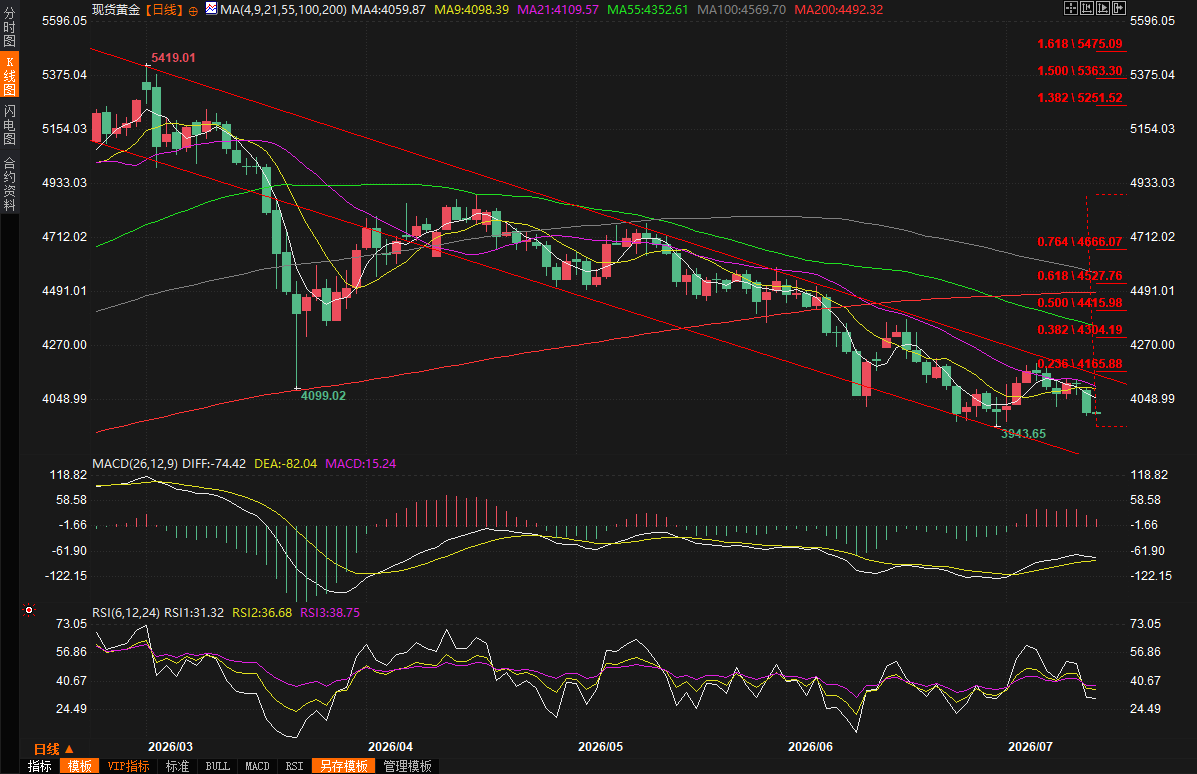 (Spot gold daily chart, source: FX678) At 07:48 Beijing time, spot gold is currently trading at $3996.45 per ounce.
Escalating geopolitical conflicts in the Middle East: Oil prices surge 9%, becoming the biggest drag on gold prices.
The current situation in the Middle East has evolved from localized tensions into a complex conflict with multiple fronts. US President Trump has explicitly stated his intention to reinstate the naval blockade against Iran and plans to impose a 20% fee on all goods transported through the Strait of Hormuz. This strong move directly targets the strait, which Iran claims to have closed, aiming to regain control of this crucial energy route. As a result, crude oil futures prices surged more than 9% on Monday, with Brent crude settling at $83.30 per barrel, and US crude also hitting a near one-month high. The Strait of Hormuz, a vital choke point for global oil transport, has seen its shipping disruptions rapidly escalating market concerns about energy supply disruptions. Furthermore, ongoing missile and drone attacks between Iran and the US, attacks on UAE oil tankers resulting in casualties, and the Houthi rebels in Yemen breaking their ceasefire with Saudi Arabia and launching missiles at Saudi Arabia have further amplified regional instability. These events have collectively led to a slowdown in freight volume, prompting countries to seek long-term solutions to bypass the strait, while the surge in energy prices in the short term has become an irreversible reality. The sharp rise in oil prices has directly increased global energy and transportation costs, becoming a new catalyst for inflationary pressures. For gold, a traditional safe-haven asset, this "stagflation" concern has actually had a negative impact. Higher energy prices tend to prompt central banks to adopt tougher monetary policies to curb inflation, rather than easing conditions to support risk assets.Inflation looms over the Federal Reserve: Probability of a September rate hike surges to 75%.
Market expectations for Federal Reserve policy are rapidly shifting towards a hawkish stance due to the oil price shock. The CME FedWatch tool shows traders now expect a 75% probability of a September rate hike. Fed Governor Waller's comments further reinforced this expectation, explicitly stating that if upcoming inflation data remains well above the 2% target, the Fed may need to raise rates "in the near term." This week, the US will release a series of key data, including the June Consumer Price Index (CPI), Producer Price Index (PPI), retail sales, and initial jobless claims. These data will be crucial windows for assessing the transmission effect of inflation. The US dollar index rose 0.34% on Monday, hitting a one-week high of 101.32, reflecting increased investor preference for US assets. US Treasury yields also climbed sharply, with the 10-year yield rising to 4.618%, a near two-month high, and the two-year yield also reaching its highest level since February 2025. The steepening yield curve reflects the market's pricing in short-term interest rate hike pressure. In this environment, gold's attractiveness as a non-yielding asset has significantly diminished. Market analyst Fawad Razaqzada points out that the Middle East conflict is pushing up oil prices and could prompt the Federal Reserve to maintain high interest rates for longer, which is a double whammy for gold. If oil prices continue to rise, gold prices may break down further, with an initial target of $3,800, and in extreme cases, it could even test the $3,500 level.Market risk aversion sentiment is diverging: both the US dollar and bond yields are strengthening.
While Middle East conflicts typically trigger safe-haven buying, this market reaction has exhibited a clear shift from risk aversion to policy tightening. Investors haven't flocked to gold in large numbers, instead opting to increase their dollar positions and push up bond yields. John Velis, a strategist at BNY Mellon, believes the market is currently reacting to the escalation with mild risk aversion, but fundamental factors still support a stronger dollar. The Trump administration continues to pressure Iran while simultaneously signaling a desire to reach a negotiated agreement. However, the risk of a protracted conflict—which Trump himself has compared to the Vietnam War, suggesting it could last months or even longer—makes it difficult for the market to quickly price in a peaceful outcome. This further solidifies the dollar's strength and limits gold's upside potential.Gold Outlook: Short-term pressure, but structural support remains in the medium to long term.
In summary, the recent decline in gold prices is a result of the convergence of geopolitical events and monetary policy expectations. In the short term, with the release of US inflation data this week, if CPI and PPI figures show a significant transmission effect from oil prices, expectations of interest rate hikes may further intensify, and gold prices will continue to face downward pressure. Technically, gold prices have broken below the recent trading range, with the low around $3986 becoming a key support level. A breach of this level would open up further downside potential. However, from a medium- to long-term perspective, gold has not completely lost support. Global geopolitical risks have not been fundamentally eliminated. The fragility of the Strait of Hormuz, the Iranian nuclear issue, and broader Middle East turmoil all provide a basis for potential safe-haven demand for gold. Furthermore, if the Federal Reserve signals a policy shift after raising interest rates, or if global economic growth slows more than expected, gold may still regain its upward momentum.Conclusion: Gold investment requires caution in the face of "black swan" events coupled with policy changes.
The conflict in the Middle East has driven up energy prices and raised expectations of interest rate hikes, putting short-term downward pressure on gold prices but also sowing the seeds of future uncertainty. Investors should closely monitor this week's US economic data, statements from Federal Reserve officials, and the latest developments in the Middle East situation. Today's trading day will see the release of the US June CPI data, as well as Federal Reserve Chairman Warsh's testimony before the House Financial Services Committee on the "Federal Reserve's Semi-Annual Monetary Policy Report," which investors should pay close attention to. (Spot gold daily chart, source: FX678) At 07:48 Beijing time, spot gold is currently trading at $3996.45 per ounce.- Risk Warning and Disclaimer
- The market involves risk, and trading may not be suitable for all investors. This article is for reference only and does not constitute personal investment advice, nor does it take into account certain users’ specific investment objectives, financial situation, or other needs. Any investment decisions made based on this information are at your own risk.