Escalating tensions in the Middle East and hawkish expectations from the Federal Reserve supported the US dollar, causing the USD/JPY pair to continue its high-level consolidation.
2026-07-14 10:46:10
The USD/JPY pair continued its high-level consolidation during Tuesday's Asian trading session, trading around 162.50 . Although the dollar has entered a period of consolidation after a period of continuous gains, the pair remains near its highest level in nearly four decades, supported by escalating geopolitical risks in the Middle East and expectations of a hawkish Federal Reserve policy. Market concerns about potential renewed intervention in the foreign exchange market by Japanese authorities also continue to rise.  In Japan, Finance Minister Satsuki Katayama stated that the Japanese government could reassess the asset allocation plan for the Government Pension Investment Fund (GPIF) if the investment environment changes significantly in the future. This statement initially provided some support for the yen, but overall, its impact on the exchange rate was limited. Meanwhile, the dollar index temporarily slowed its rise after two consecutive trading days, as investors awaited the release of the US June Consumer Price Index (CPI) and Federal Reserve Chairman Kevin Warsh's testimony before Congress that day to release further policy signals. Ahead of the important data release, some bullish investors chose to take profits, limiting further upside potential for the dollar against the yen. However, from a fundamental perspective, the dollar still receives support from multiple factors. Tensions between the US and Iran continue to escalate, with the US reinstating restrictions on Iranian ports and vessels and launching military strikes against Iran for the third consecutive night. In response, Iran intensified its military operations against US allies and related facilities, and two oil tankers from the United Arab Emirates were attacked near the Strait of Hormuz, significantly increasing global energy supply risks. The Strait of Hormuz handles approximately 20% of global seaborne crude oil transport . As an economy heavily reliant on energy imports, Japan imports a significant amount of crude oil from the Middle East. Rising international oil prices not only increase import costs but may also further drag down expectations for Japan's economic recovery, putting pressure on the yen. Simultaneously, rising international oil prices have reignited market concerns about global inflation, with investors anticipating the possibility of further monetary tightening by the Federal Reserve before the end of the year. Although the Bank of Japan has already raised its policy rate to 1% , the highest level since 1995, a significant interest rate gap remains between the US and Japan, keeping carry trades active. Funds are more inclined to buy dollars and sell yen, providing sustained support for the USD/JPY exchange rate. The market is also highly focused on whether the Japanese government will take new measures to intervene in the foreign exchange market. With the exchange rate consistently above 160, Japanese officials have recently repeatedly emphasized that they will closely monitor exchange rate fluctuations. If the USD/JPY continues to rise rapidly, the Japanese Ministry of Finance may issue verbal warnings or even directly intervene in the market to stabilize the yen's trend. Therefore, against a backdrop of bullish fundamentals, the exchange rate may continue to fluctuate wildly at high levels in the short term. From a technical perspective, the USD/JPY daily chart maintains a clear upward trend, with the price consistently trading above major moving averages, and the bullish structure remains intact. The MACD indicator maintains its golden cross and continues to diverge upwards, indicating that the medium- to long-term upward momentum remains strong. The RSI indicator is running at a high level, reflecting that the market has entered a relatively strong zone, but also suggesting some overbought risk in the short term. If the exchange rate effectively breaks through 162.80 , it is expected to further challenge the resistance areas of 163.50 and 164.20 . On the downside, watch for support at 161.80 and 160.80 . As long as these key support levels hold, the overall upward trend is likely to continue. Looking at the 4-hour chart, USD/JPY has entered a high-level consolidation phase, with the price oscillating around the 162 level. The MACD histogram has narrowed somewhat, indicating that the short-term upward momentum has slowed slightly, but the two lines are still above the zero axis; the RSI remains around 60, indicating that the bullish advantage has not changed. If US CPI data continues to support the Federal Reserve's tight policy, the exchange rate is likely to retest the resistance above 162.80 ; if the data falls short of expectations or the Japanese authorities release stronger intervention signals, it may fall back to test the support areas of 161.80 and 160.80 , and short-term volatility is expected to increase further.
 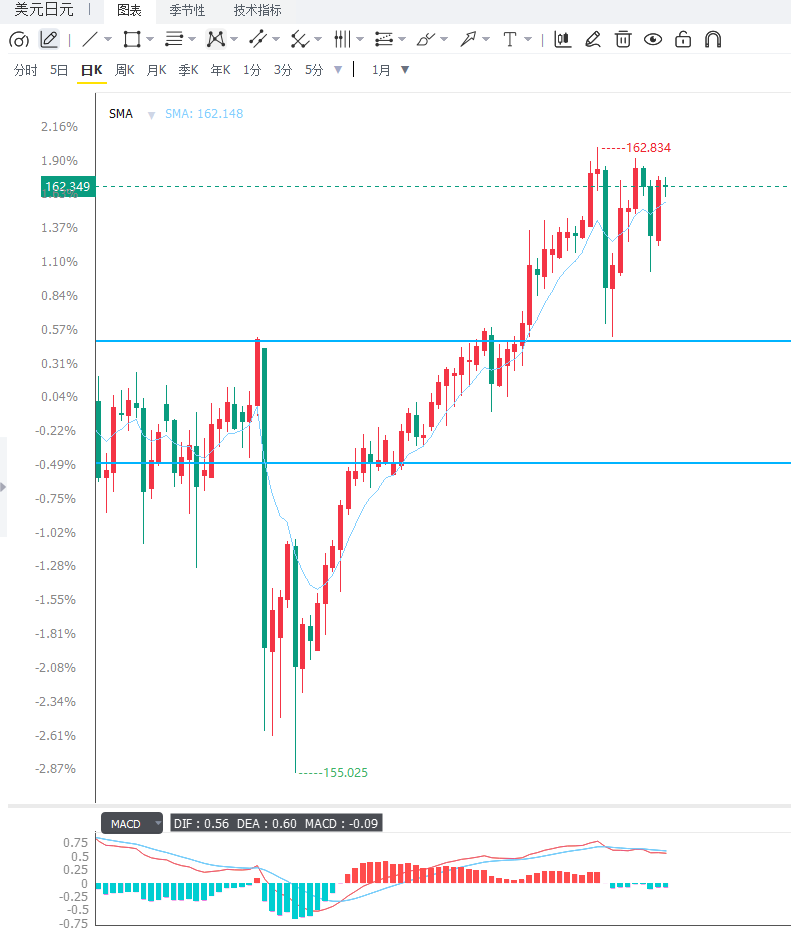 Editor's Summary: The USD/JPY pair remains supported by multiple factors, including Middle East geopolitical risks, rising international oil prices, and hawkish expectations from the Federal Reserve, maintaining an overall strong trend. However, the exchange rate is approaching multi-decade highs, and rising expectations of Japanese government intervention pose significant policy risks to the market. In the short term, the US June CPI data, Federal Reserve Chairman Kevin Warsh's speech, and developments in the Middle East will remain key variables influencing exchange rate movements. If US inflation remains resilient, the USD/JPY pair is likely to maintain its high levels; however, if policy expectations change or Japan takes actual intervention measures, exchange rate volatility could increase significantly.
In Japan, Finance Minister Satsuki Katayama stated that the Japanese government could reassess the asset allocation plan for the Government Pension Investment Fund (GPIF) if the investment environment changes significantly in the future. This statement initially provided some support for the yen, but overall, its impact on the exchange rate was limited. Meanwhile, the dollar index temporarily slowed its rise after two consecutive trading days, as investors awaited the release of the US June Consumer Price Index (CPI) and Federal Reserve Chairman Kevin Warsh's testimony before Congress that day to release further policy signals. Ahead of the important data release, some bullish investors chose to take profits, limiting further upside potential for the dollar against the yen. However, from a fundamental perspective, the dollar still receives support from multiple factors. Tensions between the US and Iran continue to escalate, with the US reinstating restrictions on Iranian ports and vessels and launching military strikes against Iran for the third consecutive night. In response, Iran intensified its military operations against US allies and related facilities, and two oil tankers from the United Arab Emirates were attacked near the Strait of Hormuz, significantly increasing global energy supply risks. The Strait of Hormuz handles approximately 20% of global seaborne crude oil transport . As an economy heavily reliant on energy imports, Japan imports a significant amount of crude oil from the Middle East. Rising international oil prices not only increase import costs but may also further drag down expectations for Japan's economic recovery, putting pressure on the yen. Simultaneously, rising international oil prices have reignited market concerns about global inflation, with investors anticipating the possibility of further monetary tightening by the Federal Reserve before the end of the year. Although the Bank of Japan has already raised its policy rate to 1% , the highest level since 1995, a significant interest rate gap remains between the US and Japan, keeping carry trades active. Funds are more inclined to buy dollars and sell yen, providing sustained support for the USD/JPY exchange rate. The market is also highly focused on whether the Japanese government will take new measures to intervene in the foreign exchange market. With the exchange rate consistently above 160, Japanese officials have recently repeatedly emphasized that they will closely monitor exchange rate fluctuations. If the USD/JPY continues to rise rapidly, the Japanese Ministry of Finance may issue verbal warnings or even directly intervene in the market to stabilize the yen's trend. Therefore, against a backdrop of bullish fundamentals, the exchange rate may continue to fluctuate wildly at high levels in the short term. From a technical perspective, the USD/JPY daily chart maintains a clear upward trend, with the price consistently trading above major moving averages, and the bullish structure remains intact. The MACD indicator maintains its golden cross and continues to diverge upwards, indicating that the medium- to long-term upward momentum remains strong. The RSI indicator is running at a high level, reflecting that the market has entered a relatively strong zone, but also suggesting some overbought risk in the short term. If the exchange rate effectively breaks through 162.80 , it is expected to further challenge the resistance areas of 163.50 and 164.20 . On the downside, watch for support at 161.80 and 160.80 . As long as these key support levels hold, the overall upward trend is likely to continue. Looking at the 4-hour chart, USD/JPY has entered a high-level consolidation phase, with the price oscillating around the 162 level. The MACD histogram has narrowed somewhat, indicating that the short-term upward momentum has slowed slightly, but the two lines are still above the zero axis; the RSI remains around 60, indicating that the bullish advantage has not changed. If US CPI data continues to support the Federal Reserve's tight policy, the exchange rate is likely to retest the resistance above 162.80 ; if the data falls short of expectations or the Japanese authorities release stronger intervention signals, it may fall back to test the support areas of 161.80 and 160.80 , and short-term volatility is expected to increase further. Editor's Summary: The USD/JPY pair remains supported by multiple factors, including Middle East geopolitical risks, rising international oil prices, and hawkish expectations from the Federal Reserve, maintaining an overall strong trend. However, the exchange rate is approaching multi-decade highs, and rising expectations of Japanese government intervention pose significant policy risks to the market. In the short term, the US June CPI data, Federal Reserve Chairman Kevin Warsh's speech, and developments in the Middle East will remain key variables influencing exchange rate movements. If US inflation remains resilient, the USD/JPY pair is likely to maintain its high levels; however, if policy expectations change or Japan takes actual intervention measures, exchange rate volatility could increase significantly.
- Risk Warning and Disclaimer
- The market involves risk, and trading may not be suitable for all investors. This article is for reference only and does not constitute personal investment advice, nor does it take into account certain users’ specific investment objectives, financial situation, or other needs. Any investment decisions made based on this information are at your own risk.