US inflation unexpectedly cooled in June, causing gold to rebound from its lows and maintain range-bound trading.
2026-07-15 09:34:11
The across-the-board cooling of US inflation data in June provided a significant boost to the gold market. During Wednesday's Asian trading session, spot gold (XAU/USD) rebounded to around $4050 per ounce , primarily driven by a weaker dollar and a readjustment of market expectations regarding the Federal Reserve's monetary policy. Investors believe that the latest inflation data indicates easing price pressures in the US, reducing the need for further aggressive tightening by the Fed, thus restoring buying support for gold, a non-interest-bearing asset.  Data released by the U.S. Bureau of Labor Statistics showed that the U.S. Consumer Price Index (CPI) rose 3.5% year-on-year in June, lower than the market expectation of 3.8% and significantly lower than May's 4.2% . On a month-on-month basis, the June CPI fell 0.4% , while May saw a 0.5% increase, indicating that a decline in energy and some commodity prices led to a significant slowdown in overall inflation. Core inflation, excluding food and energy prices, also released positive signals. Data showed that the core CPI rose 2.6% year-on-year in June, lower than May's 2.9% and also lower than the market expectation of 2.8%; it remained flat month-on-month , reflecting a weakening of upward momentum in service sector prices. This result further strengthened market expectations that U.S. inflation would gradually return to a controllable range, and also reduced investors' bets on the Federal Reserve continuing to raise interest rates in the short term. After the inflation data was released, the market quickly adjusted its interest rate expectations. The market generally believes that the possibility of the Federal Reserve continuing to raise interest rates at its meeting at the end of July has significantly decreased, and the dollar index and U.S. Treasury yields have fallen in tandem, creating a more favorable trading environment for gold. Since gold itself does not generate interest income, the opportunity cost of holding gold decreases when the market expects less room for interest rate increases, attracting funds back into the precious metals market. Independent precious metals traders stated that the biggest highlight of this inflation data was not only the significant decline in overall CPI, but more importantly, the failure of core inflation to continue rising month-on-month. This means that market expectations for further interest rate hikes at the next two Federal Reserve meetings may have cooled significantly, leading to a temporary rebound in gold prices. However, the upside potential for gold is still constrained by new inflation risks. Recently, international crude oil prices have remained high, and the ongoing tensions in the Middle East have renewed market concerns that rising energy costs could push up global inflation again. If oil prices continue to rise, it could not only weaken the recent improvements in inflation but also force the Federal Reserve to maintain a restrictive monetary policy for a longer period, thus limiting further gains in gold. Meanwhile, the geopolitical situation in the Middle East remains a significant risk factor for the current market. The US Central Command stated that a new round of military operations targeting Iranian military targets has begun, aimed at further weakening its military capabilities regarding commercial shipping in the Strait of Hormuz. Subsequently, an Iranian Foreign Ministry spokesperson condemned the military operations, stating that this was the latest military strike by the United States. Market concerns are growing that the Strait of Hormuz, which handles approximately 20% of global seaborne crude oil transport , could further escalate regional tensions and disrupt global energy supplies, potentially driving up oil prices and safe-haven demand. Currently, the gold market is caught in a battle between two forces. On one hand, slowing US inflation is weakening the dollar and improving the investment environment for gold; on the other hand, rising energy prices could reignite inflation expectations, leading the Federal Reserve to maintain high interest rates longer than market expectations. In the coming days, US June PPI, retail sales, and speeches by Federal Reserve officials will be crucial indicators for the market to reassess monetary policy and will directly impact the next phase of gold's price movement. Technically, spot gold has stabilized above the $4,000 level on the daily chart and is gradually recovering short-term moving averages, shifting from a correction to a consolidation phase. If gold can effectively hold above $4,050 and break through the resistance near $4,085 , bulls could potentially challenge the $4,120 or even $4,160 area; initial support is seen at $4,015 , with further support around $3,980 . Daily momentum has improved somewhat, but it hasn't fully shaken off the effects of the previous correction, and the market still needs more fundamental positive news. The 4-hour chart shows that gold has regained its position above short-term moving averages, with short-term bullish momentum continuing to recover. The moving average system is gradually turning bullish, indicating that funds are flowing back into the gold market after market risk appetite improved. However, as gold prices approach the previous densely traded area, there is still some technical resistance around $4085 . A break above this area would further confirm the continuation of the short-term rebound; a break below $4015 could lead to a retest of the $3980- $3950 support zone. In the short term, it is expected to maintain a high-level, slightly bullish trend.
 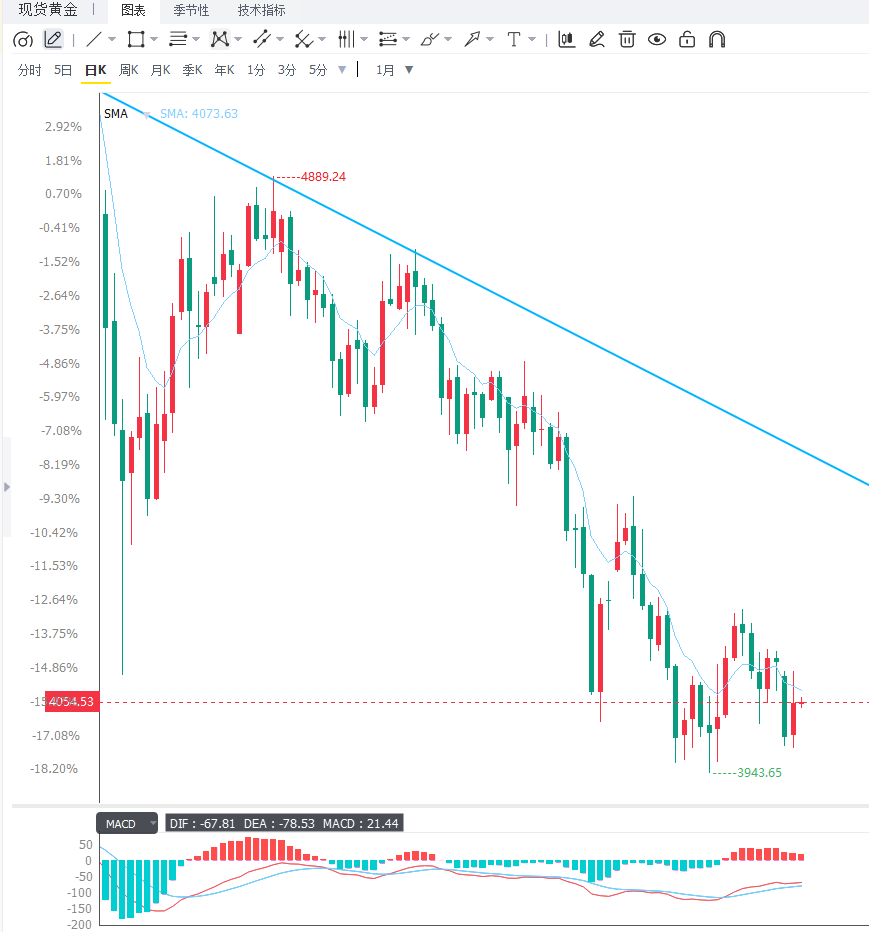 Editor's Summary: Lower-than-expected US inflation data in June provided a temporary boost to gold prices and prompted the market to reassess the Federal Reserve's future monetary policy path. Meanwhile, continued tensions in the Middle East and high international oil prices maintain significant uncertainty about the global inflation outlook, and the high-interest-rate environment may persist longer than previously anticipated, putting some downward pressure on gold. In the short term, gold will continue to fluctuate based on US economic data, Fed policy signals, and geopolitical developments. If inflation continues to decline and the dollar remains weak, gold prices are expected to continue their recovery; conversely, if energy prices drive inflation to rebound and high-interest-rate expectations resurface, gold may face renewed downward pressure.
Data released by the U.S. Bureau of Labor Statistics showed that the U.S. Consumer Price Index (CPI) rose 3.5% year-on-year in June, lower than the market expectation of 3.8% and significantly lower than May's 4.2% . On a month-on-month basis, the June CPI fell 0.4% , while May saw a 0.5% increase, indicating that a decline in energy and some commodity prices led to a significant slowdown in overall inflation. Core inflation, excluding food and energy prices, also released positive signals. Data showed that the core CPI rose 2.6% year-on-year in June, lower than May's 2.9% and also lower than the market expectation of 2.8%; it remained flat month-on-month , reflecting a weakening of upward momentum in service sector prices. This result further strengthened market expectations that U.S. inflation would gradually return to a controllable range, and also reduced investors' bets on the Federal Reserve continuing to raise interest rates in the short term. After the inflation data was released, the market quickly adjusted its interest rate expectations. The market generally believes that the possibility of the Federal Reserve continuing to raise interest rates at its meeting at the end of July has significantly decreased, and the dollar index and U.S. Treasury yields have fallen in tandem, creating a more favorable trading environment for gold. Since gold itself does not generate interest income, the opportunity cost of holding gold decreases when the market expects less room for interest rate increases, attracting funds back into the precious metals market. Independent precious metals traders stated that the biggest highlight of this inflation data was not only the significant decline in overall CPI, but more importantly, the failure of core inflation to continue rising month-on-month. This means that market expectations for further interest rate hikes at the next two Federal Reserve meetings may have cooled significantly, leading to a temporary rebound in gold prices. However, the upside potential for gold is still constrained by new inflation risks. Recently, international crude oil prices have remained high, and the ongoing tensions in the Middle East have renewed market concerns that rising energy costs could push up global inflation again. If oil prices continue to rise, it could not only weaken the recent improvements in inflation but also force the Federal Reserve to maintain a restrictive monetary policy for a longer period, thus limiting further gains in gold. Meanwhile, the geopolitical situation in the Middle East remains a significant risk factor for the current market. The US Central Command stated that a new round of military operations targeting Iranian military targets has begun, aimed at further weakening its military capabilities regarding commercial shipping in the Strait of Hormuz. Subsequently, an Iranian Foreign Ministry spokesperson condemned the military operations, stating that this was the latest military strike by the United States. Market concerns are growing that the Strait of Hormuz, which handles approximately 20% of global seaborne crude oil transport , could further escalate regional tensions and disrupt global energy supplies, potentially driving up oil prices and safe-haven demand. Currently, the gold market is caught in a battle between two forces. On one hand, slowing US inflation is weakening the dollar and improving the investment environment for gold; on the other hand, rising energy prices could reignite inflation expectations, leading the Federal Reserve to maintain high interest rates longer than market expectations. In the coming days, US June PPI, retail sales, and speeches by Federal Reserve officials will be crucial indicators for the market to reassess monetary policy and will directly impact the next phase of gold's price movement. Technically, spot gold has stabilized above the $4,000 level on the daily chart and is gradually recovering short-term moving averages, shifting from a correction to a consolidation phase. If gold can effectively hold above $4,050 and break through the resistance near $4,085 , bulls could potentially challenge the $4,120 or even $4,160 area; initial support is seen at $4,015 , with further support around $3,980 . Daily momentum has improved somewhat, but it hasn't fully shaken off the effects of the previous correction, and the market still needs more fundamental positive news. The 4-hour chart shows that gold has regained its position above short-term moving averages, with short-term bullish momentum continuing to recover. The moving average system is gradually turning bullish, indicating that funds are flowing back into the gold market after market risk appetite improved. However, as gold prices approach the previous densely traded area, there is still some technical resistance around $4085 . A break above this area would further confirm the continuation of the short-term rebound; a break below $4015 could lead to a retest of the $3980- $3950 support zone. In the short term, it is expected to maintain a high-level, slightly bullish trend. Editor's Summary: Lower-than-expected US inflation data in June provided a temporary boost to gold prices and prompted the market to reassess the Federal Reserve's future monetary policy path. Meanwhile, continued tensions in the Middle East and high international oil prices maintain significant uncertainty about the global inflation outlook, and the high-interest-rate environment may persist longer than previously anticipated, putting some downward pressure on gold. In the short term, gold will continue to fluctuate based on US economic data, Fed policy signals, and geopolitical developments. If inflation continues to decline and the dollar remains weak, gold prices are expected to continue their recovery; conversely, if energy prices drive inflation to rebound and high-interest-rate expectations resurface, gold may face renewed downward pressure.
- Risk Warning and Disclaimer
- The market involves risk, and trading may not be suitable for all investors. This article is for reference only and does not constitute personal investment advice, nor does it take into account certain users’ specific investment objectives, financial situation, or other needs. Any investment decisions made based on this information are at your own risk.