hawkish expectations from the Bank of England are rising, causing the pound to remain range-bound against the yen.
2026-07-15 16:14:13
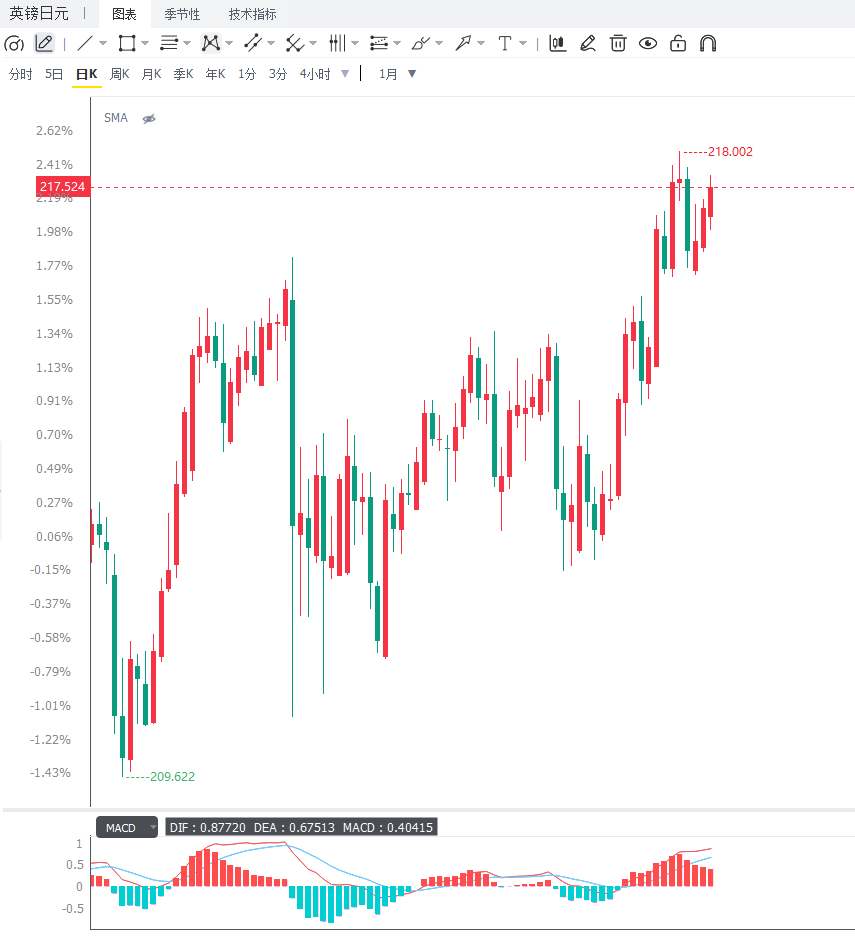
The British pound continued its upward trend against the Japanese yen (GBP/JPY) in European trading on Wednesday, rising to around 217.50 , a new high for the week and approaching its highest level since January 2008. Market expectations for further interest rate hikes from the Bank of England continued to rise, while the Bank of Japan maintained a relatively loose monetary environment, keeping the pound/yen pair on a strong upward trajectory.  The core factor driving the current exchange rate appreciation remains the significant interest rate differential between the UK and Japan. The Bank of Japan raised its short-term policy rate to 1.00% in June, the highest level since 1995, while the Bank of England's benchmark interest rate remains at 3.75% , resulting in a spread of approximately 275 basis points . This substantial yield advantage continues to attract carry trade funds into sterling assets, providing sustained support for the pound against the yen. Although the market remains concerned about potential currency intervention by the Japanese government, the high interest rate environment encourages investors to continue holding pounds and selling yen, keeping the yen generally weak. Analysts believe that unless the UK-Japan interest rate differential narrows significantly, the yen is unlikely to experience a sustained rebound in the short term. Meanwhile, continued tensions in the Middle East have further weakened the yen's performance. Recent escalating military friction between the US and Iran has raised market concerns about potential disruptions to global energy supplies. Japan relies on the Middle East for over 90% of its crude oil imports , and the Strait of Hormuz handles approximately 20% of global seaborne crude oil transport . If energy transport is affected, Japan's import costs will further increase, adding pressure to its economy and weighing on the yen. In contrast, the pound continues to be supported by domestic fundamentals in the UK. As political uncertainty in the UK gradually diminishes, market focus has shifted back to the Bank of England's monetary policy. Bank of England Governor Andrew Bailey stated during a parliamentary hearing that the renewed escalation of the conflict between the US and Iran indicates that global inflationary pressures have not completely subsided, and rising energy prices could still influence future price trends. Bailey's remarks further strengthened market expectations for continued tightening by the Bank of England. The market has largely priced in at least a 25 basis point rate hike this year and anticipates the next round of rate increases could begin as early as September . This expectation continues to boost UK government bond yields and further enhances the pound's attractiveness to international funds. Meanwhile, lower-than-expected US inflation data in June and a generally weaker dollar have improved global risk appetite, providing additional support for high-yield currencies. Driven by multiple positive factors, the market generally believes that the pound/yen pair still has the foundation for further gains, and short-term pullbacks are more likely to be seen as opportunities to buy on dips. From a technical perspective, the pound/yen pair continues to maintain a strong upward structure on the daily chart, with the price firmly above major moving averages, and the bullish trend remains intact. The exchange rate is currently approaching the psychological level of 218.00 , with the first resistance level to watch at 218.20 . A successful break above this level could lead to further challenges towards the 219.00 and 220.00 areas. Initial support is at 217.00 , with further support around 216.20 and 215.00 . Daily momentum remains positive, and the market is still dominated by bulls. The 4-hour chart shows the GBP/JPY pair steadily rising along short-term moving averages, with the moving average system maintaining a bullish alignment, indicating a healthy short-term upward trend. Although some profit-taking may occur after the exchange rate approaches multi-year highs, as long as the 217.00 support holds, the overall bullish trend is not expected to change. A break above 218.20 could open up further upside potential; a break below 217.00 could lead to a retest of the 216.20 support area, but the expected downside is relatively limited.
  Editor's Summary: The British pound continued its strengthening against the Japanese yen, primarily supported by multiple factors including hawkish expectations from the Bank of England, the UK-Japan interest rate differential, and escalating risks associated with Japanese energy imports. Market expectations for further interest rate hikes by the Bank of England this year are strengthening, while Japan's loose interest rate environment and carry trade demand continue to suppress the yen's performance. In the short term, UK inflation data, Japanese policy developments, and developments in the Middle East will continue to dominate market sentiment. If the Bank of England continues to signal a hawkish stance and the yen lacks new positive factors, the British pound/yen pair is expected to continue reaching new highs; however, after approaching multi-year highs, the risk of short-term volatility due to potential Japanese intervention in the exchange rate should also be monitored.
The core factor driving the current exchange rate appreciation remains the significant interest rate differential between the UK and Japan. The Bank of Japan raised its short-term policy rate to 1.00% in June, the highest level since 1995, while the Bank of England's benchmark interest rate remains at 3.75% , resulting in a spread of approximately 275 basis points . This substantial yield advantage continues to attract carry trade funds into sterling assets, providing sustained support for the pound against the yen. Although the market remains concerned about potential currency intervention by the Japanese government, the high interest rate environment encourages investors to continue holding pounds and selling yen, keeping the yen generally weak. Analysts believe that unless the UK-Japan interest rate differential narrows significantly, the yen is unlikely to experience a sustained rebound in the short term. Meanwhile, continued tensions in the Middle East have further weakened the yen's performance. Recent escalating military friction between the US and Iran has raised market concerns about potential disruptions to global energy supplies. Japan relies on the Middle East for over 90% of its crude oil imports , and the Strait of Hormuz handles approximately 20% of global seaborne crude oil transport . If energy transport is affected, Japan's import costs will further increase, adding pressure to its economy and weighing on the yen. In contrast, the pound continues to be supported by domestic fundamentals in the UK. As political uncertainty in the UK gradually diminishes, market focus has shifted back to the Bank of England's monetary policy. Bank of England Governor Andrew Bailey stated during a parliamentary hearing that the renewed escalation of the conflict between the US and Iran indicates that global inflationary pressures have not completely subsided, and rising energy prices could still influence future price trends. Bailey's remarks further strengthened market expectations for continued tightening by the Bank of England. The market has largely priced in at least a 25 basis point rate hike this year and anticipates the next round of rate increases could begin as early as September . This expectation continues to boost UK government bond yields and further enhances the pound's attractiveness to international funds. Meanwhile, lower-than-expected US inflation data in June and a generally weaker dollar have improved global risk appetite, providing additional support for high-yield currencies. Driven by multiple positive factors, the market generally believes that the pound/yen pair still has the foundation for further gains, and short-term pullbacks are more likely to be seen as opportunities to buy on dips. From a technical perspective, the pound/yen pair continues to maintain a strong upward structure on the daily chart, with the price firmly above major moving averages, and the bullish trend remains intact. The exchange rate is currently approaching the psychological level of 218.00 , with the first resistance level to watch at 218.20 . A successful break above this level could lead to further challenges towards the 219.00 and 220.00 areas. Initial support is at 217.00 , with further support around 216.20 and 215.00 . Daily momentum remains positive, and the market is still dominated by bulls. The 4-hour chart shows the GBP/JPY pair steadily rising along short-term moving averages, with the moving average system maintaining a bullish alignment, indicating a healthy short-term upward trend. Although some profit-taking may occur after the exchange rate approaches multi-year highs, as long as the 217.00 support holds, the overall bullish trend is not expected to change. A break above 218.20 could open up further upside potential; a break below 217.00 could lead to a retest of the 216.20 support area, but the expected downside is relatively limited. Editor's Summary: The British pound continued its strengthening against the Japanese yen, primarily supported by multiple factors including hawkish expectations from the Bank of England, the UK-Japan interest rate differential, and escalating risks associated with Japanese energy imports. Market expectations for further interest rate hikes by the Bank of England this year are strengthening, while Japan's loose interest rate environment and carry trade demand continue to suppress the yen's performance. In the short term, UK inflation data, Japanese policy developments, and developments in the Middle East will continue to dominate market sentiment. If the Bank of England continues to signal a hawkish stance and the yen lacks new positive factors, the British pound/yen pair is expected to continue reaching new highs; however, after approaching multi-year highs, the risk of short-term volatility due to potential Japanese intervention in the exchange rate should also be monitored.
- Risk Warning and Disclaimer
- The market involves risk, and trading may not be suitable for all investors. This article is for reference only and does not constitute personal investment advice, nor does it take into account certain users’ specific investment objectives, financial situation, or other needs. Any investment decisions made based on this information are at your own risk.