As tensions escalate between the US and Iran, gold bulls await a new sentiment low.
2026-07-15 16:10:11
On Wednesday (July 15) during the Asian and European sessions, spot gold prices fell back after rising 2% yesterday, continuing to decline today, trading around 4030, down 0.55%, erasing half of yesterday's gains. Geopolitical risks have exacerbated inflation stickiness, and the short-term cooling of CPI has not dispelled market bets on a Fed rate hike at the end of the year. Early Wednesday morning, the US military reinstated its naval blockade of Iranian ports, striking dozens of Iranian targets within seven hours of the reinstatement. The US currently has more than 19 warships deployed in the Arabian Sea, including two aircraft carriers and an amphibious assault ship carrying over a thousand Marines, with hundreds of military aircraft deployed across the Middle East. Iran launched numerous missiles and drones at Gulf Arab states, with Bahrain and Kuwait issuing missile warnings. Jordanian forces shot down three incoming Iranian missiles. However, there are some actual signs of de-escalation in the text. 
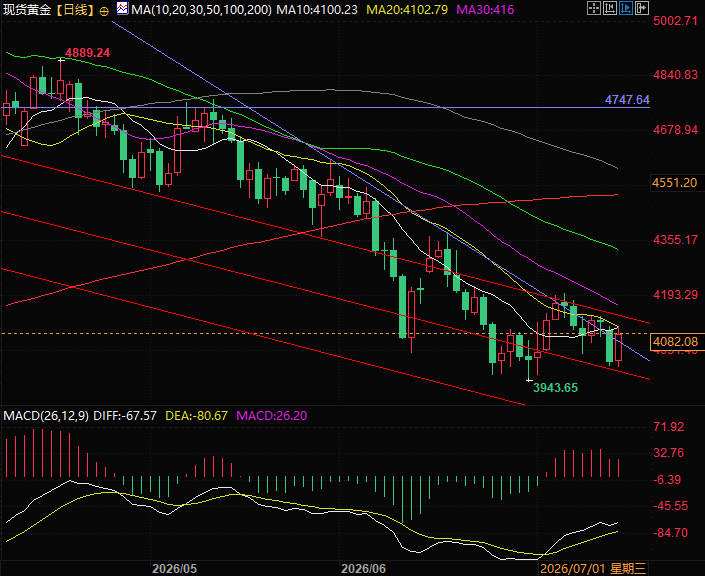 (Spot gold daily chart, source: EasyForex) At 16:04 Beijing time, spot gold is currently trading at $4024 per ounce.
Tensions between the US and Iran are escalating, but the US military continues to show strong signals of seeking peace talks.
Iran's Ministry of Health disclosed that the recent nighttime airstrikes alone injured more than 260 Iranians, indicating a significant increase in bombing intensity. When Trump officially announced the resumption of the lockdown on Monday, he initially planned to impose a 20% compensatory passage fee on ships transiting the Strait of Hormuz. However, due to demands from Gulf allies, he abandoned the fee plan, instead opting for a policy of hundreds of billions of dollars in Gulf state investment in the US. Strangely, the US simultaneously pressured Israel to withdraw its troops . According to Axios, citing US and Israeli officials, Trump called Netanyahu, demanding that Israeli troops gradually withdraw from Syrian-controlled areas and simultaneously reduce their troop presence in Lebanon. Trump believes that a long-term Israeli military presence would exacerbate regional tensions and increase the risk of conflict. However, Israel insists on its need for a border security buffer zone, and there are significant differences between the US-promoted bilateral security arrangements for Syria and Lebanon and the troop withdrawal timetable. Trump further tightened his military threats, stating in a Fox News interview on the 14th that if Iran refuses to return to the negotiating table, the US military will target Iranian bridges and power plants next week, launch large-scale airstrikes on the next two nights, and even consider deploying ground troops. US negotiators have warned Iran that failure to reach an agreement will result in devastating repercussions, and military action will continue until Trump deems the situation under control. He also described Iran as a resilient boxer, weakened but still capable of fighting back. This suggests that the US's renewed blockade and infrastructure strikes fall under the category of maximum pressure, while its demand for Israel to withdraw its troops represents a clear compromise. The US's goal remains to advance negotiations and force Iran to the negotiating table.Strait shipping disruptions put pressure on global energy circulation.
The US has threatened to use force to forcibly open the Strait of Hormuz, but industry analysts point out that complete control of the waterway would require a super-large fleet, or even tens of thousands of ground troops, making it extremely difficult in practice. Iran has clearly stated that as long as the US military continues its operations in the Middle East, Middle Eastern oil and gas exports will be completely disrupted, the resumption of navigation in the Strait of Hormuz will be indefinitely delayed, the risk of energy supply disruptions will continue to rise, global commodity risk premiums will increase, and shipping companies' hedging costs and tanker transportation costs will rise simultaneously.The probability of a rate hike in July has been significantly lowered, but the market is still betting on a rate hike this year.
The U.S. Labor Department's June CPI data significantly missed market expectations, drastically reducing the probability of a July rate hike. The CPI fell 0.4% month-on-month, the largest monthly drop since April 2020 and the first negative month-on-month growth in six years. The year-on-year CPI increase fell to 3.5% from 4.2% in May. The core CPI, excluding food and energy, remained flat month-on-month but rose 2.6% year-on-year, with a sharp decline in energy prices being the core driver of the inflation slowdown. The probability of a July rate hike in the interest rate swap market plummeted from 40% to 20%, postponing the first rate hike window. The probabilities of rate hikes in September and October remain at 60% and 80%, respectively. Zach Griffiths, head of macro strategy at CreditSights, analyzed that the June CPI essentially ruled out a July rate hike. Even with current inflation remaining high and the Middle East situation continuing to deteriorate, the weak data provides the Federal Reserve with ample room for maneuver. However, after the data release, Federal Reserve Chairman Warsh reiterated his zero-tolerance stance on high inflation and stated that he did not believe a single inflation report could indicate that inflation had been adjusted to the appropriate level. During his questioning on Capitol Hill, which lasted for more than two hours, Warsh answered numerous questions about independence, inflation, and other topics, but it was still unclear whether he supported raising interest rates.Summary and Technical Analysis:
Current gold price movements remain primarily influenced by data and geopolitical factors. On one hand, unexpectedly weaker-than-expected inflation data significantly reduced the likelihood of a short-term interest rate hike by the Federal Reserve, leading to a simultaneous weakening of US Treasury yields and the dollar, directly reducing the opportunity cost of holding gold and providing solid bullish support for gold prices. This is the core driving force behind the rapid rebound in precious metals after the data release. On the other hand, the escalating tensions between the US and Iran in the Middle East directly suppress gold prices. Pressure on the Strait of Hormuz has directly resulted in a sharp decline in the income of oil-producing countries and a loss of dollar reserves for energy-importing countries, indirectly leading to a stronger dollar and weaker gold prices. The market continues to follow the trading strategy of Trump puts, with the point of escalation of conflict often marking a temporary low for gold, while points of significant positive or negative easing become temporary highs due to the downward trend in gold prices. Technically, spot gold is facing continuous pressure from the fan-shaped area formed by the descending channel and the descending trend line. This pattern was highlighted to readers a month ago. Currently, the pattern is nearing its end, but no significant breakout has occurred. Furthermore, after breaking below the 0.618 Fibonacci retracement level, the rebound failed to hold, indicating a continued downward trend. Gold prices are likely to continue to fluctuate, searching for a bottom and awaiting a rebound opportunity. (Spot gold daily chart, source: EasyForex) At 16:04 Beijing time, spot gold is currently trading at $4024 per ounce.
- Risk Warning and Disclaimer
- The market involves risk, and trading may not be suitable for all investors. This article is for reference only and does not constitute personal investment advice, nor does it take into account certain users’ specific investment objectives, financial situation, or other needs. Any investment decisions made based on this information are at your own risk.