A weaker yen kept the euro strong against the yen, while tensions in the Middle East supported the euro, with the exchange rate holding steady above the 185 level.
2026-07-15 16:20:12
The euro/yen (EUR/JPY) pair retreated slightly from above 185.60 in early Asian and European trading on Wednesday, but remained generally strong. Despite some short-term profit-taking, bearish sentiment towards the yen still dominates the market, while the euro remains relatively firm amid escalating geopolitical risks.  The Japanese yen has been under continued pressure recently, primarily due to changes in expectations regarding Japanese pension fund investment policies. Market surveys indicate that the Japanese Ministry of Finance has no immediate plans to push for large-scale withdrawals of overseas investments and reallocation of assets from major pension funds, including the Government Pension Investment Fund (GPIF), back to domestic assets. This contrasts with previous market expectations and weakens the yen's upward momentum. Previously, Finance Minister Satsuki Katayama stated that the government would encourage Japanese pension funds to increase their domestic asset allocation to attract overseas funds back to Japan, which initially boosted the yen significantly. However, the latest news suggests that this adjustment process may take several months or even longer to gradually implement, leading the market to rebuild short positions in the yen and causing it to weaken again. Meanwhile, the euro has remained generally stable. Recent escalation of tensions between the US and Iran, with the US continuing operations against Iranian military targets and warning of potential expansion, while Iran has indicated it may take further measures in response and threatened to affect more important energy transport routes, has created market concerns about new uncertainties in global energy supply, keeping international oil prices at near one-month highs. Rising energy prices have also renewed market focus on Eurozone inflation. Investors believe that if international oil prices remain high for an extended period, the pace of inflation decline in the Eurozone may slow, increasing the likelihood that the European Central Bank (ECB) will maintain a tight monetary policy, thus providing some support for the euro. Martin Koch, ECB official and Governor of the Austrian Central Bank, recently stated that the Eurozone has not yet experienced a significant second round of inflation, but the ECB will continue to take necessary measures to ensure that inflation eventually falls back to the 2% target level. Since this statement was largely in line with market expectations, its impact on the euro exchange rate was relatively limited. The market will continue to focus on the ECB's future policy path and whether the Japanese government will introduce new measures to support the yen. If the ECB maintains a hawkish stance and the Bank of Japan maintains its accommodative policy pace, the euro/yen exchange rate is expected to remain strong; conversely, if the Japanese government strengthens exchange rate intervention or accelerates capital repatriation, it may limit further appreciation of the exchange rate. From a technical perspective, the euro/yen exchange rate remains in an overall upward trend on the daily chart, with the price continuing to trade above major moving averages, and the bullish trend has not yet been broken. The exchange rate is currently consolidating around 185.40 , with the first resistance level to watch at 185.60 . A decisive break above this level could lead to further challenges towards 186.80 and the previous high of 187.95 . Initial support is at 185.00 , with further support around 183.80 . Daily momentum remains positive, with bulls still holding a slight advantage. The 4-hour chart shows the EUR/JPY pair consolidating at higher levels in the short term, with the moving average system continuing its bullish alignment. However, as the exchange rate approaches recent highs, short-term momentum has slightly slowed. If the exchange rate regains a foothold above 185.60 , it is expected to open up further upside potential; a break below 185.00 could lead to a retest of the 183.80 support area, but the overall bullish trend is expected to continue.
 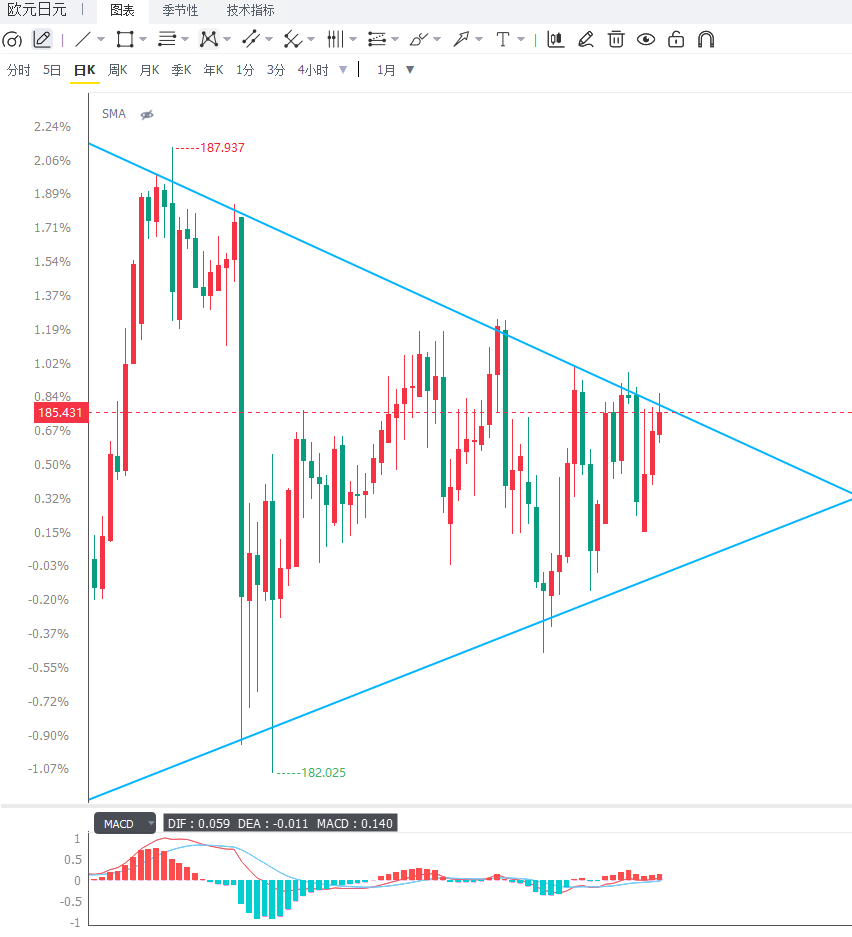 Editor's Summary: The euro continued its strength against the yen this week, primarily driven by easing expectations of Japanese pension fund repatriation and relatively stable monetary policy expectations in the Eurozone. Meanwhile, escalating tensions in the Middle East and rising international oil prices also strengthened market expectations that the European Central Bank would maintain a tight monetary policy, providing support for the euro. In the short term, Japanese policy developments, speeches by European Central Bank officials, and the global geopolitical situation will remain the core factors influencing the exchange rate. If the euro successfully breaks through the key resistance level near 185.60, it is expected to further challenge historical highs; if Japan releases more positive signals supporting the yen, the exchange rate may enter a period of high-level consolidation.
The Japanese yen has been under continued pressure recently, primarily due to changes in expectations regarding Japanese pension fund investment policies. Market surveys indicate that the Japanese Ministry of Finance has no immediate plans to push for large-scale withdrawals of overseas investments and reallocation of assets from major pension funds, including the Government Pension Investment Fund (GPIF), back to domestic assets. This contrasts with previous market expectations and weakens the yen's upward momentum. Previously, Finance Minister Satsuki Katayama stated that the government would encourage Japanese pension funds to increase their domestic asset allocation to attract overseas funds back to Japan, which initially boosted the yen significantly. However, the latest news suggests that this adjustment process may take several months or even longer to gradually implement, leading the market to rebuild short positions in the yen and causing it to weaken again. Meanwhile, the euro has remained generally stable. Recent escalation of tensions between the US and Iran, with the US continuing operations against Iranian military targets and warning of potential expansion, while Iran has indicated it may take further measures in response and threatened to affect more important energy transport routes, has created market concerns about new uncertainties in global energy supply, keeping international oil prices at near one-month highs. Rising energy prices have also renewed market focus on Eurozone inflation. Investors believe that if international oil prices remain high for an extended period, the pace of inflation decline in the Eurozone may slow, increasing the likelihood that the European Central Bank (ECB) will maintain a tight monetary policy, thus providing some support for the euro. Martin Koch, ECB official and Governor of the Austrian Central Bank, recently stated that the Eurozone has not yet experienced a significant second round of inflation, but the ECB will continue to take necessary measures to ensure that inflation eventually falls back to the 2% target level. Since this statement was largely in line with market expectations, its impact on the euro exchange rate was relatively limited. The market will continue to focus on the ECB's future policy path and whether the Japanese government will introduce new measures to support the yen. If the ECB maintains a hawkish stance and the Bank of Japan maintains its accommodative policy pace, the euro/yen exchange rate is expected to remain strong; conversely, if the Japanese government strengthens exchange rate intervention or accelerates capital repatriation, it may limit further appreciation of the exchange rate. From a technical perspective, the euro/yen exchange rate remains in an overall upward trend on the daily chart, with the price continuing to trade above major moving averages, and the bullish trend has not yet been broken. The exchange rate is currently consolidating around 185.40 , with the first resistance level to watch at 185.60 . A decisive break above this level could lead to further challenges towards 186.80 and the previous high of 187.95 . Initial support is at 185.00 , with further support around 183.80 . Daily momentum remains positive, with bulls still holding a slight advantage. The 4-hour chart shows the EUR/JPY pair consolidating at higher levels in the short term, with the moving average system continuing its bullish alignment. However, as the exchange rate approaches recent highs, short-term momentum has slightly slowed. If the exchange rate regains a foothold above 185.60 , it is expected to open up further upside potential; a break below 185.00 could lead to a retest of the 183.80 support area, but the overall bullish trend is expected to continue. Editor's Summary: The euro continued its strength against the yen this week, primarily driven by easing expectations of Japanese pension fund repatriation and relatively stable monetary policy expectations in the Eurozone. Meanwhile, escalating tensions in the Middle East and rising international oil prices also strengthened market expectations that the European Central Bank would maintain a tight monetary policy, providing support for the euro. In the short term, Japanese policy developments, speeches by European Central Bank officials, and the global geopolitical situation will remain the core factors influencing the exchange rate. If the euro successfully breaks through the key resistance level near 185.60, it is expected to further challenge historical highs; if Japan releases more positive signals supporting the yen, the exchange rate may enter a period of high-level consolidation.
- Risk Warning and Disclaimer
- The market involves risk, and trading may not be suitable for all investors. This article is for reference only and does not constitute personal investment advice, nor does it take into account certain users’ specific investment objectives, financial situation, or other needs. Any investment decisions made based on this information are at your own risk.