What signal is the Bank of Canada sending after six consecutive interest rate freezes? Analysis of short-term fluctuations in the Canadian dollar.
2026-07-15 21:56:12
On Wednesday (July 15), the Bank of Canada announced at 21:45 Beijing time that it would maintain its overnight interest rate at 2.25%, in line with widespread market expectations. This marks the sixth consecutive day the bank has held rates steady, having already lowered them to current levels through last year's aggressive easing cycle. The USD/CAD pair rose 0.02% in the short term, trading at 1.4063. [Image link: https://upload.fx678img.com/upload/ht/20240626/2024062616521894.png]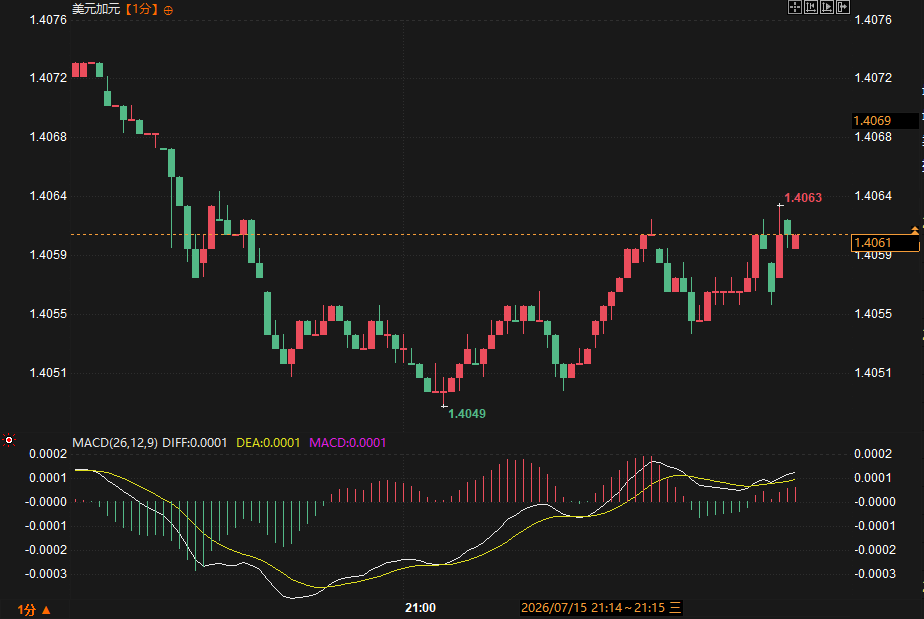
Market Background
Prior to the decision, market expectations were largely aligned that the Bank of Canada would maintain interest rates. Institutions generally believed that keeping rates unchanged was a rational choice given the signs of improving economic growth but short-term inflation fluctuations due to energy prices. The Canadian dollar remained relatively stable before the decision, with USD/CAD fluctuating around a key range. After the announcement, USD/CAD rose slightly, reflecting the market's immediate interpretation of the economic growth outlook and inflation path outlined in the statement.Deep interconnect analysis
The Bank of Canada's statement noted that the Canadian economy is showing signs of improvement, with growth momentum strengthening, consumer spending remaining robust, and the sources of economic growth broadening. The bank slightly raised its growth forecasts for 2027 and 2028, but lowered its 2026 growth forecast to 0.7%, while raising its 2026 inflation forecast to 2.5%. The statement emphasized that recent changes in gasoline prices have made short-term inflation expectations sensitive, but long-term inflation expectations remain well anchored; cost pressures related to the Russia-Ukraine situation are still being passed on to some consumer prices, but this has been offset by downward pressure from economic slack, and overall uncertainty remains high. From a fundamental perspective, this decision continued the cautious and balanced tone, acknowledging positive signs of economic recovery while maintaining vigilance regarding inflation risks. This contrasts with historical trends: after a significant rate-cutting cycle last year, the Bank of Canada entered a period of observation, and this latest six-time unchanged rate reinforces its "data-dependent" policy path. Latest quotes show a slight increase in USD/CAD, indicating that the market views the statement as generally neutral to slightly cautious, putting some pressure on the Canadian dollar, but without triggering significant volatility. Leading institutions largely shared a consistent view before and after the decision, believing that maintaining interest rates was in line with expectations, focusing on the statement's guidance on the future path. Some institutions pointed out in advance that if the language did not clearly shift towards a hawkish stance, the Canadian dollar might maintain range-bound trading. Retail investors, however, focused more on immediate sentiment: before the decision, there was much discussion about the potential support for the Canadian dollar from hawkish signals; after the decision, some views shifted to focusing on the long-term support that improved economic growth might bring, but in the short term, energy prices remained a variable. Overall, the expectations of institutions and retail investors differed little, with the main disagreement lying in the assessment of the sustainability of inflation transmission. The market quickly digested the decision, and sentiment stabilized. Technically, USD/CAD tested the upper limit of the recent range in the short term, indicating that bullish momentum had been released to some extent, but the magnitude was limited. In the long term, if economic growth continues to improve and the interest rate path remains stable, it may support the Canadian dollar; in the short term, it will maintain a range-bound pattern due to the uncertainties in the statement.Trend Outlook
Considering both fundamentals and market reaction, the Bank of Canada's decision did not change its neutral policy framework. Future market movements will largely depend on subsequent economic data and energy price trends. If signals of expanding consumer spending and growth continue to materialize, USD/CAD may face some downward pressure; conversely, if short-term inflation expectations rise again, the relative strength of the US dollar may continue. Overall, short-term trading is expected to be volatile, while medium-term focus will be on data-driven gradual adjustments.Frequently Asked Questions
Q: What were the main reasons the Bank of Canada kept interest rates unchanged this time? A: Primarily based on signs of improving economic growth, robust consumer spending, and while inflation has experienced short-term fluctuations, long-term expectations remain well anchored. The bank believes the current policy rate is appropriate to support economic recovery, but uncertainty remains high, requiring continued data monitoring. Q: What was the immediate impact of the decision on the USD/CAD exchange rate? A: After the announcement, USD/CAD rose approximately 0.02% to around 1.4063, reflecting a neutral interpretation of the growth outlook and inflation path in the statement, without a significant one-sided movement. Q: What are the differences between institutional and retail investor views? A: Institutional views were consistent, focusing on meeting expectations and future guidance; retail investors were more concerned with short-term sentiment and energy price variables, with some shifting to acknowledging the improving economic growth signals after the decision, but the overall deviation was not significant. Q: How will this decision affect the long-term logic of the Canadian dollar? A: If the sources of economic growth continue to broaden and inflation gradually declines, the Canadian dollar may find support; the current statement lowered the 2026 growth forecast but raised the inflation forecast, meaning that long-term data verification is still needed, and the policy path remains flexible. Q: What factors should we focus on to determine the next policy direction? A: We need to pay attention to the actual transmission of gasoline prices to inflation, the verification of economic growth data, consumer spending trends, and changes in global uncertainties. The bank has explicitly stated that it will adjust its stance based on the data.- Risk Warning and Disclaimer
- The market involves risk, and trading may not be suitable for all investors. This article is for reference only and does not constitute personal investment advice, nor does it take into account certain users’ specific investment objectives, financial situation, or other needs. Any investment decisions made based on this information are at your own risk.