Gold Trading Alert: Unexpected PPI Decline Meets Middle East Powder Keg; Bulls and Bears Tug-of-War Above $4000; Watch for "Terrifying Data"
2026-07-16 07:18:11
On Wednesday (July 15), the US June Producer Price Index (PPI) unexpectedly fell 0.3%, far below market expectations. This data quickly eased investors' concerns about aggressive interest rate hikes by the Federal Reserve, pushing gold prices up to around $4,080 at one point. Gold prices then fluctuated widely, ultimately closing up 0.2% at $4,060 per ounce. Although US gold futures closed slightly lower, overall market sentiment shifted from cautious in the morning to cautiously optimistic. Meanwhile, the situation in the Middle East escalated sharply, with the US launching a new round of airstrikes against Iran and oil prices approaching a one-month high. This geopolitical storm is providing new safe-haven support for gold, but also bringing complex inflationary variables. On Thursday (July 16) in early Asian trading, spot gold fluctuated narrowly, currently trading around $4,060 per ounce. 
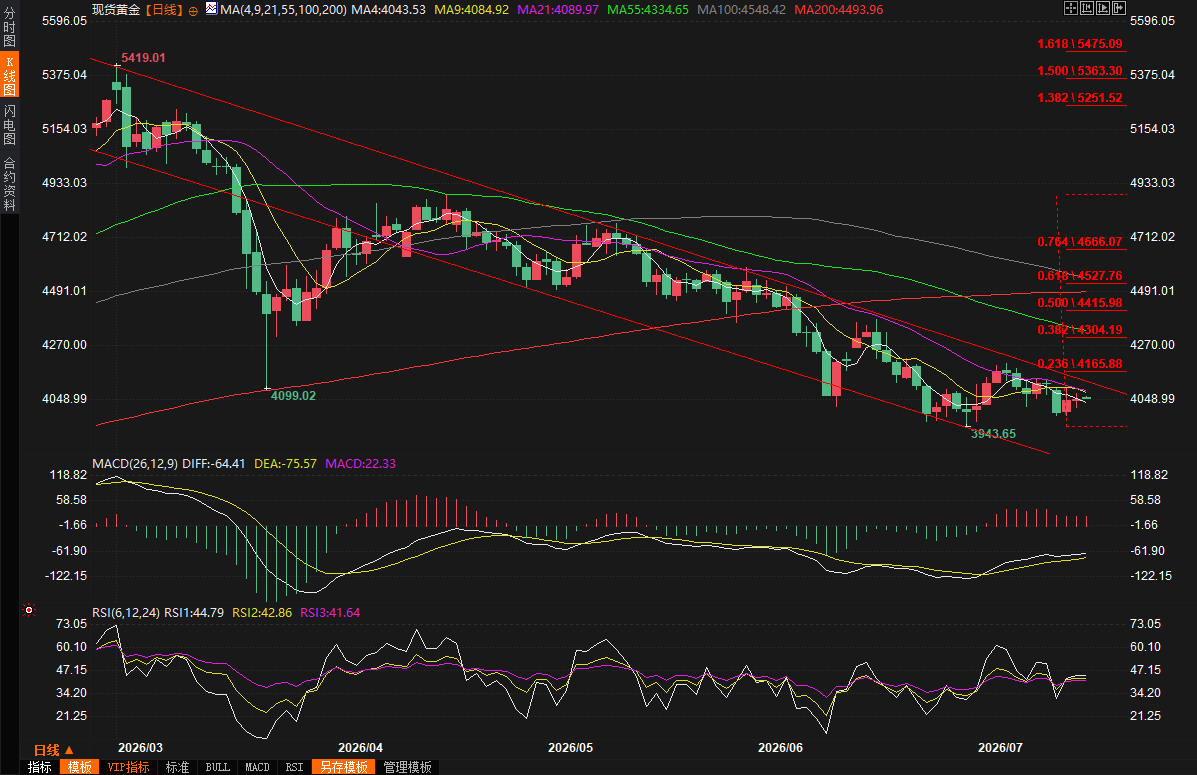 (Spot gold daily chart, source: EasyTrade) At 07:13 Beijing time, spot gold is currently trading at $4060.12 per ounce.
PPI data cooled: Pressure on the Fed to raise rates eased sharply, giving gold some breathing room.
The latest PPI data released by the U.S. Bureau of Labor Statistics showed that the final demand producer price index fell 0.3% month-on-month in June, while the May data was revised to a 0.6% increase. Economists had generally predicted that the June PPI would remain flat, and this unexpected positive development directly reversed the market's persistently pessimistic expectations for inflation. Following Tuesday's release of a slowing Consumer Price Index (CPI) signal, two consecutive sets of weaker inflation data provided a sigh of relief to investors. The CME Group's FedWatch tool showed that the probability of a rate hike at the Fed's July meeting further decreased from 16.6% before the data release to 10.2%. Traders' concerns about multiple rate hikes this year have clearly eased. Phillip Streible, chief market strategist at Blue Line Futures, pointed out that gold recovered some of its earlier losses precisely because of the lower-than-expected PPI. As a non-interest-bearing asset, gold typically faces pressure in a high-interest-rate environment, and the cooling inflation expectations directly benefit its performance. The dollar index also fell 0.55% to 100.36, its lowest level since mid-June. The bond market reacted in unison, with the 10-year Treasury yield falling 4 basis points to 4.545%, and the two-year yield experiencing an even more significant decline. This series of chain reactions has created a favorable monetary policy environment for gold. Officials, including New York Fed President Williams, have also stated that inflation may have peaked and that current policy is in a favorable position, further reinforcing market expectations that the Fed will remain on hold.Escalating tensions in the Middle East: A dual struggle between safe-haven demand and oil price inflation risks.
However, the rebound in gold prices was not without its challenges. Geopolitical tensions in the Middle East once again became the dominant factor. Following the reimposition of a naval blockade on Iranian ports, the United States launched a new round of airstrikes against Iranian coastal defense facilities and missile bases. Iran responded strongly, threatening to cut off more energy exports from the region and declaring that it was waging a "war for the survival of the nation" with the United States. The Strait of Hormuz, a vital global oil shipping route, once again became the focus. Before the war, approximately one-fifth of global oil and gas shipments relied on this strait. The escalating conflict directly pushed up oil prices, with Brent crude closing at $84.95 per barrel on Wednesday, a one-month high. US crude futures also rose slightly. Although data from the US Energy Information Administration showed a decrease of 1.7 million barrels in crude oil inventories last week (lower than expected), geopolitical risk premiums dominated market sentiment. Goldman Sachs even warned that if exports from the Gulf region remain sluggish, Brent crude could break through $110 in the fourth quarter. FXTM senior research analyst Lukman Otunuga analyzed that the situation surrounding the Strait of Hormuz has once again raised concerns in the market about uncontrolled price pressures. If escalating tensions lead to a sustained rise in oil prices, it could offset the recent slowdown in inflation, prompting central banks to maintain high interest rates for a longer period, thus diminishing the appeal of gold. On the other hand, the geopolitical conflict itself strengthens gold's status as a traditional safe-haven asset, especially given the weakening of the US dollar, which, while possessing safe-haven attributes, is being dragged down by inflation data. The Trump administration's statements have also added uncertainty. On the one hand, he optimistically stated that Iran "extremely desires reconciliation" and hinted that negotiations are still ongoing; on the other hand, he strongly declared that "Iran will be defeated soon." With the ceasefire agreement stalled and the Iranian Foreign Ministry clearly stating that the focus remains on defense, hopes for a short-term de-escalation have become increasingly slim.Technical factors and multiple other factors intertwine: Gold faces short-term support test.
From a technical perspective, gold prices are currently finding some support near the $4,000 mark. Analysts point out that if the $4,000 level holds, gold is expected to rebound and test the $4,100 area; however, if it breaks down clearly, it may fall to $3,950, or even further test the $3,000 level. Currently, gold prices are showing a volatile rebound under the dual influence of positive PPI and geopolitical risks, and the short-term direction still depends on further developments in the Middle East. A weaker dollar provides additional support for gold, while the slowdown in economic growth in major Asian countries to 4.3% in the second quarter has also stimulated market expectations for policy easing, indirectly benefiting commodities. Within the Federal Reserve, although hawkish officials remain vigilant, a consensus is forming that inflation has peaked. However, market bets on a September rate hike remain around 50%, indicating that investors have not completely relaxed their guard.Outlook: Gold bulls should remain wary of recurring inflation; geopolitical risks may be the biggest variable.
In summary, cooling US inflation data provides solid fundamental support for gold, while escalating conflicts in the Middle East inject strong safe-haven momentum. In the short term, gold prices are expected to maintain strong fluctuations within the $4000-$4100 range. However, investors must closely monitor two major risks: first, if oil prices remain high, they may reignite inflation expectations, limiting gold's upside potential; second, if the US-Iran conflict unexpectedly eases or a new agreement is reached, oil prices may fall sharply, alleviating inflation concerns, which could provide a new round of upward momentum for gold prices. For gold investors, the current environment is full of both opportunities and challenges. The positive effects of PPI data may continue to unfold in the coming weeks, while any movement in the Strait of Hormuz could trigger significant gold price fluctuations. Against the backdrop of increased global uncertainty, gold's role as a wealth preservation tool remains prominent. Investors are advised to maintain a flexible strategy, pay attention to subsequent statements from Federal Reserve officials and the latest developments in the Middle East, and manage risks effectively. Overall, despite increased short-term volatility, gold is expected to maintain a relatively strong performance amidst the dual narratives of easing inflation and geopolitical risks. Today's trading session will focus on the US initial jobless claims for the week ending July 6 and the US June retail sales month-on-month rate (commonly known as "the terror data"), which investors should pay close attention to. (Spot gold daily chart, source: EasyTrade) At 07:13 Beijing time, spot gold is currently trading at $4060.12 per ounce.- Risk Warning and Disclaimer
- The market involves risk, and trading may not be suitable for all investors. This article is for reference only and does not constitute personal investment advice, nor does it take into account certain users’ specific investment objectives, financial situation, or other needs. Any investment decisions made based on this information are at your own risk.