Crude oil trading alert: Oil prices rebounded to a near one-month high, but a short-term bullish reversal has not yet formed; be wary of a pullback.
2026-07-16 09:26:16
WTI crude oil extended its gains in Asian trading on Thursday, hovering around $80 and hitting its highest level in nearly a month. This price increase was primarily driven by escalating geopolitical risks, with the market reassessing the stability of oil supplies in the Middle East and investors increasing their allocation to risk premiums in energy assets.  The U.S. Central Command stated that the U.S. military recently launched multiple strikes against Iranian coastal military targets, with one of the key focuses being maintaining the safety of shipping in the Strait of Hormuz. The market is focused on the fact that this strait plays a crucial role in global energy transportation, and any escalation of transportation risks could impact international crude oil supply expectations. As a critical global energy transport route, the stability of the Strait of Hormuz directly affects risk sentiment in the global crude oil market. The U.S. stated that the actions are aimed at ensuring the smooth flow of vital shipping routes. Investors are closely monitoring subsequent developments, as further escalation of regional tensions could lead to delays in some crude oil shipments and increase market concerns about supply disruptions. U.S. President Trump stated that when asked whether he would set a timeline for further action against Iran, he did not favor setting a specific deadline. This statement increased market uncertainty regarding the duration of the situation and prompted the energy market to re-induce risk factors. In addition to geopolitical factors, declining U.S. crude oil inventories also provided additional support for oil prices. Data released by the U.S. Energy Information Administration (EIA) showed that U.S. commercial crude oil inventories fell by approximately 1.693 million barrels in the week ending July 10, compared with a decrease of approximately 2.998 million barrels in the previous week. The market had previously expected a decrease of approximately 2.6 million barrels. The continued decline in U.S. crude oil inventories indicates a slight easing of short-term supply pressure, while increased exports and improved refinery capacity utilization have improved expectations for crude oil demand. Following the release of the inventory data, market attention to the fundamentals of U.S. crude oil has increased. Recently, U.S. refinery activity has remained at a high level, and demand for refined products continues to be supported by the summer travel season. At the same time, the recovery in crude oil exports has also reduced the pressure of domestic inventory accumulation, providing fundamental support for the rise in WTI prices. However, further increases in oil prices still face certain limitations. On the one hand, the global economic growth outlook remains uncertain, and weak manufacturing activity in some economies may affect energy consumption expectations; on the other hand, if there are signs of easing in the Middle East situation, the supply risk premium previously accumulated in the market may fall rapidly. Currently, investors are focusing on two key factors: first, whether the situation in the Middle East continues to affect the security of crude oil transportation; and second, subsequent changes in U.S. inventories and the performance of global crude oil demand. If supply risks continue to escalate while inventories maintain a downward trend, WTI oil prices may test higher levels further. From a daily chart perspective, WTI crude oil recently ended its previous consolidation phase, regaining its position above short-term moving averages and trading above $79, with an overall upward bias. Current market momentum is clearly strengthening, with the MACD indicator gradually widening upwards, indicating a recovery in bullish strength; meanwhile, the 60-day moving average has formed a significant support area. If oil prices can stably break through the $80 mark, they may further test the resistance near $82. Support levels to watch are $78 and $75; a break below $75 could damage the short-term rebound structure. From a 4-hour chart perspective, WTI prices maintain an upward channel, with short-term moving averages showing a bullish alignment and the RSI indicator remaining in a strong zone, indicating that buying pressure still dominates. However, after a rapid price increase, there is a risk of profit-taking in the short term. If prices fail to effectively break through the resistance near $80, a pullback to the $78 area to confirm support is possible. If the market continues to be driven by geopolitical risks and breaks through $80, short-term upside potential may open up, with the next target area to watch being around $82 to $83.
 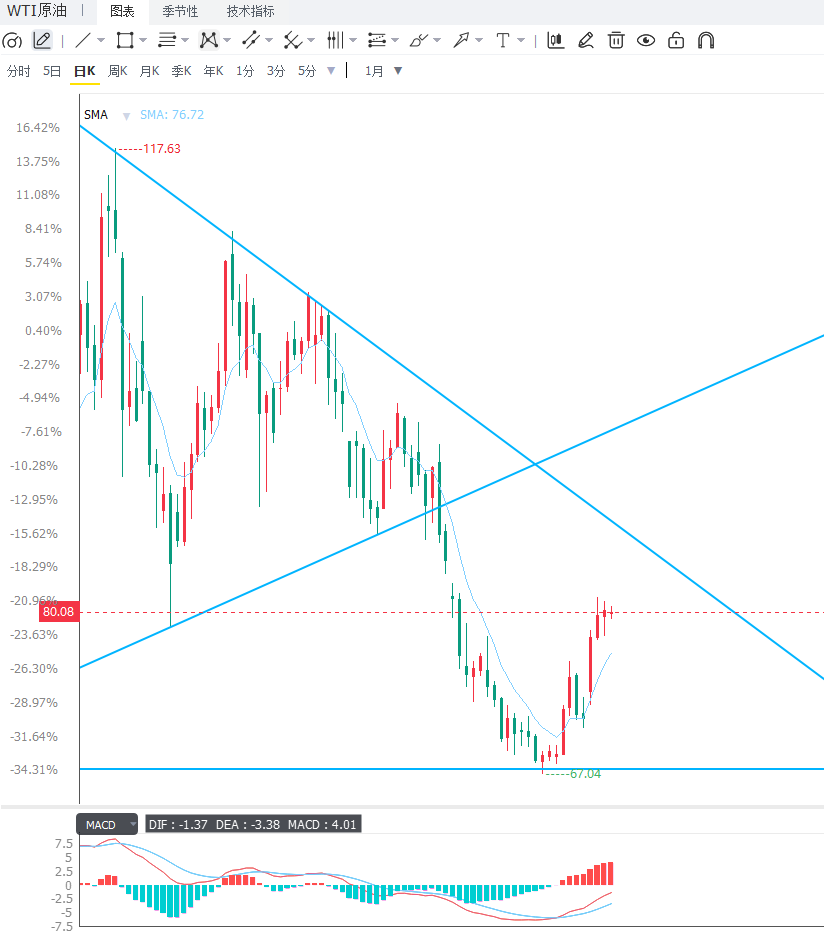 The recent rise in WTI crude oil prices is primarily driven by two factors: geopolitical risks and declining US inventories. Escalating tensions in the Middle East have increased market concerns about supply disruptions, while continued declines in US crude oil inventories have reinforced expectations of a tight supply-demand balance in the short term. Future oil price movements will still depend on regional developments and the recovery of global oil demand. In the medium to long term, if supply risks persist, crude oil prices may remain highly volatile; however, if these risks gradually subside, insufficient demand growth could limit further price increases. Investors should pay close attention to changes in the supply side, US inventory data, and breakouts at key technical levels to identify signals of a market trend reversal.
The U.S. Central Command stated that the U.S. military recently launched multiple strikes against Iranian coastal military targets, with one of the key focuses being maintaining the safety of shipping in the Strait of Hormuz. The market is focused on the fact that this strait plays a crucial role in global energy transportation, and any escalation of transportation risks could impact international crude oil supply expectations. As a critical global energy transport route, the stability of the Strait of Hormuz directly affects risk sentiment in the global crude oil market. The U.S. stated that the actions are aimed at ensuring the smooth flow of vital shipping routes. Investors are closely monitoring subsequent developments, as further escalation of regional tensions could lead to delays in some crude oil shipments and increase market concerns about supply disruptions. U.S. President Trump stated that when asked whether he would set a timeline for further action against Iran, he did not favor setting a specific deadline. This statement increased market uncertainty regarding the duration of the situation and prompted the energy market to re-induce risk factors. In addition to geopolitical factors, declining U.S. crude oil inventories also provided additional support for oil prices. Data released by the U.S. Energy Information Administration (EIA) showed that U.S. commercial crude oil inventories fell by approximately 1.693 million barrels in the week ending July 10, compared with a decrease of approximately 2.998 million barrels in the previous week. The market had previously expected a decrease of approximately 2.6 million barrels. The continued decline in U.S. crude oil inventories indicates a slight easing of short-term supply pressure, while increased exports and improved refinery capacity utilization have improved expectations for crude oil demand. Following the release of the inventory data, market attention to the fundamentals of U.S. crude oil has increased. Recently, U.S. refinery activity has remained at a high level, and demand for refined products continues to be supported by the summer travel season. At the same time, the recovery in crude oil exports has also reduced the pressure of domestic inventory accumulation, providing fundamental support for the rise in WTI prices. However, further increases in oil prices still face certain limitations. On the one hand, the global economic growth outlook remains uncertain, and weak manufacturing activity in some economies may affect energy consumption expectations; on the other hand, if there are signs of easing in the Middle East situation, the supply risk premium previously accumulated in the market may fall rapidly. Currently, investors are focusing on two key factors: first, whether the situation in the Middle East continues to affect the security of crude oil transportation; and second, subsequent changes in U.S. inventories and the performance of global crude oil demand. If supply risks continue to escalate while inventories maintain a downward trend, WTI oil prices may test higher levels further. From a daily chart perspective, WTI crude oil recently ended its previous consolidation phase, regaining its position above short-term moving averages and trading above $79, with an overall upward bias. Current market momentum is clearly strengthening, with the MACD indicator gradually widening upwards, indicating a recovery in bullish strength; meanwhile, the 60-day moving average has formed a significant support area. If oil prices can stably break through the $80 mark, they may further test the resistance near $82. Support levels to watch are $78 and $75; a break below $75 could damage the short-term rebound structure. From a 4-hour chart perspective, WTI prices maintain an upward channel, with short-term moving averages showing a bullish alignment and the RSI indicator remaining in a strong zone, indicating that buying pressure still dominates. However, after a rapid price increase, there is a risk of profit-taking in the short term. If prices fail to effectively break through the resistance near $80, a pullback to the $78 area to confirm support is possible. If the market continues to be driven by geopolitical risks and breaks through $80, short-term upside potential may open up, with the next target area to watch being around $82 to $83. The recent rise in WTI crude oil prices is primarily driven by two factors: geopolitical risks and declining US inventories. Escalating tensions in the Middle East have increased market concerns about supply disruptions, while continued declines in US crude oil inventories have reinforced expectations of a tight supply-demand balance in the short term. Future oil price movements will still depend on regional developments and the recovery of global oil demand. In the medium to long term, if supply risks persist, crude oil prices may remain highly volatile; however, if these risks gradually subside, insufficient demand growth could limit further price increases. Investors should pay close attention to changes in the supply side, US inventory data, and breakouts at key technical levels to identify signals of a market trend reversal.
- Risk Warning and Disclaimer
- The market involves risk, and trading may not be suitable for all investors. This article is for reference only and does not constitute personal investment advice, nor does it take into account certain users’ specific investment objectives, financial situation, or other needs. Any investment decisions made based on this information are at your own risk.