Cooling US PPI weakens expectations of interest rate hikes; gold remains range-bound at low levels.
2026-07-16 09:42:11
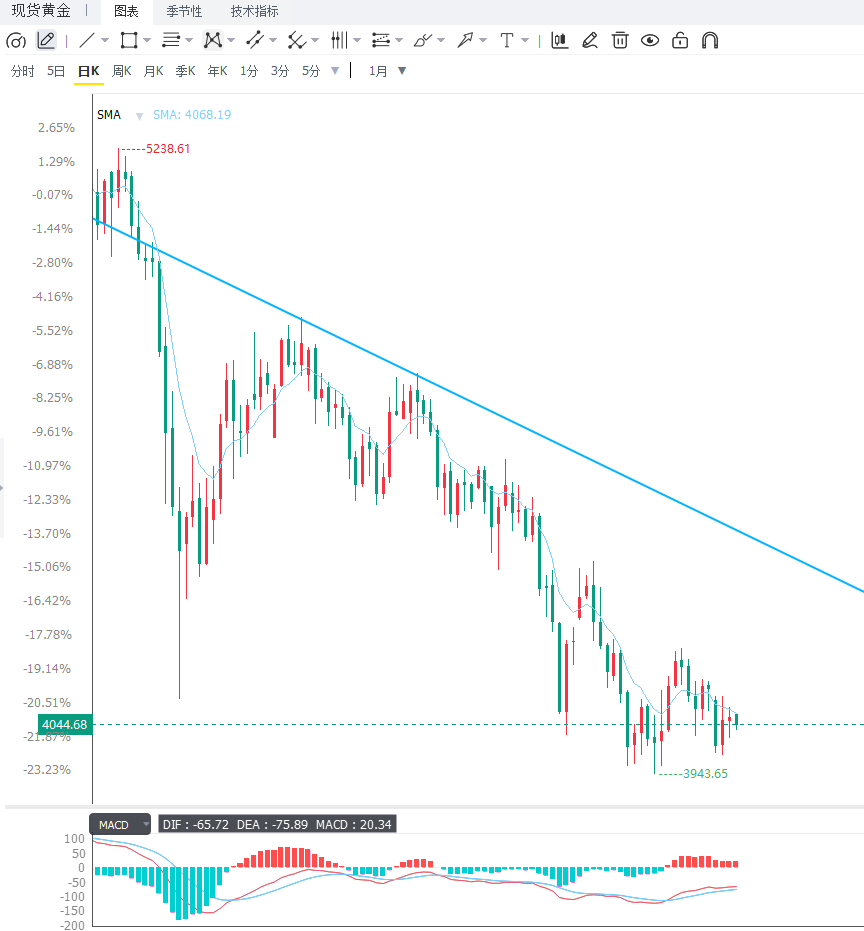
International gold prices fluctuated slightly during Asian trading on Thursday, with spot gold (XAU/USD) trading around $4050, continuing its previous low-level consolidation. The main factor driving gold prices higher was further cooling of US inflation data, leading the market to readjust its expectations for the Federal Reserve's future monetary policy path and reducing interest rate pressures on gold.  Data released by the U.S. Bureau of Labor Statistics showed that the U.S. Producer Price Index (PPI) rose 5.5% year-on-year in June, lower than the revised 6.0% in May and the market's previous expectation of 6.2%. Meanwhile, the June PPI fell 0.3% month-on-month, significantly weaker than the revised 0.6% growth in May, but better than the market's previous expectation of flat growth. The significant slowdown in U.S. producer inflation strengthened market expectations that the Federal Reserve would maintain stable interest rates, reducing the risk of gold being pressured by a high-interest-rate environment. After the data release, market expectations for a rate hike at the Fed's July policy meeting further declined. According to market data, traders now expect a 10.2% probability of a rate hike in July, lower than the 16.6% before the data release. Previously, U.S. consumer inflation data for June also fell short of expectations, further reinforcing the market's judgment that future monetary policy would shift more cautiously. Philip Streibull, chief market strategist at Blue Line Futures, said that the previous decline in gold prices had eased, mainly due to the lower-than-expected PPI, which reduced market concerns about multiple Fed rate hikes this year. Investors increased their gold holdings again, providing short-term support for precious metal prices. However, the upside potential for gold is still constrained by other factors. Recent escalation of tensions between the US and Iran has led to rising oil prices due to regional conflicts. Rising energy prices could reignite inflationary pressures, prompting some central banks to maintain higher interest rates for an extended period. For gold, as a non-yielding asset, the high-interest-rate environment will continue to diminish its investment appeal. The market is closely watching the impact of energy price changes on global inflation expectations. If oil prices continue to rise and drive up inflationary pressures, the Federal Reserve's pace of interest rate cuts may be limited, thus putting downward pressure on gold. Meanwhile, the situation in the Middle East remains a crucial variable affecting gold. The US has recently taken further military action against Iranian targets, with President Trump stating that the US might take stronger measures if Iran does not resume negotiations. Iran, on the other hand, has stated that it has no reason to continue adhering to existing agreements if they do not bring tangible benefits. Geopolitical risks typically increase demand for gold as a safe haven, but if risk factors primarily affect the market by driving up energy prices, it could create a two-way impact. On the one hand, safe-haven funds flow into gold; on the other hand, inflationary pressures may keep interest rates high, thus limiting gold's valuation growth. Currently, the market focus is on future Federal Reserve policy signals, US inflation trends, and changes in global risk events. If subsequent economic data continues to show a slow decline in inflation, gold may gain further upward momentum; however, if energy prices drive inflation back up, the gold price rebound may be suppressed. From a daily chart perspective, spot gold recently rebounded after finding support near $4000, returning above $4050, indicating a slight improvement in the short-term trend. Currently, gold remains in a high-level consolidation structure, with the MACD indicator gradually converging at low levels, suggesting that bearish momentum has weakened and bulls are attempting to regain control. Key resistance to watch is around $4100; a successful break above this level could open up further upside potential, with the next target around $4150. Support lies at the $4020 and $4000 levels; a break below $4000 could lead to a retest of the $3950 area. From a 4-hour chart perspective, gold prices have formed a rebound channel, short-term moving averages are starting to turn upwards, and the RSI indicator has risen to a slightly bullish zone, indicating increased short-term buying pressure. However, the $4060-$4080 area still presents some resistance, and a technical pullback may occur if prices fail to break through. If gold can hold above $4050 and break through the resistance near $4080, it may continue to challenge $4100 in the short term; conversely, a drop below $4020 could increase downward pressure.
  Editor's Summary: The current rise in gold prices is primarily driven by cooling US inflation and declining expectations of further Fed rate hikes, with market expectations for a future shift in monetary policy strengthening. Meanwhile, global risk factors continue to provide safe-haven support for gold, maintaining its resilience. However, the future direction of gold will depend on the balance between inflation and interest rates. If US economic data continues to support expectations of looser monetary policy, gold may continue its rebound; but if rising energy prices reignite inflationary pressures, the Fed may extend the period of high interest rates, limiting the upside potential for gold. The market is currently in a phase influenced by policy expectations, inflation changes, and safe-haven demand. Investors should pay attention to breakouts at key technical levels and seize opportunities arising from trend changes.
Data released by the U.S. Bureau of Labor Statistics showed that the U.S. Producer Price Index (PPI) rose 5.5% year-on-year in June, lower than the revised 6.0% in May and the market's previous expectation of 6.2%. Meanwhile, the June PPI fell 0.3% month-on-month, significantly weaker than the revised 0.6% growth in May, but better than the market's previous expectation of flat growth. The significant slowdown in U.S. producer inflation strengthened market expectations that the Federal Reserve would maintain stable interest rates, reducing the risk of gold being pressured by a high-interest-rate environment. After the data release, market expectations for a rate hike at the Fed's July policy meeting further declined. According to market data, traders now expect a 10.2% probability of a rate hike in July, lower than the 16.6% before the data release. Previously, U.S. consumer inflation data for June also fell short of expectations, further reinforcing the market's judgment that future monetary policy would shift more cautiously. Philip Streibull, chief market strategist at Blue Line Futures, said that the previous decline in gold prices had eased, mainly due to the lower-than-expected PPI, which reduced market concerns about multiple Fed rate hikes this year. Investors increased their gold holdings again, providing short-term support for precious metal prices. However, the upside potential for gold is still constrained by other factors. Recent escalation of tensions between the US and Iran has led to rising oil prices due to regional conflicts. Rising energy prices could reignite inflationary pressures, prompting some central banks to maintain higher interest rates for an extended period. For gold, as a non-yielding asset, the high-interest-rate environment will continue to diminish its investment appeal. The market is closely watching the impact of energy price changes on global inflation expectations. If oil prices continue to rise and drive up inflationary pressures, the Federal Reserve's pace of interest rate cuts may be limited, thus putting downward pressure on gold. Meanwhile, the situation in the Middle East remains a crucial variable affecting gold. The US has recently taken further military action against Iranian targets, with President Trump stating that the US might take stronger measures if Iran does not resume negotiations. Iran, on the other hand, has stated that it has no reason to continue adhering to existing agreements if they do not bring tangible benefits. Geopolitical risks typically increase demand for gold as a safe haven, but if risk factors primarily affect the market by driving up energy prices, it could create a two-way impact. On the one hand, safe-haven funds flow into gold; on the other hand, inflationary pressures may keep interest rates high, thus limiting gold's valuation growth. Currently, the market focus is on future Federal Reserve policy signals, US inflation trends, and changes in global risk events. If subsequent economic data continues to show a slow decline in inflation, gold may gain further upward momentum; however, if energy prices drive inflation back up, the gold price rebound may be suppressed. From a daily chart perspective, spot gold recently rebounded after finding support near $4000, returning above $4050, indicating a slight improvement in the short-term trend. Currently, gold remains in a high-level consolidation structure, with the MACD indicator gradually converging at low levels, suggesting that bearish momentum has weakened and bulls are attempting to regain control. Key resistance to watch is around $4100; a successful break above this level could open up further upside potential, with the next target around $4150. Support lies at the $4020 and $4000 levels; a break below $4000 could lead to a retest of the $3950 area. From a 4-hour chart perspective, gold prices have formed a rebound channel, short-term moving averages are starting to turn upwards, and the RSI indicator has risen to a slightly bullish zone, indicating increased short-term buying pressure. However, the $4060-$4080 area still presents some resistance, and a technical pullback may occur if prices fail to break through. If gold can hold above $4050 and break through the resistance near $4080, it may continue to challenge $4100 in the short term; conversely, a drop below $4020 could increase downward pressure. Editor's Summary: The current rise in gold prices is primarily driven by cooling US inflation and declining expectations of further Fed rate hikes, with market expectations for a future shift in monetary policy strengthening. Meanwhile, global risk factors continue to provide safe-haven support for gold, maintaining its resilience. However, the future direction of gold will depend on the balance between inflation and interest rates. If US economic data continues to support expectations of looser monetary policy, gold may continue its rebound; but if rising energy prices reignite inflationary pressures, the Fed may extend the period of high interest rates, limiting the upside potential for gold. The market is currently in a phase influenced by policy expectations, inflation changes, and safe-haven demand. Investors should pay attention to breakouts at key technical levels and seize opportunities arising from trend changes.
- Risk Warning and Disclaimer
- The market involves risk, and trading may not be suitable for all investors. This article is for reference only and does not constitute personal investment advice, nor does it take into account certain users’ specific investment objectives, financial situation, or other needs. Any investment decisions made based on this information are at your own risk.