Despite heightened geopolitical risks, gold prices have not fallen. Is this a signal from major players on the left side of the trend?
2026-07-17 16:24:15
On Friday (July 17th) during the Asian and European sessions, the US-Iran conflict escalated, coupled with a sharp decline in global equity markets and deteriorating risk appetite. However, spot gold showed a remarkable resilience despite the negative news , currently trading up 0.50% at $3994 per ounce. This morning, the US President delivered a national address, stating that the US possesses the world's most powerful military and holds the upper hand on the Iran issue. The main focus was on election-related matters, suggesting that Trump's attention is shifting towards the midterm elections . The market has priced in a potential positive announcement from Trump if the US-Iran conflict continues to escalate, leading to a broad decline in US stocks, which would benefit his midterm election campaign. Recently, the geopolitical rivalry between the US and Iran over dominance in the Strait of Hormuz has intensified, with both sides launching successive military strikes. The previously reached temporary ceasefire agreement has completely collapsed, plunging the Middle East into continued instability. In an effort to pressure Iran to ease its control over shipping in the Strait of Hormuz, the United States has continued to escalate its airstrikes against Iran, intensifying its military operations early Friday morning. The US targeted multiple bridges in southern Iran with precision strikes and destroyed the core control tower at Chabahar port in the Gulf of Oman, focusing its precision strikes on key Iranian shipping and land infrastructure. 
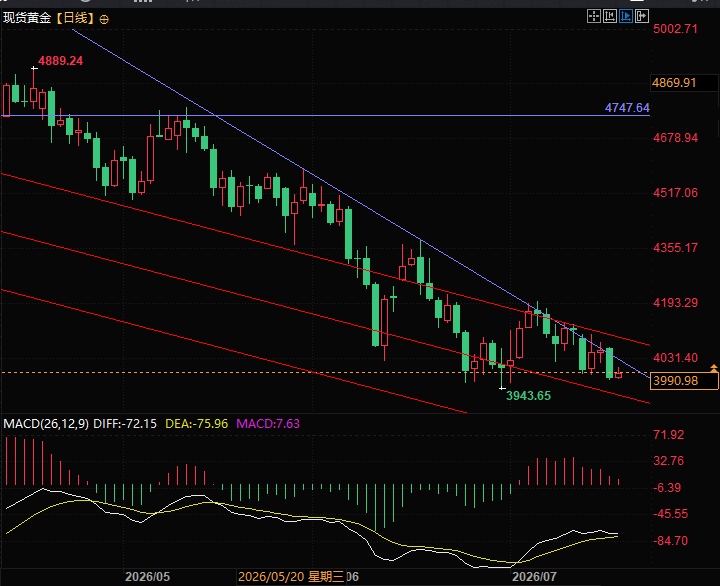 (Spot gold daily chart, source: EasyTrade) At 16:19 Beijing time, spot gold is currently trading at $3991 per ounce.
US airstrikes exert precise pressure, severely damaging Iran's inland transportation system.
This round of US airstrikes focused on strategic routes in Iran's Hormozgan province, destroying multiple road-rail bridges. The aim was to sever the land transport artery connecting Iran's largest port, Bandar Abbas, to the inland hinterland and directly to the capital, Tehran, thereby paralyzing Iran's logistics and military supply systems. According to Iranian state television, the airstrikes have resulted in at least seven deaths, and the death toll continues to rise. US Central Command confirmed that the airstrikes targeted dozens of locations, marking the sixth consecutive night of US airstrikes against Iran, further escalating pressure on the country.Iran retaliates in kind, with several Middle Eastern countries attacked by missiles.
Following the attack on US infrastructure, Iran swiftly retaliated militarily , launching missile strikes against several pro-US Middle Eastern countries and mediators in the conflict. On Friday, Iran launched a barrage of missiles targeting Qatar, Bahrain, and Kuwait. Qatar, a key mediator in the US-Iran conflict, issued two evacuation notices to its citizens. Missile debris also caused minor injuries to a child. Meanwhile, the Jordanian military successfully intercepted three incoming Iranian missiles, and air defense explosions were heard in multiple locations in Iraq's northern Kurdistan Region, putting the region's air defense system under pressure.The US military's comprehensive blockade of Iranian crude oil exports has led to a significant drop in shipping data.
The conflict in the maritime shipping sector continues to escalate. An oil tanker was attacked in the Omani side of the Strait of Hormuz, sustaining minor hull damage, but fortunately no crew injuries. Although Iran has recently been targeting oil tankers passing through this channel, it has not claimed responsibility for this attack. Currently, ships are scattered in ports, with more ships leaving than entering, resulting in severe disruptions to shipping. In addition, the US military has reinstated a comprehensive maritime blockade of Iranian ports, strictly intercepting civilian merchant ships and taking control measures such as expelling, disabling equipment, and boarding vessels that break through the blockade, effectively cutting off Iran's crude oil export channels. On the 17th local time, the UK's Office of Maritime Trade Operations stated that an oil tanker was attacked by an unidentified projectile approximately 19 nautical miles east of the Sea of Saab off the coast of Oman. The ship sustained minor damage to its port side, but the crew was safe and continued to its destination; the attack had no environmental impact. This escalating geopolitical conflict has significantly impacted shipping and trade in the Strait of Hormuz, profoundly disrupting the global crude oil market. Statistics from Lloyd's Register, a maritime data agency, show that weekly freight turnover in the Strait of Hormuz had already shrunk by nearly 25% compared to the previous month. Recent rounds of military strikes have further exacerbated the shipping stagnation, with the actual trade contraction far exceeding the statistical figures. Affected by soaring war risk premiums, most shipping companies have chosen to suspend operations and wait and see to avoid risk, with only a few vessels disabling their positioning systems and venturing through the straits. Although some Middle Eastern energy exports are attempting to switch to pipeline transportation, the pipeline capacity gap is enormous and completely insufficient to offset the precipitous decline in Strait of Hormuz shipping volume.Summary and Technical Analysis:
The renewed conflict between the US and Iran, coupled with a sharp decline in global equity markets and a contraction in market sentiment, has put considerable pressure on gold prices. Currently, Trump's focus is shifting significantly towards the midterm elections, while he hopes to open the Strait of Hormuz with Iran through talks as soon as possible. However, there may be internal disagreements within Iran between pragmatic peace advocates and pro-war factions within the Revolutionary Guard. One side hopes to stabilize the domestic economy through negotiations, while the other hopes to seize the opportunity to gain permanent toll rights. The US has chosen to cut off the Revolutionary Guard's funding and deplete its military assets, which is a protracted war of attrition. How long this can last remains to be seen. Today's global asset market movements are largely in line with the low point in sentiment previously mentioned. The early strength in gold prices today indicates that some funds are betting that the situation will not worsen and are choosing to enter the market early. Traders need to closely monitor gold price movements and the global situation. If the US-Iran conflict continues to escalate and the global equity market sell-off continues, gold prices may have further downside potential. Technically, spot gold is currently far from the upper rail of the descending channel and the descending resistance line. The strength in gold prices is limited to the intraday period, and the overall trend remains weak and bearish. (Spot gold daily chart, source: EasyTrade) At 16:19 Beijing time, spot gold is currently trading at $3991 per ounce.
- Risk Warning and Disclaimer
- The market involves risk, and trading may not be suitable for all investors. This article is for reference only and does not constitute personal investment advice, nor does it take into account certain users’ specific investment objectives, financial situation, or other needs. Any investment decisions made based on this information are at your own risk.