Oil price rebound supports the Canadian dollar, USD/CAD fluctuates at low levels.
2026-07-17 15:18:12
The US dollar (USD/CAD) edged lower in Asian trading on Friday, currently trading around 1.4035 . Although the pair failed to extend its overnight rebound, it held above the 1.4000 level, indicating continued support. With high international oil prices and a strong US dollar, the USD/CAD pair is currently in a volatile, mixed market.  The main driver of the Canadian dollar's strength remains the international crude oil market. The escalating conflict between the US and Iran has further exacerbated risks to global energy supplies. The US launched airstrikes against Iranian targets for the sixth consecutive night and expanded its military operations, while Iran continued to retaliate against US military facilities in the Middle East. Market concerns that the conflict could escalate further to a wider region have led to a continued rise in energy market risk premiums. Meanwhile, the Iranian Revolutionary Guard indicated it might further expand its military operations. Market surveys show that Iran has asked the Houthi rebels in Yemen to prepare to blockade energy shipping routes in the Red Sea. Coupled with the US's continued strengthening of its maritime blockade of Iranian ports, the risk of disruption in the Strait of Hormuz remains high. The Strait of Hormuz handles approximately 20% of global seaborne crude oil transport ; any disruption could significantly impact global energy supplies, a key reason why international oil prices have remained at near-month-high levels recently. Strong oil prices provide some support for the Canadian economy. As a major global crude oil exporter, Canada's export revenue is expected to benefit from rising international oil prices, thus the commodity currency Canadian dollar continues to receive buying support, limiting the upside potential of the USD/CAD exchange rate to some extent. Despite the Bank of Canada's relatively cautious policy signals this week, the positive impact of rising energy prices has temporarily offset some of the negative factors. On the other hand, the US dollar remains resilient. Rising international oil prices have reignited market concerns about energy-driven inflation, with investors believing the Federal Reserve may need to maintain a restrictive monetary policy for a longer period to ensure inflation returns to its target level. Recent robust US employment and manufacturing data have further strengthened market confidence in the resilience of the US economy. Currently, the market estimates that the probability of the Federal Reserve raising interest rates by another 25 basis points before the end of the year remains high, and US Treasury yields remain high, supporting the US dollar index and providing some support for the USD/CAD exchange rate. Therefore, although the Canadian dollar has benefited from rising oil prices, the strength of the US dollar has limited the overall decline in the exchange rate. The market will now focus on US building permits, new home starts, industrial production, the University of Michigan consumer sentiment index, and inflation expectations, while closely monitoring speeches by several Federal Reserve officials. If US economic data continues to exceed market expectations, the Fed's hawkish stance may strengthen further, potentially giving the USD/CAD pair renewed upward momentum. Conversely, weak data could weaken the dollar's advantage, creating conditions for further Canadian dollar strength. Technically, the USD/CAD pair remains in a consolidation phase on the daily chart. After finding support near a one-month low around 1.4000 , the rebound has been relatively limited, indicating a cautious market sentiment. The MACD indicator shows some weakening bearish momentum, but no clear reversal signal has yet formed. Short-term moving averages are gradually flattening, suggesting the pair has entered a consolidation phase. The first resistance level to watch is around 1.4100 , with further resistance at 1.4180 and 1.4250 . On the downside, the key level to watch is the 1.4000 psychological barrier; a break below this level could lead to further declines towards 1.3950 and 1.3880 . On the 4-hour chart, the USD/CAD pair is maintaining a short-term range, with the MACD gradually approaching the zero line, indicating continued market uncertainty. Short-term moving averages are intertwined, suggesting a relatively balanced market sentiment. If the exchange rate can regain its footing above 1.4100, the short-term recovery is expected to continue; conversely, if it falls below the key support level of 1.4000, the bears may regain control, and the exchange rate faces the risk of further decline.
 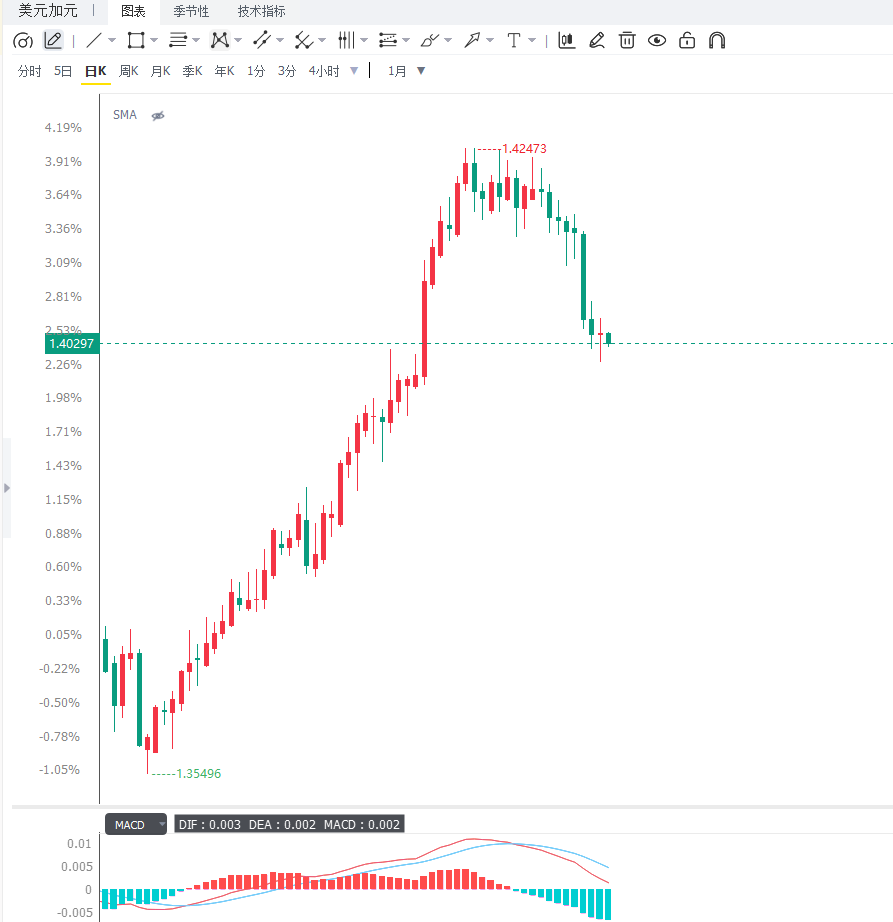 Editor's Summary : Overall, international oil prices remained high, driven by the escalating tensions between the US and Iran, providing strong support for the Canadian economy and the Canadian dollar. Meanwhile, robust US economic data and expectations of the Federal Reserve maintaining high interest rates continued to support the US dollar, causing the USD/CAD exchange rate to maintain a low-level consolidation trend. In the short term, oil price movements, US economic data, Federal Reserve policy signals, and the situation in the Middle East will remain the core factors influencing exchange rate movements. With these bullish and bearish factors balancing each other, the USD/CAD exchange rate may continue to fluctuate around key support and resistance levels, awaiting new fundamental catalysts to guide its future direction.
The main driver of the Canadian dollar's strength remains the international crude oil market. The escalating conflict between the US and Iran has further exacerbated risks to global energy supplies. The US launched airstrikes against Iranian targets for the sixth consecutive night and expanded its military operations, while Iran continued to retaliate against US military facilities in the Middle East. Market concerns that the conflict could escalate further to a wider region have led to a continued rise in energy market risk premiums. Meanwhile, the Iranian Revolutionary Guard indicated it might further expand its military operations. Market surveys show that Iran has asked the Houthi rebels in Yemen to prepare to blockade energy shipping routes in the Red Sea. Coupled with the US's continued strengthening of its maritime blockade of Iranian ports, the risk of disruption in the Strait of Hormuz remains high. The Strait of Hormuz handles approximately 20% of global seaborne crude oil transport ; any disruption could significantly impact global energy supplies, a key reason why international oil prices have remained at near-month-high levels recently. Strong oil prices provide some support for the Canadian economy. As a major global crude oil exporter, Canada's export revenue is expected to benefit from rising international oil prices, thus the commodity currency Canadian dollar continues to receive buying support, limiting the upside potential of the USD/CAD exchange rate to some extent. Despite the Bank of Canada's relatively cautious policy signals this week, the positive impact of rising energy prices has temporarily offset some of the negative factors. On the other hand, the US dollar remains resilient. Rising international oil prices have reignited market concerns about energy-driven inflation, with investors believing the Federal Reserve may need to maintain a restrictive monetary policy for a longer period to ensure inflation returns to its target level. Recent robust US employment and manufacturing data have further strengthened market confidence in the resilience of the US economy. Currently, the market estimates that the probability of the Federal Reserve raising interest rates by another 25 basis points before the end of the year remains high, and US Treasury yields remain high, supporting the US dollar index and providing some support for the USD/CAD exchange rate. Therefore, although the Canadian dollar has benefited from rising oil prices, the strength of the US dollar has limited the overall decline in the exchange rate. The market will now focus on US building permits, new home starts, industrial production, the University of Michigan consumer sentiment index, and inflation expectations, while closely monitoring speeches by several Federal Reserve officials. If US economic data continues to exceed market expectations, the Fed's hawkish stance may strengthen further, potentially giving the USD/CAD pair renewed upward momentum. Conversely, weak data could weaken the dollar's advantage, creating conditions for further Canadian dollar strength. Technically, the USD/CAD pair remains in a consolidation phase on the daily chart. After finding support near a one-month low around 1.4000 , the rebound has been relatively limited, indicating a cautious market sentiment. The MACD indicator shows some weakening bearish momentum, but no clear reversal signal has yet formed. Short-term moving averages are gradually flattening, suggesting the pair has entered a consolidation phase. The first resistance level to watch is around 1.4100 , with further resistance at 1.4180 and 1.4250 . On the downside, the key level to watch is the 1.4000 psychological barrier; a break below this level could lead to further declines towards 1.3950 and 1.3880 . On the 4-hour chart, the USD/CAD pair is maintaining a short-term range, with the MACD gradually approaching the zero line, indicating continued market uncertainty. Short-term moving averages are intertwined, suggesting a relatively balanced market sentiment. If the exchange rate can regain its footing above 1.4100, the short-term recovery is expected to continue; conversely, if it falls below the key support level of 1.4000, the bears may regain control, and the exchange rate faces the risk of further decline. Editor's Summary : Overall, international oil prices remained high, driven by the escalating tensions between the US and Iran, providing strong support for the Canadian economy and the Canadian dollar. Meanwhile, robust US economic data and expectations of the Federal Reserve maintaining high interest rates continued to support the US dollar, causing the USD/CAD exchange rate to maintain a low-level consolidation trend. In the short term, oil price movements, US economic data, Federal Reserve policy signals, and the situation in the Middle East will remain the core factors influencing exchange rate movements. With these bullish and bearish factors balancing each other, the USD/CAD exchange rate may continue to fluctuate around key support and resistance levels, awaiting new fundamental catalysts to guide its future direction.
- Risk Warning and Disclaimer
- The market involves risk, and trading may not be suitable for all investors. This article is for reference only and does not constitute personal investment advice, nor does it take into account certain users’ specific investment objectives, financial situation, or other needs. Any investment decisions made based on this information are at your own risk.