The "bloated" dollar and the "gamble" on the pound: When safe-haven buying collides with the ebb of interest rate hikes, a reversal of roles between bulls and bears is unfolding in the currency market.
2026-07-18 12:34:12
Over the past week, the foreign exchange market was torn apart by two distinct forces. On one hand, escalating geopolitical risks in the Middle East, with the US-Iran ceasefire agreement rendered worthless amidst the fighting and news of shipping disruptions in the Strait of Hormuz constantly stimulating safe-haven demand, pushed the US dollar index back and forth from near a one-month low at the beginning of the week. Ultimately, the dollar managed to hold above 100.76 thanks to safe-haven demand, still recording a weekly decline of approximately 0.2%. Non-US currencies diverged further: the British pound rose for the third consecutive week, becoming one of the most resilient major currencies recently; the euro hovered near the key support/resistance level, lacking direction; and the Japanese yen hovered near 40-year lows, with increasingly frequent warnings of official intervention failing to substantially shake its trend. In commodities, crude oil rebounded in a V-shape driven by concerns about supply disruptions, while gold also saw buying interest at lower levels after testing key support levels multiple times this week, indicating a heated battle between risk assets and safe-haven assets. 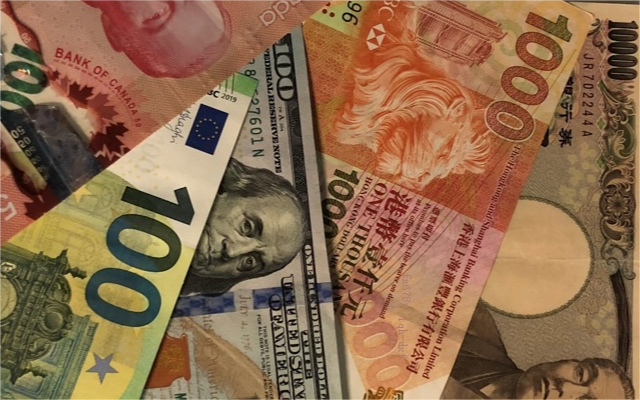
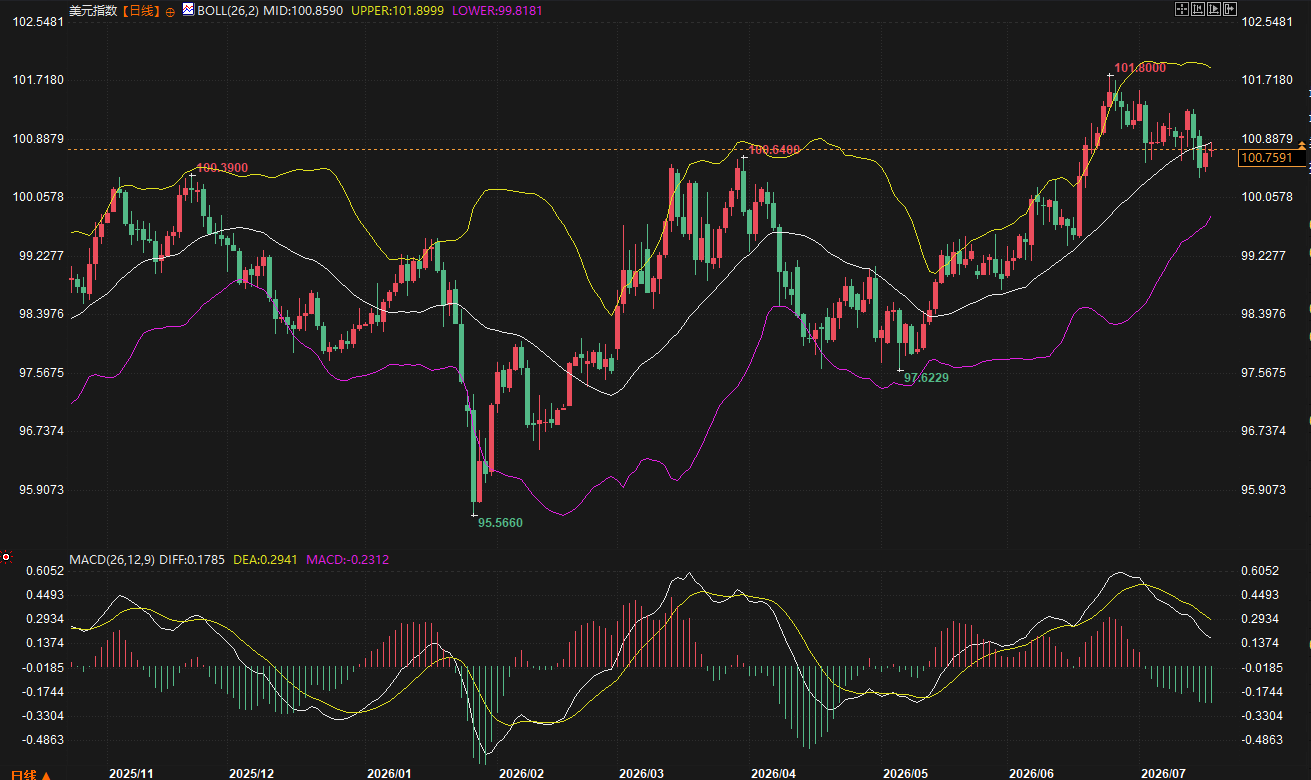
US Dollar Index: Safe-haven buying offsets cooling interest rate hikes; tug-of-war continues above the 100 mark.
This week's dollar index movement reflects a typical struggle between risk aversion and interest rate expectations. At the beginning of the week, the dollar index briefly fell to a monthly low due to a cooling June consumer price index and a significant reduction in market bets on an imminent Fed rate hike. Subsequently, the US-Iran situation rapidly deteriorated, with the fighting escalating from localized conflict to a full-blown breach of the ceasefire agreement. Coupled with a global stock market decline led by technology stocks, panic spread, and funds flowed into the dollar for safety, pushing the index back up to 100.76. A well-known foreign media outlet quoted Elias Haddad, global head of market strategy at a certain institution, as saying, "The plunge in technology stocks and the continued disruption to shipping in the Strait of Hormuz jointly triggered risk aversion, causing the dollar to recover some of its losses this week, while global bond yields also declined slightly." From a technical perspective, the dollar index is currently trading at 100.76, closely below the Bollinger Band middle line at 100.86. The MACD histogram is showing a moderate increase in green bars, and the DIFF line is running below the DEA line, indicating weak short-term momentum, but limited downside potential. In terms of price movement, the index has been declining from its previous high of 101.80, reaching a low of 95.57 before gradually stabilizing and rebounding. It is currently in a consolidation phase. Market assessments of the US economic fundamentals are also mixed: June retail sales rose slightly, gas station sales declined due to falling oil prices, but online consumption unexpectedly surged, prompting economists to raise their second-quarter economic growth forecasts. The stable labor market further confirms the economy's resilience. Regarding inflation, June data showed some easing, enough to raise the probability that the Federal Reserve will maintain interest rates at its July meeting to 86%. However, Shaun Osborne, chief foreign exchange strategist at a Toronto bank, cautioned that the market's pricing in subsequent rate hikes may still be too high. He believes that "at least for now, the dollar may have peaked around a few weeks ago." If this assessment is confirmed by subsequent data, the dollar index may end its correction near the 100 level and return to a weaker structure.GBP/USD: Political expectations and economic data converge, leading to a third consecutive week of gains.
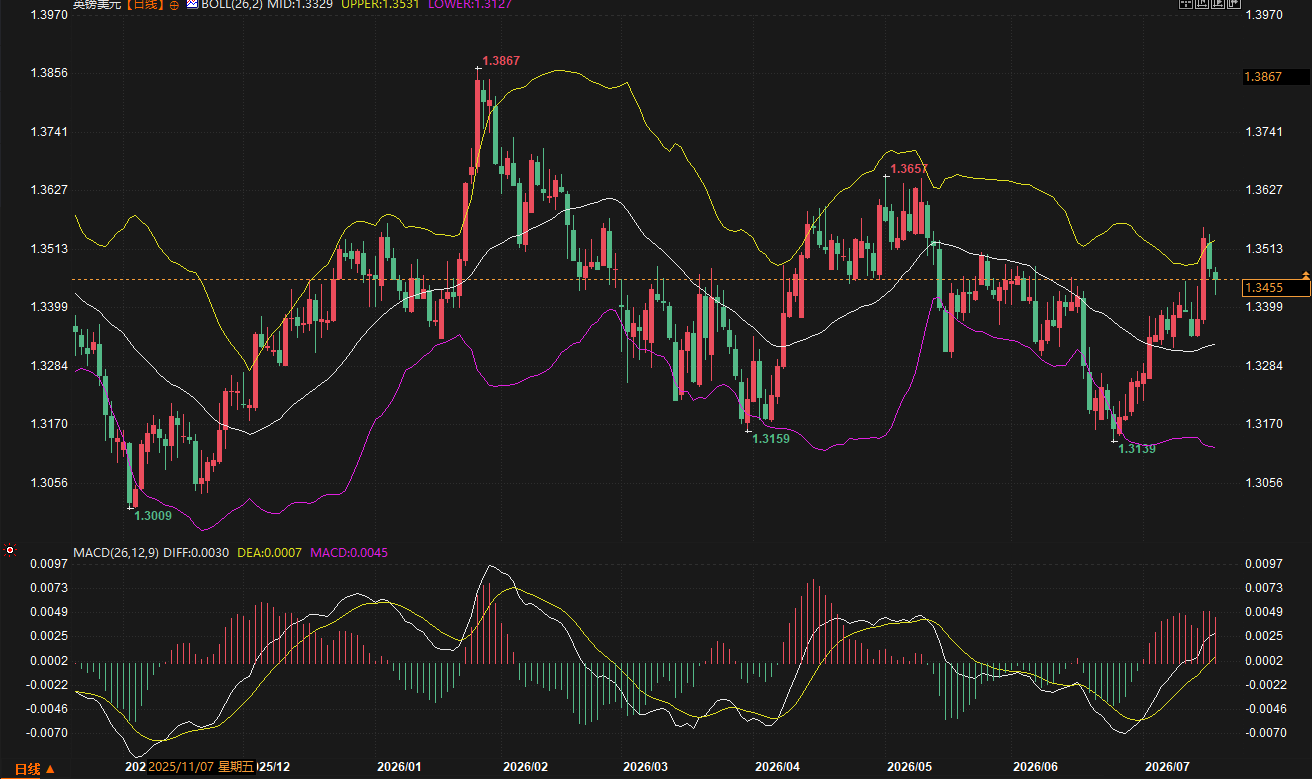
The pound sterling dipped slightly by 0.16% to 1.3455 this week, but this did not prevent it from recording its third consecutive weekly gain. The forces driving the pound's steady climb come from two dimensions. On the economic front, recent UK growth indicators have stabilized, providing fundamental support for the bulls. On the political front, according to a well-known foreign media report, incoming Prime Minister Burnham will appoint a relatively centrist Chancellor of the Exchequer, a signal that has significantly eased previous market concerns about extreme fiscal expansion, injecting downward pressure on the pound's political risk premium. Technically, GBP/USD is currently trading at 1.3455, between the Bollinger Band middle line at 1.3329 and the upper line at 1.3531, maintaining a slightly bullish pattern. The MACD histogram is showing a slight increase in volume, and the DIFF line remains bullish above the DEA line. A review of the price action shows that the exchange rate previously fell from a high of 1.3867, found support around 1.3009, and then rebounded in an orderly manner. The current upward trend exhibits characteristics of a trend correction rather than a news-driven impulse. It is worth noting that if the market perceives the upcoming new government fiscal framework as "too mild," or if global risk aversion tightens again, the pound may face profit-taking pressure.USD/JPY: Psychological Warfare Ahead of 40-Year Lows, Hovering on the Edge of Intervention
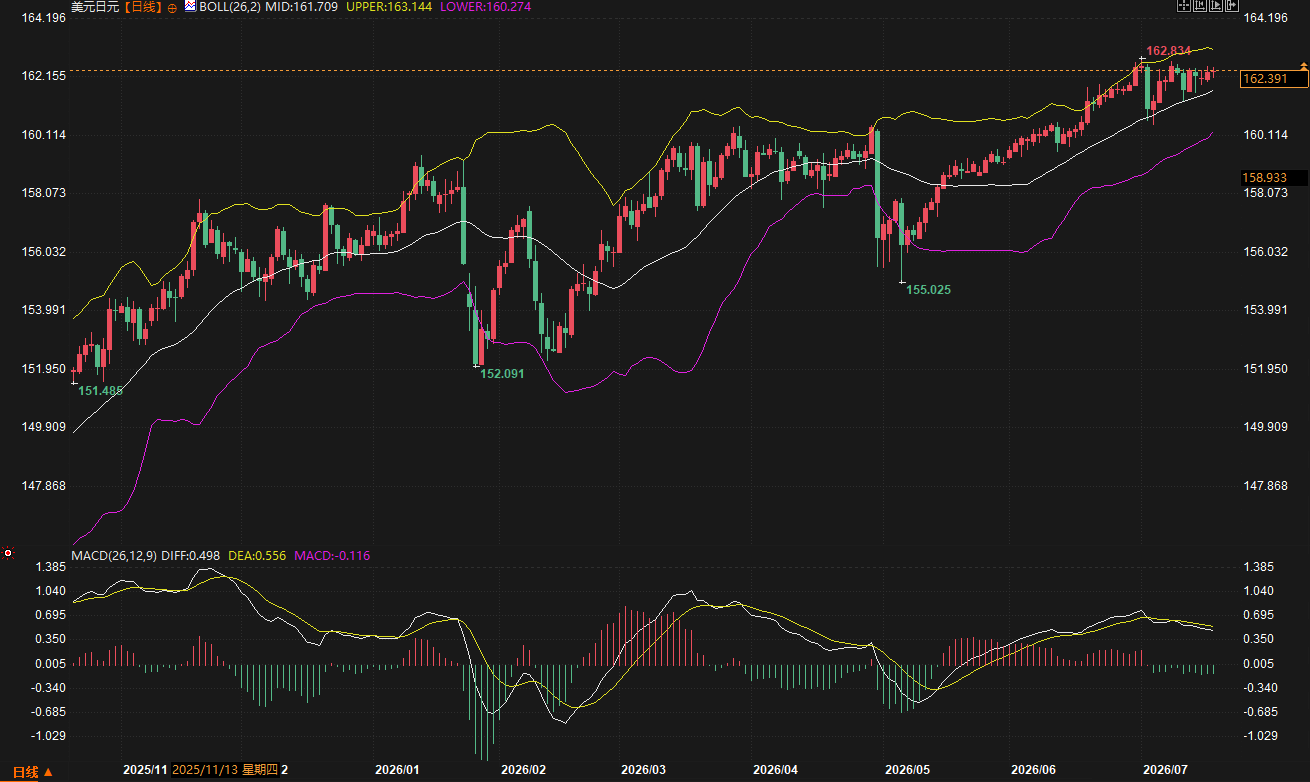
The USD/JPY pair closed nearly flat this week at 162.39, just shy of the 40-year low of 162.84 reached earlier this month. Japanese Finance Minister Satsuki Katayama reiterated publicly this week that the government is prepared to take decisive action to address excessive exchange rate volatility. This statement was widely interpreted by the market as a signal of impending intervention. However, Shaun Osborne remained cautious, noting that "judging from the threat of 'decisive action,' intervention seems imminent again, but I'm not sure this time it will have a more lasting effect on the yen than before." This assessment highlights the current predicament—the marginal effect of verbal intervention diminishes with each repetition. Unless there is substantial, coordinated action aligned with monetary policy, yen bulls will find it difficult to mount an effective counterattack based solely on deterrence. Technically, the USD/JPY pair is trading between the upper Bollinger Band at 163.14 and the middle band at 161.71, remaining in a relatively strong range. The MACD histogram is showing a slight increase in volume, and the DIFF line is slightly below the DEA, indicating that while there is short-term downward pressure, the medium-term upward trend has not yet been broken. The sustained rise in the yen since its low of 151.49 is driven by the interest rate differential between Japan and the US, as well as the Bank of Japan's continued accommodative stance. However, with escalating tensions between the US and Iran pushing up import costs and further eroding Japan's terms of trade, the yen's structural weakness cannot be reversed solely through foreign exchange intervention.EUR/USD: Closely following the middle Bollinger Band, bulls and bears are locked in a stalemate around 1.1440.
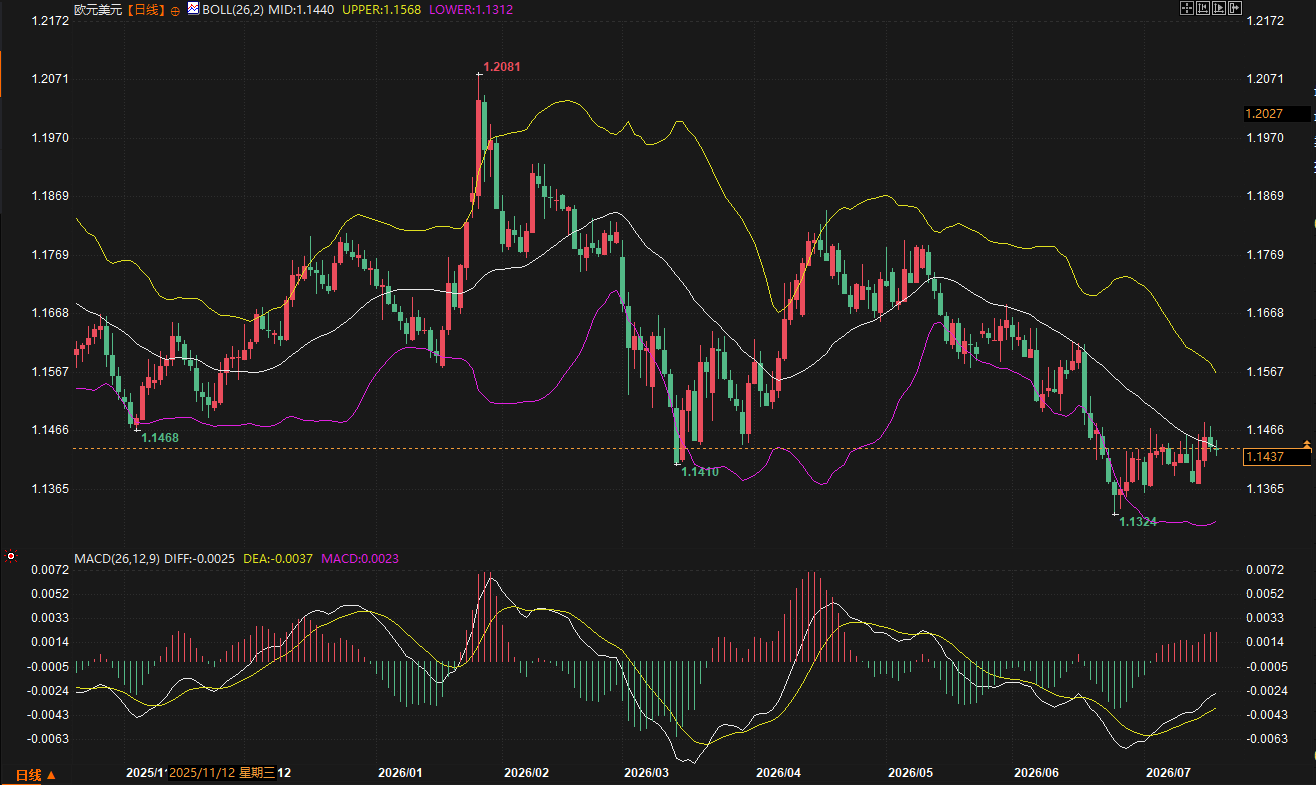
The euro/dollar pair closed at 1.1437 on Friday, up slightly by about 0.2% for the week, exhibiting a sluggish and directionless movement. Since its high of 1.2081, which saw it fall to a low of 1.1324, the euro has been trading in a narrow range around the Bollinger Band's middle band at 1.1440. The MACD histogram shows a slight increase in bullish momentum, with the DIFF line moving upwards towards the DEA, indicating initial signs of stabilization, but no significant upward momentum has yet emerged. The Eurozone's economic surprise index did not provide clear guidance, and market attention is largely focused on variables related to the US dollar. If the ECB's interest rate decision next week maintains its current policy, the exchange rate will likely continue to consolidate with low volatility around the middle band, postponing the decision on direction.USD/CAD: Oil price surges and data vacuum give bears an edge.
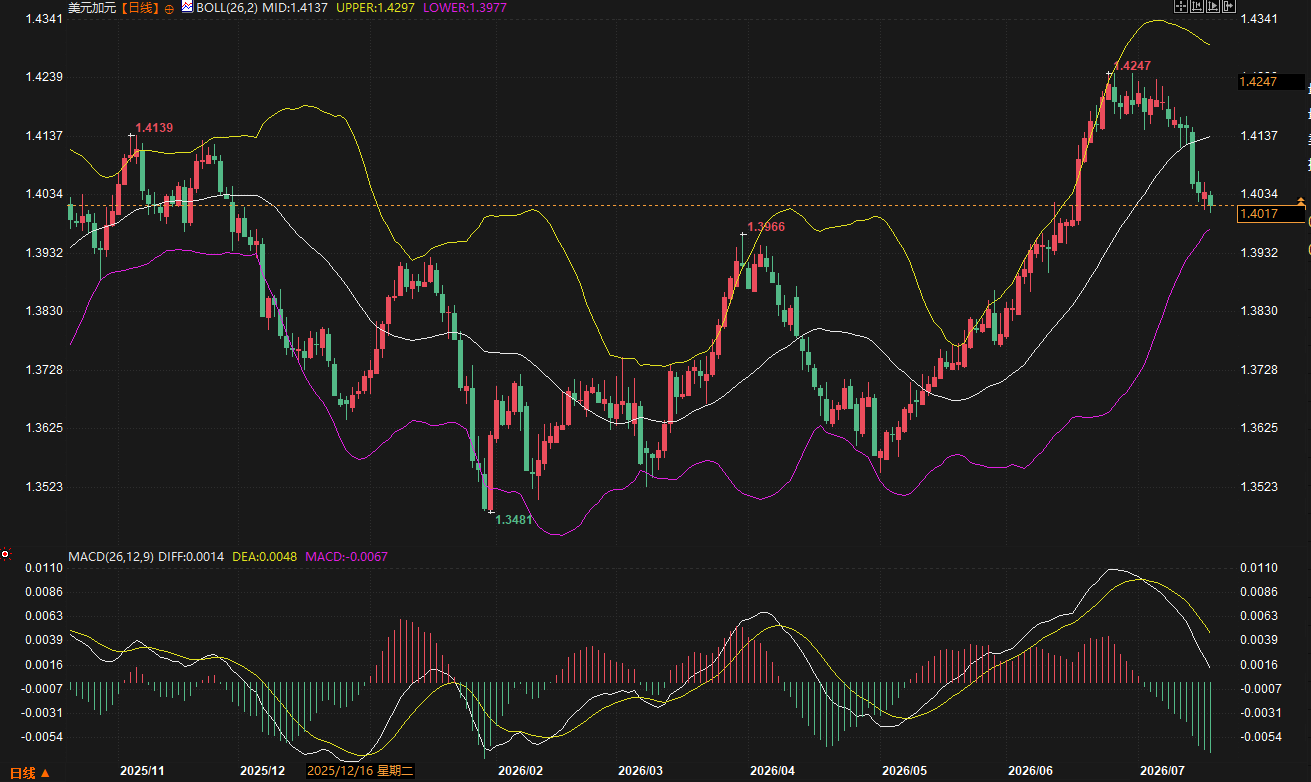
The USD/CAD pair fell 0.17% this week to 1.4017, with a bearish technical pattern. After rising from a low of 1.3481 to 1.4247, the pair encountered resistance and retreated, currently trading in the weak zone between the lower Bollinger Band at 1.3977 and the middle band at 1.4137. The MACD histogram is expanding, with the DIFF line below the DEA line, indicating short-term dominance by the bears and a potential further test of the lower Bollinger Band support. It's worth noting that the V-shaped rebound in oil prices, triggered by the Middle East situation, provided some support to the Canadian dollar, but the dollar did not show a correspondingly strong performance. This suggests that market caution regarding the Bank of Canada's monetary policy path and the global economic outlook continues to constrain the pair's unilateral movement.Conclusion
The surface logic of this week's currency market was a return to "risk aversion," but the deeper picture is more complex. The US dollar was torn between weakening expectations of interest rate hikes and geopolitical risk premiums, ultimately closing with sideways movement. The pound outperformed most non-US currencies due to political clarity, but its priced-in political benefits risk being overestimated. The yen's repeated fluctuations before reaching 40-year lows resembled a psychological war of attrition between the market and government. Looking ahead to next week, the ECB's interest rate decision will be a key variable, but the real risk may still stem from the unpredictability of the Middle East situation. During this policy vacuum, any clue about energy supply disruptions could instantly alter the trading logic of the dollar and commodity currencies. Moments when volatility is compressed to low levels often mark the eve of a price breakout.QA module
The US dollar index closed lower for the week, but why is it still considered a safe-haven asset? Is the demand for safe-haven assets overstated? Although the dollar closed lower this week, its rebound from its monthly low was almost entirely driven by geopolitical risks. Escalating tensions between the US and Iran and concerns about a liquidity crisis triggered by a sell-off in tech stocks led to a short-term influx of funds into the dollar seeking a safety margin, which is not contradictory to its weakening long-term interest rate expectations. Safe-haven demand is real, but its scale is limited by the market's repricing of the Fed's policy path. If subsequent economic data continues to point to moderate inflation and robust growth, the dollar's safe-haven premium may evaporate more rapidly, as the core market issue will ultimately return to interest rate differentials. The pound has risen for three consecutive weeks; what is the driving logic behind this rally? How sustainable is it? The recent strength of the pound is not due to a single factor. UK economic growth data provides basic support, but more importantly, a shift in political expectations: the new Prime Minister Burnham may appoint a centrist Chancellor, which has significantly alleviated market concerns about extreme fiscal policies, thus removing some of the political risk premium weighing on the pound. From a technical perspective, the rebound since 1.3009 has shown an orderly pattern of higher lows and higher highs, representing a relatively healthy recovery. The biggest variable in its sustainability lies in whether the fiscal framework to be released in the coming weeks can meet market expectations for a moderate recovery, and whether global risk aversion will escalate sharply. If risk appetite reverses, the pound, as a risk-sensitive currency, may be the first to come under pressure. Warnings of yen intervention have been frequently issued, but why is the market becoming increasingly indifferent? Is intervention truly ineffective? The Japanese Ministry of Finance has upgraded its wording from "closely monitoring" to "decisive action," but the market reaction has become increasingly muted. The core reason is that past interventions have failed to change the fundamental trend driven by the Japan-US interest rate differential. Genuine intervention requires a shift in monetary policy; otherwise, foreign exchange operations alone often have short-term effects and may even be seen by speculative funds as an opportunity to sell on rallies. Intervention is not entirely ineffective, but its impact on expectations is diminishing. Only when the Bank of Japan issues a clear tightening signal, or when expectations of a Fed rate cut rise significantly, can the yen gain sustained momentum for a rebound. The EUR/USD pair is tightly straddling the Bollinger Band's middle line. How will this extremely low volatility be broken? The euro is currently trading around 1.1440, closely following the middle band, with the MACD signal lines converging, indicating a temporary equilibrium between bulls and bears. Breaking this equilibrium requires an external shock. The most likely trigger is the ECB's interest rate decision and policy statement. Any unexpected wording from Lagarde regarding the future path of interest rates would push the euro out of its current gravitational pull. Another possibility comes from US data. If next week's PMI or employment-related indicators significantly deviate from expectations, it will drive the euro in a directional move through the dollar side. In a low-volatility environment, once a breakout occurs, the initial movement is often quite dramatic, but distinguishing between genuine and false breakouts is correspondingly more difficult. What is the impact path of the US-Iran situation on the foreign exchange market? Which currencies are most sensitive to this? The US-Iran situation is transmitted to the foreign exchange market through two main channels. The first is the energy price channel. The risk of shipping disruptions in the Strait of Hormuz directly pushes up crude oil prices, which benefits commodity currencies such as the Canadian dollar and the Norwegian krone, while simultaneously exacerbating Japan's trade deficit as an energy importer, putting downward pressure on the yen. The second channel is risk aversion. Escalating conflicts often trigger stock market declines and rising volatility indices, driving funds towards traditional safe-haven assets such as the US dollar and the Swiss franc. These two paths can sometimes contradict each other; for example, the US dollar may benefit from safe-haven inflows but also face pressure from inflationary concerns and expectations of slowing economic growth due to rising oil prices. Therefore, traders need to distinguish between different stages of conflict intensity. Impulsive clashes primarily affect sentiment, while the reaction chain of commodity currencies becomes clearer once a substantial supply disruption occurs.- Risk Warning and Disclaimer
- The market involves risk, and trading may not be suitable for all investors. This article is for reference only and does not constitute personal investment advice, nor does it take into account certain users’ specific investment objectives, financial situation, or other needs. Any investment decisions made based on this information are at your own risk.