Oil prices failed to stage an island reversal but still face the risk of a second shock.
2026-07-20 16:10:14
On Monday (July 20), during the Asian and European sessions, international oil prices continued to rise, experiencing a sharp decline after an initial surge. WTI crude oil is currently trading at $82.36 per ounce, up 0.73%, having risen as much as 3.5% during the session. The geopolitical tensions between the US and Iran have escalated recently, with military confrontations continuing to intensify. However, both sides have maintained that the negotiation window remains open. On July 20, local time, Iranian Foreign Ministry spokesman Bagaei confirmed at a press conference that he had received a proposal from a mediator, but declined to provide details. The Iranian Foreign Ministry spokesman stated that negotiations with the US can be conducted based on national interests, but Iran's sovereign rights in the Strait of Hormuz are non-negotiable. After reporting two additional US military personnel killed and one missing, the US launched a new round of airstrikes against Iran early Monday morning. This marks the ninth consecutive night of US airstrikes against Iran, targeting key military facilities including Iran's military command center, air defense monitoring system, naval combat platforms, missile and drone launch sites, and its nationwide communication network. In response, Iran launched a full-scale retaliatory strike, targeting US allies in the Middle East. On Monday morning, missile air defense sirens were sounded throughout Bahrain, and Kuwaiti air defense forces simultaneously activated their interception systems to defend against Iran's concentrated missile offensive, escalating geopolitical risks across the Middle East. 
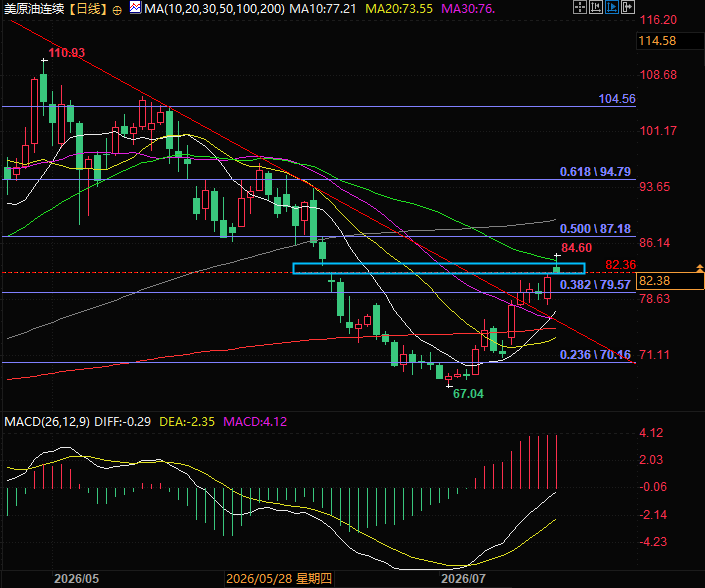 (WTI crude oil futures daily chart, source: EasyTrade) At 15:53 Beijing time, WTI crude oil futures were trading at $82.35 per barrel.
The interim agreement has completely collapsed, and diplomatic negotiations between the US and Iran have stalled.
In mid-June of this year, the US and Iran reached a provisional agreement to reopen the Strait of Hormuz and push for an end to the conflict, which temporarily eased global oil supply anxieties and led to a temporary decline in oil prices. This round of conflict has completely shattered previous expectations of a ceasefire. While US Secretary of State Rubio stated that the US has not closed the door to negotiations, he explicitly rejected formalistic and vague dialogue, demanding that consultations have substantial grounds for action. He bluntly stated that the current situation in Iran does not yet meet the conditions for pragmatic negotiations, and the probability of a short-term easing of tensions between the US and Iran has significantly decreased.Shipping in the Strait of Hormuz is virtually paralyzed, and navigation safety has been completely compromised.
As military confrontation escalates, shipping order in the Strait of Hormuz, a vital global energy route, has been completely disrupted, with a sharp decline in its efficiency. The US military has not only continued airstrikes on Iranian soil but has also reinstated a maritime blockade of Iranian ports, cutting off its crude oil export routes. The blockade has already forced six crude oil tankers to halt and paralyzed one shipping vessel. Trump previously issued threatening statements, planning to destroy Iran's power hubs and land bridges to force Iran to relinquish control of the strait; the current series of US military actions are all part of this pressure strategy. Shipping data shows a recent precipitous drop in tanker traffic through the strait, with only three product tankers passing through daily, the lowest level since May. Late on the 19th local time, the situation further deteriorated when two tankers, instigated and coerced by the US military, attempted to cross the southern channel of the Strait of Hormuz but were forced to stop due to an explosion en route. The Iranian Revolutionary Guard has clearly stated that as long as the US continues its military operations and illegal interference in the Middle East, the Strait of Hormuz will completely lose its security for oil and gas transportation, and all oil and gas transport vessels will be unable to pass safely. More seriously, the risks to the Middle East energy supply chain have spread outward from the Strait of Hormuz, creating a multi-point pressure situation. Iran has instructed the Houthi rebels in Yemen to immediately block Red Sea oil transport routes if the US attacks Iranian power facilities. To mitigate these risks, Saudi Arabia has urgently adjusted its energy export strategy, diverting most of its crude oil exports to the port of Yanbu on the Red Sea. Since July, 75% of Saudi Arabia's daily crude oil exports of 5.29 million barrels have been exported through Yanbu, forcing a restructuring of the regional energy trade landscape. Data from Kpler shows that in the first half of July, crude oil and condensate exports from Saudi Arabia, the UAE, Iraq, Kuwait, and Iran rebounded sharply, reaching an average of 12 million barrels per day, a 16% increase compared to the average daily level for the entire month of June. Vortexa's estimates are even higher, with an average daily export volume of 13.06 million barrels. Saudi Arabia, Iran, and Iraq are the core drivers of this export rebound, with only the UAE's exports slightly declining from the record high in June. However, this temporary rebound in exports is only a short-term recovery. With shipping in the Taiwan Strait currently disrupted and military conflicts ongoing, oil-producing countries are forced to proactively reduce production and scale up crude oil shipments. At present, the average daily export volume of core oil-producing countries in the Middle East is still 32% lower than the pre-war peak of 17.6 million barrels in February, indicating a significant contraction in actual supply capacity.Institutional Commentary on Supply and Demand Game: Oil Prices Determined by Both Geopolitical Shocks and Weak Demand
A Fidelity research report indicates that during this year's first energy price surge cycle, the risk buffers built up by companies through hedging tools and inventory reserves have been thinning, and a large number of hedging protection contracts are expiring. Energy, freight, and raw material cost pressures will become fully apparent, intensifying cost pressures across the consumer, industrial, and utilities sectors. The escalation of the US-Iran conflict, leading to the stagnation of shipping in the Strait of Hormuz, has triggered a second round of energy supply shocks far exceeding initial expectations, directly pushing oil prices to monthly highs and gas prices nearing their April peaks. The risk of short-term supply shortages has rapidly increased geopolitical volatility in the market. Meanwhile, US macroeconomic data continues to weaken, with manufacturing output stagnating in June. Demand for durable goods, machinery, and electronic equipment is weak across the board, with only slight growth in utilities and mining supporting industrial data. The momentum of real demand recovery has significantly diminished, and further increases in energy consumption will remain limited. In summary, the short-term market is dominated by secondary supply shocks from geopolitics. Conflicts, shipping disruptions, and supply contraction will continue to amplify oil price volatility, resulting in a stable high-level consolidation pattern. In the long term, however, insufficient demand due to economic weakness will be the core suppressing factor. The continuously weakening end-user demand for oil will gradually offset the positive geopolitical momentum, completely locking in the upside potential of oil prices and limiting the extent of price increases in the medium to long term.Summary and Technical Analysis:
The US and Iran continue their protracted war of attrition, with neither side possessing the means to quickly end the conflict in the short term, unless Iran makes concessions on fees in the Strait of Hormuz, or the US makes a strategic compromise on its long-held principles of "freedom of navigation" and international passage through the straits. The US's mid-term ceasefire and the signing of an MOU with Iran seem to circumvent the restriction requiring approval from the White House for 60 consecutive days of fighting, while simultaneously providing time for US military resupply, easing oil prices, and creating the impression that the US is in control of the war and Iran is eager to negotiate. However, in reality, this has bought Iran valuable time to clear its accumulated crude oil inventory and alleviate the extreme strain on its supply chain. At the same time, it has also exposed the potential for a rift between the negotiating and pro-war factions within Iran, and a significant structural information discrepancy between the intelligence Trump received regarding Iran's willingness to negotiate and the actual political reality in Iran. Technically: WTI oil prices broke through the 0.382 Fibonacci retracement level and opened higher, breaking through the previous downward gap from 82.36 to 83, exhibiting an island reversal pattern during the session. Although this was quickly filled, it suggests that oil prices remain strong. Currently, we are observing the support level around 82, and whether oil prices can continue to strengthen after today's gap is filled. The support level is around 82, and the resistance level is around 87. (WTI crude oil futures daily chart, source: EasyTrade) At 15:53 Beijing time, WTI crude oil futures were trading at $82.35 per barrel.
- Risk Warning and Disclaimer
- The market involves risk, and trading may not be suitable for all investors. This article is for reference only and does not constitute personal investment advice, nor does it take into account certain users’ specific investment objectives, financial situation, or other needs. Any investment decisions made based on this information are at your own risk.