July 21st Financial Breakfast: "Higher and longer interest rates" suppress gold prices, which hover around the $4,000 mark; mediators propose a 10-day US-Iran ceasefire plan; crude oil experiences a rollercoaster ride.
2026-07-21 06:42:13
On Tuesday (July 21, Beijing time) in early Asian trading, spot gold was trading around $4,007 per ounce. Gold prices fell on Monday, closing below the $4,000 per ounce mark, mainly due to the rapidly escalating situation in the Middle East. Iran's Revolutionary Guard launched attacks on US military assets in the Middle East, and the Houthi rebels in Yemen announced a naval blockade against Saudi Arabia, exacerbating inflation concerns and reinforcing market expectations that interest rates will remain high for a longer period. As a result, oil prices rose on Monday, with US crude oil briefly touching a monthly high of $84.60 per barrel. However, gains were partially limited by hopes of renewed US-Iran negotiations, and US crude oil is currently trading around $82.58 per barrel. 
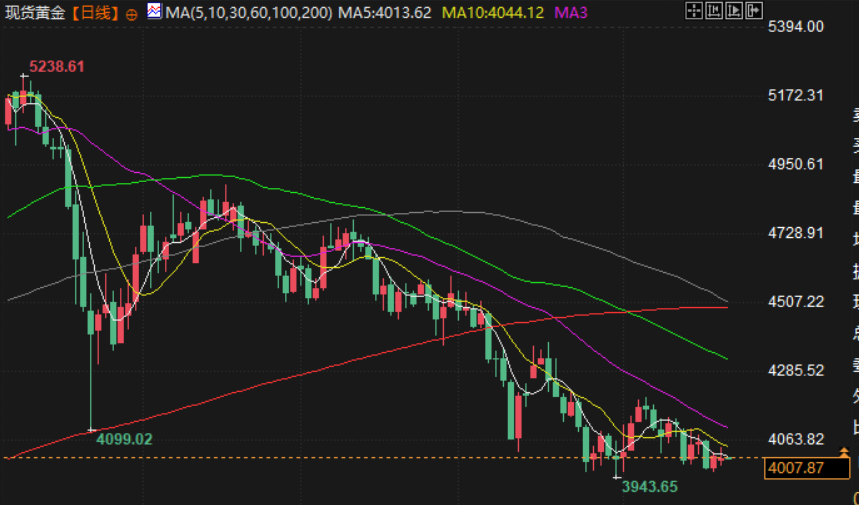 Meanwhile, Cleveland Fed President Hammark joined the ranks of officials supporting interest rate hikes, suggesting a potentially heated debate on rate increases at next week's Fed meeting. CME Group data showed traders' bets on a December rate hike rose from 73% last week to 83%. This, coupled with a 0.4% rise in the benchmark 10-year Treasury yield and a 0.2% increase in the dollar, further diminished gold's appeal. Although gold is generally considered an inflation hedge, high interest rates are suppressing its non-yielding asset attributes. In other precious metals, spot silver rose 0.9% to $56.38, platinum edged up 0.1% to $1592.86, and palladium rose 0.9% to $1258.83.
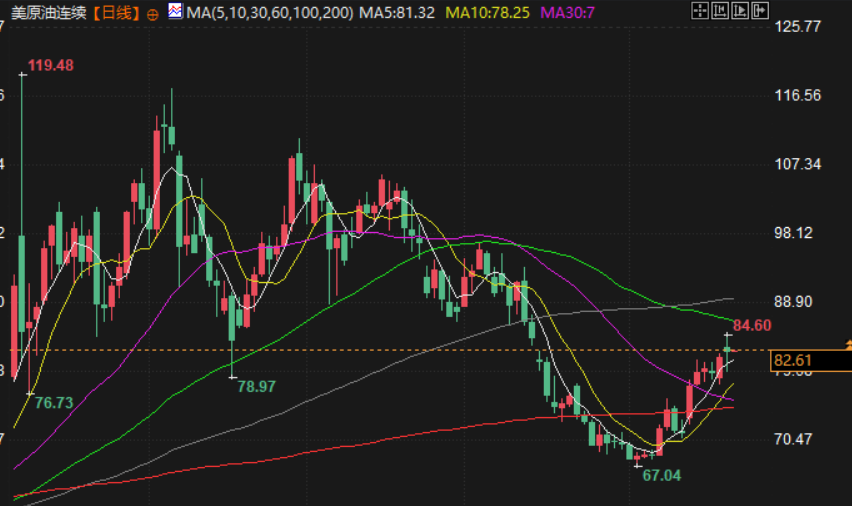 A senior Iranian official revealed that mediators have submitted a 10-day ceasefire proposal to seek a resumption of the interim agreement reached last month. Despite the ninth consecutive night of US airstrikes on Iran, and attacks on Kuwait and Bahrain, the prospect of negotiations eased market panic regarding potential disruptions to oil shipments through the Strait of Hormuz. Meanwhile, the Houthi blockade threat has opened a new front against the US. Rystad Energy warned that if the ceasefire fails, approximately 2.5 million barrels per day of Saudi crude oil could be at risk, significantly increasing the likelihood of a sharp price rebound. However, Kpler analysts pointed out that record-high marine crude oil inventories of approximately 1.35 billion barrels may limit further gains. While the number of ships transiting the Strait of Hormuz has dropped to single digits (only four on Sunday), shipping data shows that Gulf states' crude oil and condensate exports in the first half of July still rose to their highest level since the start of the war with Iran. Amidst these mixed factors, the market remains generally bullish.
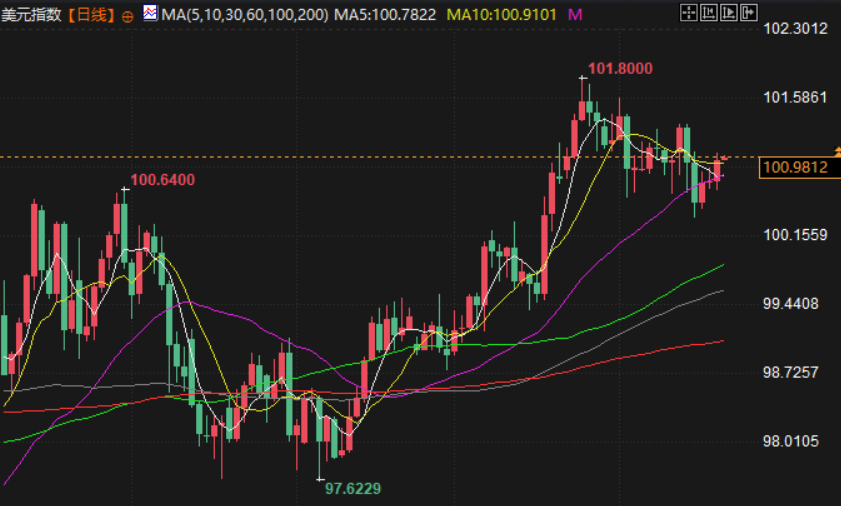 Amid cautious market sentiment, the euro fell 0.19% to $1.1417; the pound retreated 0.12% from its intraday high of $1.3481 to $1.3437, as Burnham appointed Healy as Chancellor of the Exchequer after succeeding Starmer as the new British Prime Minister. The market held a cautiously optimistic view of the new government's proactive approach, but noted the need to balance public finances. Meanwhile, the probability of a rate hike at the Federal Reserve's meeting next week has dropped sharply from over 40% a week ago to 16.6%, but the expectation of a rate hike in September remains at 62.8%. The probability of a rate hike at the European Central Bank's meeting this week is only 13.1%, and 78% in September. The market believes the ECB may be more aggressive due to its sensitivity to energy prices. The dollar rose slightly by 0.06% against the yen to 162.48 due to weaker liquidity during the Japanese holiday.
Key Focus Today
stock market
U.S. stocks rose on Monday, driven by a rebound in chip stocks. The Dow Jones Industrial Average, S&P 500, and Nasdaq Composite Index closed up 0.2%, 0.6%, and 0.9%, respectively. The market is awaiting key earnings reports from tech giants such as Alphabet, Tesla, and Intel later this week to determine whether the semiconductor sector can regain its upward momentum after a deep correction. The Philadelphia Semiconductor Index rebounded 2.5% on Monday, led by Micron Technology and SanDisk, while Alphabet's stock rose 3.4% on reports that it is developing a new AI chip. Meanwhile, Domino's Pizza rose 3.6% on better-than-expected quarterly revenue. Moderate inflation data eased concerns about a Fed rate hike this month, but escalating tensions in the Middle East (Houthi threats of a naval blockade) exacerbated global energy supply risks, narrowing market margins for error. Any earnings reports or geopolitical events could trigger downward pressure.Gold Market
Gold prices edged lower on Monday, with spot gold settling at $3,982.83 an ounce, down 0.23%, mainly due to the rapidly escalating situation in the Middle East. Following consecutive nightly bombings of Iranian cities by the US military, the Iranian Revolutionary Guard launched attacks on US military assets in the Middle East, and the Houthi rebels in Yemen announced a naval blockade against Saudi Arabia. These actions pushed Brent crude to a more than one-month high, exacerbating inflation concerns and reinforcing market expectations that interest rates will remain high for an extended period. Meanwhile, Cleveland Fed President Hammark joined the ranks of officials supporting interest rate hikes, suggesting a potentially heated debate on rate increases at next week's Fed meeting. CME Group data showed traders' bets on a December rate hike rose from 73% last week to 83%. This, coupled with a 0.4% rise in the benchmark 10-year Treasury yield and a 0.2% increase in the dollar, further diminished gold's appeal. Although gold is generally considered an inflation hedge, high interest rates are suppressing its non-yielding asset attributes. In other precious metals, spot silver rose 0.9% to $56.38, platinum edged up 0.1% to $1592.86, and palladium rose 0.9% to $1258.83.oil market
Oil prices rose more than 1% on Monday after volatile trading. Brent crude rose 0.94% to $88.91 a barrel, hitting a monthly high of $91.04 during the session, while WTI crude rose 0.79% to $82.42, hitting a monthly high of $84.60 during the session. This was mainly due to hopes for a resumption of negotiations between the US and Iran, which partially offset supply concerns stemming from the Houthi rebels' announcement of a naval blockade against Saudi Arabia in Yemen. A senior Iranian official revealed that mediators have submitted a 10-day ceasefire proposal to seek a resumption of the interim agreement reached last month. Despite the ninth consecutive night of US airstrikes on Iran, and attacks on Kuwait and Bahrain, the prospect of negotiations eased market panic regarding potential disruptions to oil shipments through the Strait of Hormuz. Meanwhile, the Houthi blockade threat has opened a new front against the US. Rystad Energy warned that if the ceasefire fails, approximately 2.5 million barrels per day of Saudi crude oil could be at risk, significantly increasing the likelihood of a sharp price rebound. However, Kpler analysts pointed out that record-high marine crude oil inventories of approximately 1.35 billion barrels may limit further gains. While the number of ships transiting the Strait of Hormuz has dropped to single digits (only four on Sunday), shipping data shows that Gulf states' crude oil and condensate exports in the first half of July still rose to their highest level since the start of the war with Iran. Amidst these mixed factors, the market remains generally bullish.Foreign exchange market
The dollar index rose slightly by 0.22% to 100.95 on Monday as investors weighed conflicting news related to the US-Iran conflict—the Houthi rebels in Yemen announced a new front by imposing a naval blockade on Saudi Arabia, while both Iran and the US signaled a resumption of diplomatic negotiations, causing oil prices to give back their earlier gains. Amid cautious market sentiment, the euro fell 0.19% to $1.1417; the pound retreated 0.12% from its intraday high of $1.3481 to $1.3437, as Burnham appointed Healy as Chancellor of the Exchequer after succeeding Starmer as the new British Prime Minister. The market held a cautiously optimistic view of the new government's proactive approach, but noted the need to balance public finances. Meanwhile, the probability of a rate hike at the Federal Reserve's meeting next week has dropped sharply from over 40% a week ago to 16.6%, but the expectation of a rate hike in September remains at 62.8%. The probability of a rate hike at the European Central Bank's meeting this week is only 13.1%, and 78% in September. The market believes the ECB may be more aggressive due to its sensitivity to energy prices. The dollar rose slightly by 0.06% against the yen to 162.48 due to weaker liquidity during the Japanese holiday.International News
A senior Iranian official said mediators proposed a 10-day ceasefire between Iran and the US. According to foreign media reports on July 20, citing a senior Iranian official, the mediators in the Iran-US negotiations have proposed a 10-day ceasefire to ease the current situation, seeking to restore the implementation of the memorandum of understanding reached between Iran and the US last month. Iranian Foreign Ministry spokesman Baghae said at a press conference that day that Iran had received the proposal from the US and Iranian mediators, but declined to disclose specific details. He also stated that the Iranian Interior Minister would visit Pakistan that day to discuss related matters between the two countries. (Xinhua) The Saudi-led coalition announced military action to ensure the safety of shipping in the Bab el-Mandeb Strait . On July 20 local time, the Saudi-led multinational coalition command issued a statement saying that the coalition had begun taking measures to protect ships from coalition countries passing through the Bab el-Mandeb Strait. Coalition spokesman Turki al-Maliki said the command was taking all necessary military actions and strict measures to ensure the safety of coalition ships navigating the Bab el-Mandeb Strait. The coalition statement emphasized that the actions were in accordance with international law and the 1982 United Nations Convention on the Law of the Sea, and that it would resolutely respond to any threats made by the Houthis against merchant ships, deeming such actions a blatant violation of international law and constituting illegal acts at sea. This coalition military operation was a direct response to the Houthis' announcement on the same day of a maritime blockade against Saudi Arabia. Houthi spokesman Sarreya announced a maritime shipping ban against Saudi Arabia based on the "an eye for an eye" principle, in response to Saudi Arabia's nearly 12-year land, sea, and air blockade of Yemen. Previously, the Houthis had accused Saudi Arabia of airstrikes on airports under their control and retaliated by launching missiles and drones into Saudi territory. The probability of a Fed rate hike in July is 15.5%, and the probability of at least one rate hike this year is 82.5%. According to CME's "FedWatch," the probability of the Fed maintaining interest rates unchanged in July is 84.5%, and the probability of a cumulative rate hike of 25 basis points is 15.5%. The probability of the Federal Reserve maintaining interest rates unchanged by September is 36%, the probability of a cumulative 25 basis point rate hike is 55.1%, and the probability of a cumulative 50 basis point rate hike is 8.9%. The probability of the Federal Reserve maintaining interest rates unchanged by December is 312.5%, the probability of a cumulative 25 basis point rate hike is 42%, and the probability of at least a 50 basis point rate hike is 40.5%. Can Burnham, the 7th Prime Minister in 10 years, solve Britain's predicament? Andy Burnham took office as Prime Minister of the United Kingdom on July 20. In his first public speech after taking office, Burnham stated that he was the 7th Prime Minister since the UK's referendum in June 2016 to leave the EU, and that "Britain needs to prove to the world that Britain can return to stability." In his speech, Burnham briefly outlined the future policy priorities of his government, promising that the new government would focus more on people's livelihoods and take measures to address issues such as declining living standards. Burnham pledged to establish a completely new political and economic model and would announce a ten-year national development plan later this year. (CCTV International News) Iranian Foreign Ministry: Diplomacy and War Are Both Tools for Achieving National Interests In response to a question about whether the door to negotiations with the United States has been closed, Iranian Foreign Ministry spokesman Bagaei responded on Monday. He stated that Iran is not making a binary choice between war and diplomacy, but rather is advancing both in a coordinated manner based on national interests. He emphasized that diplomacy, like war, is a tool for achieving national interests, and the two are not contradictory. US Announces 50% Tariff on Some Canadian Products On July 20, local time, the White House issued a statement saying that the United States will impose an additional 50% ad valorem tariff on some Canadian products in response to "discriminatory measures taken by Canada against the United States in trade in automobiles and auto parts." The new tariffs will reportedly take effect at 00:01 on August 19, Eastern Time, and will be levied on top of existing related tariffs, taxes, and other charges. (CCTV News) US Strategic Petroleum Reserve Crude Oil Inventories Fall to Lowest Level Since March 1983 According to data from the US Department of Energy, last week, US Strategic Petroleum Reserve crude oil inventories decreased by approximately 5.1 million barrels, falling to 311.4 million barrels, the lowest level since March 1983. It is understood that since the US and Israel launched military action against Iran at the end of February, as of July 17, US Strategic Petroleum Reserve inventories have cumulatively decreased by 104.04 million barrels. British Prime Minister Burnham Appoints Former Defence Secretary John Healy as Chancellor of the Exchequer New British Prime Minister Andy Burnham unexpectedly appointed John Healy, former Defence Secretary under Keir Starmer, as Chancellor of the Exchequer. Healy served as a junior official in the Treasury from 2002 to 2007, but was not considered a leading candidate for this important position; instead, Home Secretary Shebana Mahmoud and Energy Secretary Ed Miliband were considered more likely candidates. The appointment of Healy may reflect Burnham's personnel strategy. Sources close to Burnham say he hopes the new Chancellor of the Exchequer will implement his agenda rather than act unilaterally. Healy's resignation as defense secretary in the Starmer government in protest against the government's failure to provide sufficient funding for defense spending plans dealt a heavy blow to Starmer's hopes of remaining in office.Domestic News
Russia Extends Visa-Free Entry Policy for Chinese Citizens On July 20th local time, Russian President Vladimir Putin signed a presidential decree extending the current visa-free entry policy for Chinese citizens until December 31, 2027. (CCTV News) China Securities Regulatory Commission (CSRC) Symposium: Multiple Measures to Guide Medium- and Long-Term Funds into the Market, Standardizing the Development of Quantitative Trading and AI Applications. On the morning of July 20th, Wu Qing, Secretary of the Party Committee and Chairman of the CSRC, visited a securities business department in Beijing and chaired an investor symposium. He met face-to-face with eight representatives of various types of investors, including large, medium, and small investors, to solicit opinions and suggestions on promoting the stable and healthy development of the capital market. At the meeting, investor representatives shared their experiences and insights from investing and participating in the stock market. They stated that since the implementation of the new "Nine Articles," China's capital market has generally shown a steady and positive development trend. Recently, affected by factors such as imported risks from abroad, the A-share market has experienced significant fluctuations. However, the policy logic, innovation logic, and security logic of the capital market since "September 26th" have not changed, and short-term fluctuations do not change the long-term positive trend. It is recommended to strengthen counter-cyclical adjustments in the primary and secondary markets, take multiple measures to guide medium- and long- term funds into the market, standardize the development of quantitative trading and AI applications, further promote listed companies to increase dividends, increase the cost of securities violations and crimes, and fully promote the high-quality development of the capital market. (CSRC) Three highlights to understand the industrial semi-annual report: China's intelligent computing power scale doubles . The "semi-annual report" on industrial and information technology development in the first half of 2026 has been released. In the first half of this year, high-tech manufacturing led the way, and the scale of intelligent computing power doubled year-on-year. This report card has many highlights, among which three key data and trends are particularly noteworthy. Highlight 1: The role of industry as a "ballast stone" is highlighted. In the first half of the year, the added value of industrial enterprises above designated size increased by 5.4% year-on-year, and the contribution rate of industry to economic growth exceeded 35%. 32 out of 41 major industries maintained growth. In the first five months, the total profit of industrial enterprises above designated size increased by 18.8% year-on-year, and the operating income profit margin was 5.56%, the highest monthly cumulative level since 2024. Highlight 2: New driving forces lead economic development towards new and better. Data shows that the added value of equipment manufacturing and high-tech manufacturing above designated size increased by 9.3% and 13.3% year-on-year, respectively. This is not merely an expansion in quantity, but also a manifestation of improving quality and efficiency through innovation and excellence. Highlight Three: From "trading volume for price" to "winning through intelligence." Quadruped robots account for nearly 70% of global sales, and there are over 400 models of humanoid robots, representing more than half of the global market. From January to May, China's new shipbuilding orders accounted for 81.2% of the global total, maintaining its leading position. In fields such as artificial intelligence, semiconductors, new energy, and biomedicine, a number of global unicorn companies have emerged, actively contributing "Chinese solutions" to international standard development and industrial governance. (CCTV Finance)- Risk Warning and Disclaimer
- The market involves risk, and trading may not be suitable for all investors. This article is for reference only and does not constitute personal investment advice, nor does it take into account certain users’ specific investment objectives, financial situation, or other needs. Any investment decisions made based on this information are at your own risk.