Why has the oil market already paid a risk premium even though the Houthi blockade has not yet been implemented?
2026-07-21 21:30:13
On Tuesday, July 21, Brent crude oil futures rose to around $91 per barrel, up about 2.4% from the previous trading day. The core variable driving the price movement has shifted from the obstruction of a single strait to the potential simultaneous pressure on both the Red Sea and the Persian Gulf shipping routes. Saudi Arabia previously relied on east-west pipelines to transport crude oil from its eastern production areas to Yanbu port, effectively mitigating the impact of shipping restrictions in the Strait of Hormuz. However, the Houthi rebels' announcement of a maritime blockade against Saudi ports has rapidly increased the risk premium for this alternative route. 
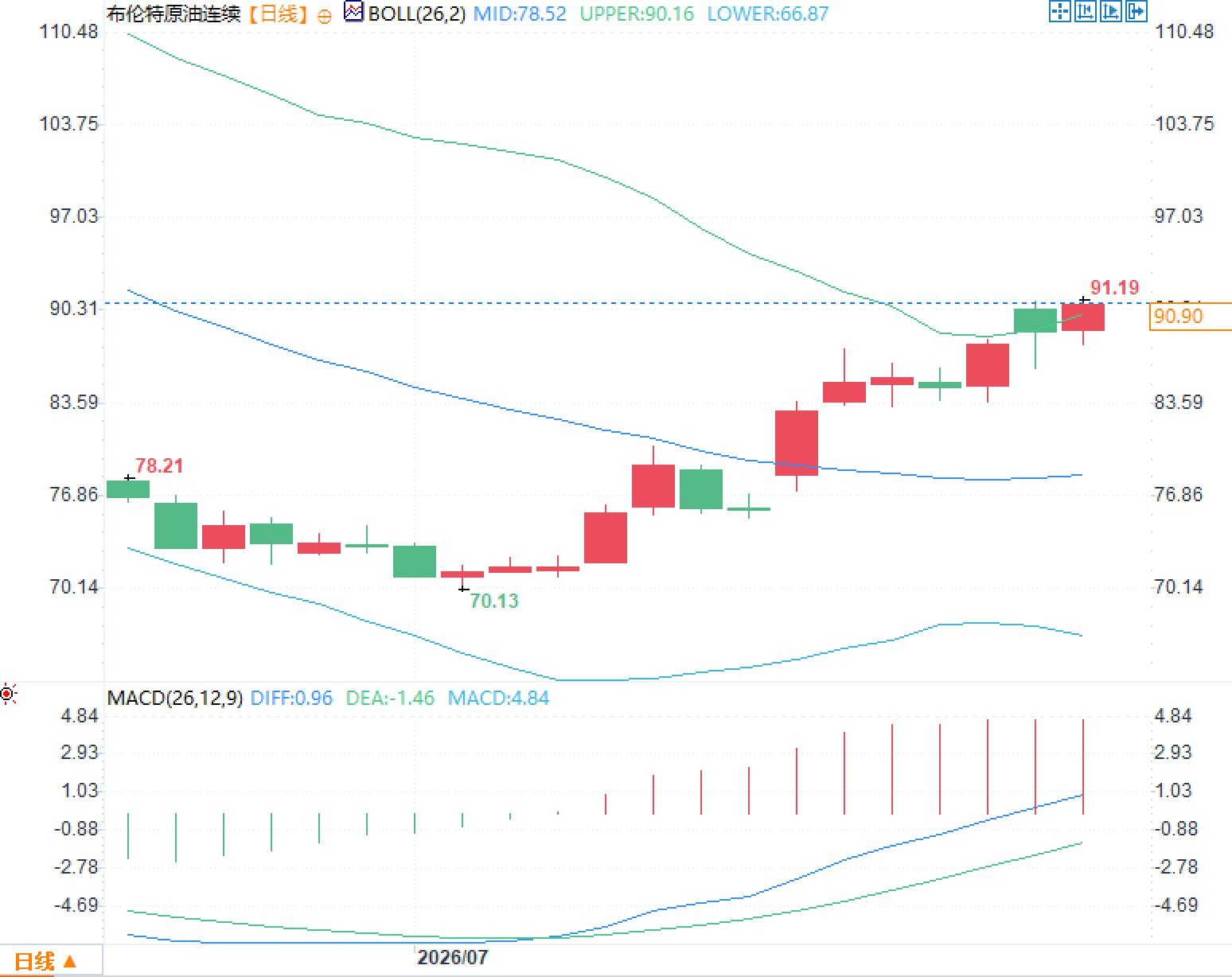 In the MACD indicator, the DIFF rose to 0.96, while the DEA remained at -1.46, and the histogram momentum expanded to 4.84. This structure reflects a strong trend recovery, but the moving average system has not yet fully digested the previous low range. A price breakout above the upper band does not necessarily mean the trend will continue; a more accurate implication is that volatility is expanding, and the market's sensitivity to new news has significantly increased. The $90 to $91.5/barrel area has become the short-term risk pricing center. If Red Sea shipments continue to remain high and tanker berthing is normal, the blockade premium in prices may be constrained; if insurance rates, freight rates, or port waiting times rise first, even if export data does not decline, near-month contracts may continue to receive support. Currently, the focus is not on single-day price fluctuations, but rather on whether spot premiums/discounts, near-to-far-month spreads, and tanker freight rates strengthen synchronously.
Yanbu's exports hit a record high, and alternative routes are nearing full capacity.
Ship tracking data shows that in the week ending July 17, crude oil shipments from Saudi Arabia's Red Sea ports reached a record 5.9 million barrels per day; the seven-day average ending July 20 fell back to 5.5 million barrels per day. These statistics include crude oil shipped to refineries in Jizan and power generation facilities along the Red Sea coast, so not all of it enters the international market, but this scale still indicates that the Red Sea system handles most of Saudi Arabia's marginal outbound shipments. The east-west pipeline connecting the eastern oil fields and Yanbu port has a designed transport capacity of approximately 7 million barrels per day, of which about 2 million barrels per day supply refineries on the west coast, leaving a theoretical export capacity of about 5 million barrels per day. The recent rise in total Red Sea port traffic to 5.5 to 5.9 million barrels per day indicates a high degree of synergy between pipelines, storage tanks, terminals, and coastal demand, with a significant decrease in system redundancy. For the crude oil market, record export volumes are both a signal of stable supply and a signal of concentrated risk. The higher the loading volume at Yanbu port, the greater the marginal importance of the Bab el-Mandeb Strait for Saudi exports. If security checks, insurance restrictions, or shipowner hedging lead to extended loading cycles, even if ports do not completely cease operations, spot supply may be tightened through mismatched shipping schedules and floating storage.Whether a blockade is effective depends not on the statement but on the shipowner's actions.
Tankers are still en route to Saudi Red Sea ports, and some Asian buyers continue to send ships to pick up cargo, indicating that the so-called blockade has not yet translated into actual closure of shipping lanes. Saudi-led forces have announced measures to protect shipping through the Bab el-Mandeb Strait, thus the market is not pricing based on a complete supply disruption scenario. However, shipping risks do not require a physical blockade to affect oil prices. Factors such as shipowners' acceptance of voyages, insurance companies' increases in surcharges, crew members' willingness to enter high-risk waters, and extended port berthing times all alter effective shipping capacity. If large tankers reroute to the southern tip of Africa, transport distance, fuel costs, and vessel occupancy time will all increase simultaneously, reducing the number of voyages that can be completed per unit of time. Forward freight rates and crude oil spreads may react before export volumes. This is also a key point of contention in the current market. Spot market participants are focused on whether actual shipments decrease, while futures funds are already factoring in tail risks. Some institutions suggest that under extreme pressure scenarios of a sustained disruption to Red Sea traffic, oil prices may retest $115 to $120 per barrel, but this calculation relies on the blockade being implemented in the long term and does not represent the baseline scenario.Oil prices broke through the upper Bollinger Band, and the risk premium entered an acceleration phase.
Observing the daily chart, Brent crude oil has rebounded continuously from around $70.13/barrel, with the latest price at approximately $91/barrel. The Bollinger Band middle line is at $78.52/barrel, the upper line is at $90.16/barrel, and the lower line is at $66.87/barrel. The price has already moved to the outside of the upper band, indicating that the short-term upward slope exceeds the normal fluctuation range of the past month. In the MACD indicator, the DIFF rose to 0.96, while the DEA remained at -1.46, and the histogram momentum expanded to 4.84. This structure reflects a strong trend recovery, but the moving average system has not yet fully digested the previous low range. A price breakout above the upper band does not necessarily mean the trend will continue; a more accurate implication is that volatility is expanding, and the market's sensitivity to new news has significantly increased. The $90 to $91.5/barrel area has become the short-term risk pricing center. If Red Sea shipments continue to remain high and tanker berthing is normal, the blockade premium in prices may be constrained; if insurance rates, freight rates, or port waiting times rise first, even if export data does not decline, near-month contracts may continue to receive support. Currently, the focus is not on single-day price fluctuations, but rather on whether spot premiums/discounts, near-to-far-month spreads, and tanker freight rates strengthen synchronously.Supply shocks will spread through refinery margins and inflation expectations.
The unique aspect of this event lies in the fact that the Red Sea is not a supplementary channel to the traditional export system, but rather serves a core diversion function after the Strait of Hormuz's passage was restricted. If both key waterways are disrupted simultaneously, the market's available transportation alternatives will be significantly reduced, and supply risks will shift from production issues to logistical problems. Continued crude oil production does not guarantee timely delivery. Extended transportation cycles will increase maritime inventories, compress the immediate feedstock available to refineries, and increase the time value of procurement. When light crude oil supply is tight, European and Asian refineries may raise prices for alternative feedstocks, and the crack spreads for gasoline, jet fuel, and middle distillates may widen accordingly. Therefore, subsequent pricing focus will shift from political statements to four sets of high-frequency indicators: actual loading volumes at Yanbu Port, vessel traffic through the Bab el-Mandeb Strait, changes in war risk surcharges, and the Brent near-month price spread.- Risk Warning and Disclaimer
- The market involves risk, and trading may not be suitable for all investors. This article is for reference only and does not constitute personal investment advice, nor does it take into account certain users’ specific investment objectives, financial situation, or other needs. Any investment decisions made based on this information are at your own risk.