Dangerous situation in the Bab el-Mandeb Strait! Will oil prices surge again tonight?
2026-07-21 21:14:16
In the recent global financial market turmoil, oil traders are facing a classic scenario of "news and market divergence": on the one hand, signals of ceasefire and peace talks are constantly being released at the diplomatic level; on the other hand, international oil prices, represented by WTI crude, continue to rise, currently trading around 84.14, showing strong downward resilience. Logically, a de-escalation of geopolitical tensions usually means a decline in safe-haven premiums and a corresponding correction in oil prices. However, the latest data shows that two oil tankers carrying Saudi crude have turned around in the Red Sea, heading towards the Suez Canal, suggesting potential problems in the Bab el-Mandeb Strait. 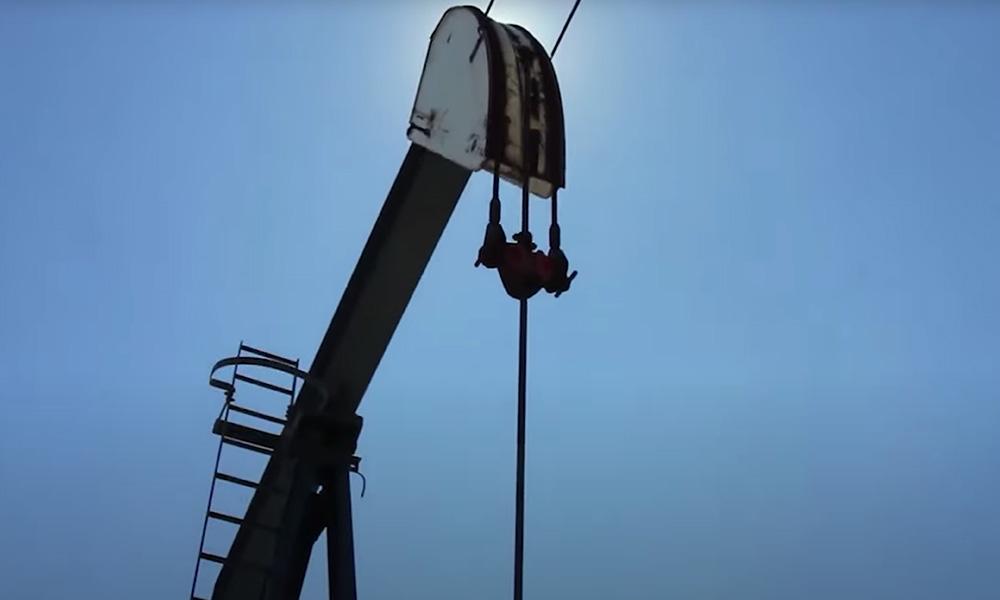
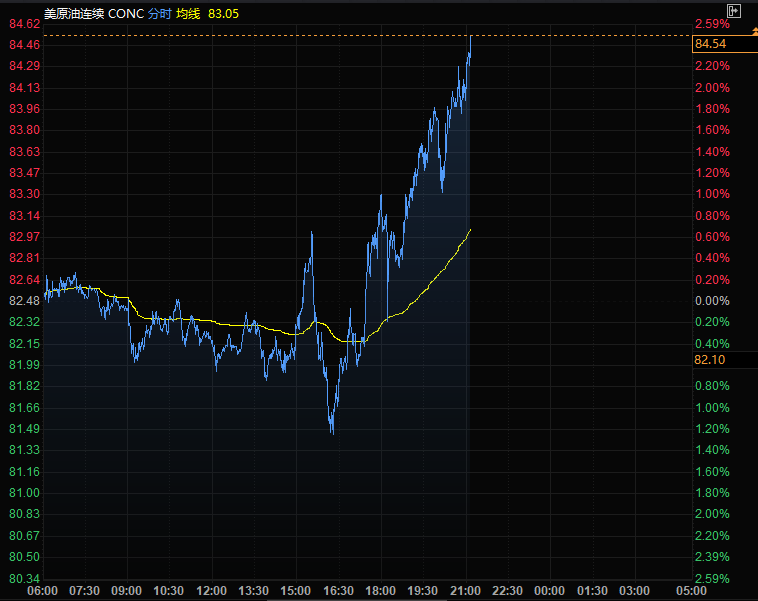 (WTI futures continuous intraday chart, source: EasyForex)
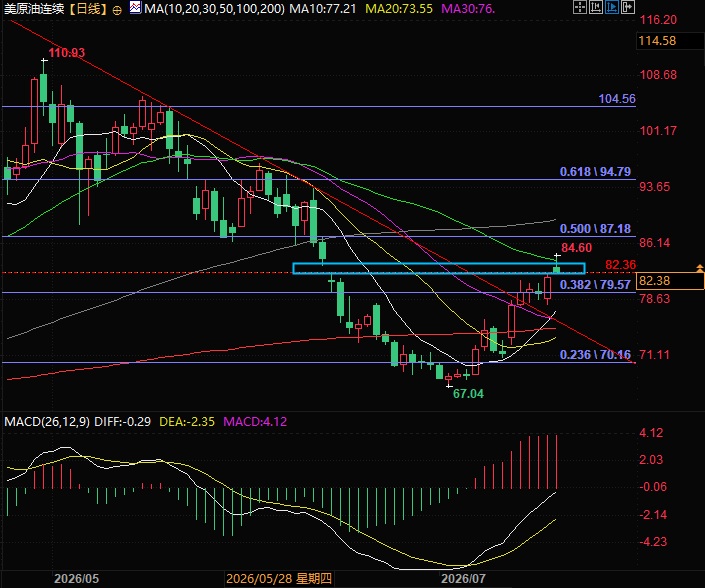 (WTI crude oil futures daily chart, source: EasyTrade) At 21:11 Beijing time, WTI crude oil is currently trading at $84.43 per barrel.
Something unusual is bound to happen; this is a clear signal to avoid danger.
There are immediate and high-risk military or security threats in the southern Red Sea and the Bab el-Mandeb Strait. Under normal circumstances, tankers would never make such a "mid-voyage U-turn" unless there is a sudden security crisis. In shipping and energy trade, tanker routes are determined before departure through speed control, scheduling, and commercial contracts. A sudden U-turn mid-voyage incurs enormous economic costs and default risks, including: Huge demurrage and fuel costs: Large tankers (VLCCs or Suezmaxes) travel thousands of extra nautical miles, incurring daily charter and fuel costs ranging from tens to hundreds of thousands of US dollars. Default due to rerouting: Bills of lading and sales contracts strictly limit delivery dates; arbitrary U-turns can lead to buyer claims or refusal to accept cargo. Soaring insurance premiums: Only when the shipowner or insurance company assesses the risk of a segment as "unacceptable" or even cancels war risk coverage for that segment will the captain receive an emergency order to forcibly turn around. (WTI futures continuous intraday chart, source: EasyForex)Disruption of physical supply chains
Diplomatic mediation can alleviate expectations, but it cannot instantly quell the real risks to physical shipping routes. The current market focus has shifted from "whether the US and Iran will hold talks" to "whether maritime energy routes are secure." The real risks of the Red Sea and the Bab el-Mandeb Strait: The Houthi attacks on the Red Sea and the Bab el-Mandeb Strait in Yemen have not ceased. On the eve of the Houthi announcement of a blockade of Saudi oil shipments, Saudi crude oil exports via Red Sea terminals had already reached a record high. During the Iran-Iraq War, Saudi Arabia diverted some crude oil shipments from the Persian Gulf to its west coast for export via the Red Sea; this alternative route played a crucial role in stabilizing international oil prices. The Houthi's subsequent announcement of a maritime blockade puts this supply route at direct risk; if the blockade is successful, it could further push up crude oil futures prices. Tanker tracking data shows that in the week ending July 17, Saudi crude oil exports via the two terminals in Yanbu Port reached a record high of 5.9 million barrels per day; this slightly decreased to 5.5 million barrels per day in the week ending July 20. This data also includes crude oil shipped to the Jizan region and supplied to refineries and power generation facilities. Meanwhile, the potential threat posed by the Strait of Hormuz, coupled with the US military's continuous precision strikes against targets within Iran and frequent countermeasures by Iran and surrounding forces against US military bases and ships around the strait, has kept this crucial chokepoint, which accounts for nearly 30% of global oil shipping, under constant pressure. As long as the "tail risk" of the Strait of Hormuz is not completely eliminated, the market will not easily relinquish its geopolitical risk premium.From "Emotional Speculation" to "Confirmed Inflation": A Profound Shift in Trading Logic
Jeff Yu, a senior analyst at BNY Mellon, stated that the current surge in energy prices is no longer solely driven by risk aversion, but has evolved into an inflationary shock with a substantial impact on global financial markets. Tightening backwardation in the spot market: Increased difficulty in physical delivery has led to a continued strengthening of the premium of near-month crude oil contracts relative to far-month contracts, indicating extremely urgent demand for immediate crude oil in the physical market, and short selling lacking support from the spot market. Concerns about double-dip inflation in the US: US gasoline retail prices have broken through the $4/gallon mark, directly transmitting Middle East geopolitical tensions to US end-consumer costs. Even with some progress in diplomatic efforts, crude oil's status as an "inflation trigger" makes it difficult for the Federal Reserve to ease its high-interest-rate expectations, thus repricing US Treasury bonds and the Fed's policy path.In summary: the threat of negotiations determines the upper limit of oil prices, while physical blockades determine the lower limit.
In summary, the US-Iran peace talks, along with the US threats and diplomatic maneuvering, have, in the short term, limited the unchecked upward surge in oil prices caused by panic. However, the actual obstacles to passage through the Red Sea and the Strait of Hormuz, the significant increase in logistics costs, and the expectation of a substantial tightening of supply have provided extremely solid support for oil prices. For traders, until the maritime logistics chain truly recovers and geopolitical blockades are completely lifted, any short-term pullbacks triggered by diplomatic positives are more likely to be seen by bullish forces in the physical market as bargain hunting rather than a trend-based bearish signal. (WTI crude oil futures daily chart, source: EasyTrade) At 21:11 Beijing time, WTI crude oil is currently trading at $84.43 per barrel.
- Risk Warning and Disclaimer
- The market involves risk, and trading may not be suitable for all investors. This article is for reference only and does not constitute personal investment advice, nor does it take into account certain users’ specific investment objectives, financial situation, or other needs. Any investment decisions made based on this information are at your own risk.