Rising oil prices fueled risk aversion, causing the euro to return to range-bound trading.
2026-07-21 15:40:16
The euro was largely unchanged against the dollar (EUR/USD) in Asian trading on Tuesday, hovering around 1.1400. Currently, the pair is in the middle of a four-week sideways trading range, with the market lacking a clear direction as investors await new fundamental catalysts. A recent mild pullback in the dollar index has provided some support for the euro. However, the global risk environment continues to limit the euro's upside, particularly with developments in the Middle East and rising oil prices keeping the market cautious about the European economic outlook.  Rising oil prices and the resulting energy cost pressures are a significant factor limiting a substantial rebound in the euro . The European economy is highly dependent on energy imports, and persistently high oil prices could increase production costs for businesses and impact market expectations for Eurozone economic growth. Recent escalation of regional tensions has raised concerns about a potential further escalation of the conflict. Energy transport routes are under scrutiny, with shipping activities in the Strait of Hormuz significantly affected. Simultaneously, some parties have announced restrictions on energy transport from the Red Sea region, exacerbating concerns about oil supply risks. If energy supplies remain affected, oil prices could rise further, pushing up global inflation expectations again. This would increase pressure on the European economy and potentially impact the European Central Bank's future monetary policy space. However, market risk sentiment has not yet completely deteriorated. Recent news of a proposed short-term ceasefire by mediators has provided some easing expectations, keeping safe-haven flows relatively stable. In Europe, investors are focused on the European Central Bank's monetary policy meeting. The market widely expects the ECB to maintain interest rates at this meeting, but traders are still watching for any signals from the central bank regarding further policy adjustments. The market still anticipates another European Central Bank (ECB) rate hike in September, and investors will focus on ECB President Christine Lagarde's remarks at the press conference. If the ECB releases a hawkish signal, the euro may receive short-term support; conversely, if the central bank emphasizes economic growth pressures, the euro may face further adjustments. The German and Eurozone ZEW economic confidence surveys will provide short-term data guidance for the euro. This indicator reflects investors' judgments on the future economic environment; if confidence improves, it may alleviate market concerns about a European economic slowdown. In the US, economic data this week is relatively limited, with market attention mainly focused on the preliminary S&P Global Manufacturing and Services Purchasing Managers' Index (PMI) to be released on Friday. Due to the lack of significant data to drive the dollar, its short-term movement may be more influenced by risk sentiment and expectations of Fed policy. Currently, the euro/dollar exchange rate is in a balanced phase. On the one hand, a weaker dollar provides support for the euro; on the other hand, energy risks and global safe-haven demand limit the euro's upside potential. The market needs to wait for new economic data and central bank signals to confirm the direction. The daily chart for the euro/dollar exchange rate shows that the exchange rate is currently fluctuating around 1.1400, remaining within a sideways structure of the past four weeks. Short-term support is initially seen around 1.1390; a break below this level could lead to a further test of the bottom of the 1.1360 range. Further support lies around 1.1300. On the upside, resistance is initially seen in the 1.1430-1.1445 area; a break above this level could lead to a challenge of the 1.1465 resistance. Currently, the daily moving average structure is flattening, market momentum is weak, and the trend direction still needs confirmation from a breakout. Looking at the 4-hour chart, the EUR/USD pair is maintaining a consolidation pattern, with the price searching for direction around 1.1400. The MACD indicator is in a weak correction phase, indicating some easing of bearish pressure, but upward momentum remains limited. The RSI indicator remains in neutral territory, suggesting a temporary balance between bullish and bearish forces. A break above 1.1445 could lead to a short-term rebound towards the 1.1465 area; a break below 1.1390 could retest the 1.1360 support. Short-term movements still depend on ECB policy expectations, changes in the US dollar, and the development of risk events.
 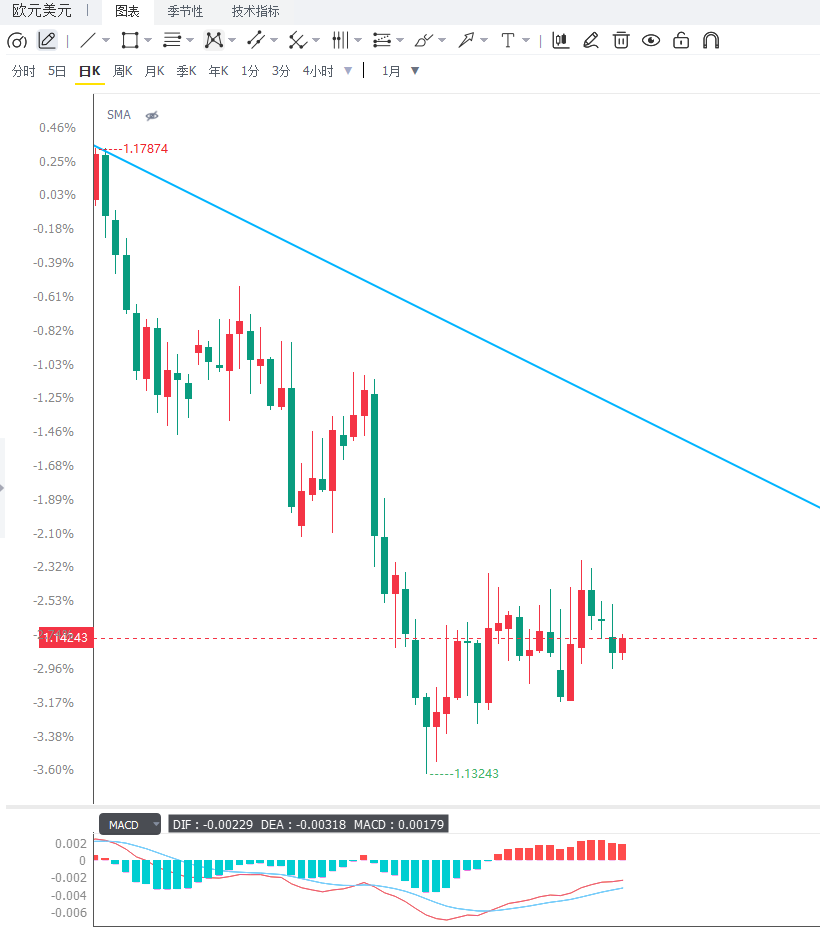 Editor's Summary: The euro/dollar exchange rate is currently in a consolidation phase, with the dollar's pullback providing support for the euro. However, rising energy prices and geopolitical risks continue to limit the euro's rebound. Going forward, the market will focus on policy signals from the European Central Bank (ECB) and changes in the energy market. If the ECB signals further tightening, the euro may gain upward momentum; however, if oil prices continue to rise and exacerbate economic pressures in Europe, the euro may still face downward pressure. In the short term, the area around 1.1400 is a battleground between bulls and bears, and 1.1360 to 1.1465 is likely to remain the main trading range. Investors should pay attention to the direction of the breakout to determine the next trend opportunity.
Rising oil prices and the resulting energy cost pressures are a significant factor limiting a substantial rebound in the euro . The European economy is highly dependent on energy imports, and persistently high oil prices could increase production costs for businesses and impact market expectations for Eurozone economic growth. Recent escalation of regional tensions has raised concerns about a potential further escalation of the conflict. Energy transport routes are under scrutiny, with shipping activities in the Strait of Hormuz significantly affected. Simultaneously, some parties have announced restrictions on energy transport from the Red Sea region, exacerbating concerns about oil supply risks. If energy supplies remain affected, oil prices could rise further, pushing up global inflation expectations again. This would increase pressure on the European economy and potentially impact the European Central Bank's future monetary policy space. However, market risk sentiment has not yet completely deteriorated. Recent news of a proposed short-term ceasefire by mediators has provided some easing expectations, keeping safe-haven flows relatively stable. In Europe, investors are focused on the European Central Bank's monetary policy meeting. The market widely expects the ECB to maintain interest rates at this meeting, but traders are still watching for any signals from the central bank regarding further policy adjustments. The market still anticipates another European Central Bank (ECB) rate hike in September, and investors will focus on ECB President Christine Lagarde's remarks at the press conference. If the ECB releases a hawkish signal, the euro may receive short-term support; conversely, if the central bank emphasizes economic growth pressures, the euro may face further adjustments. The German and Eurozone ZEW economic confidence surveys will provide short-term data guidance for the euro. This indicator reflects investors' judgments on the future economic environment; if confidence improves, it may alleviate market concerns about a European economic slowdown. In the US, economic data this week is relatively limited, with market attention mainly focused on the preliminary S&P Global Manufacturing and Services Purchasing Managers' Index (PMI) to be released on Friday. Due to the lack of significant data to drive the dollar, its short-term movement may be more influenced by risk sentiment and expectations of Fed policy. Currently, the euro/dollar exchange rate is in a balanced phase. On the one hand, a weaker dollar provides support for the euro; on the other hand, energy risks and global safe-haven demand limit the euro's upside potential. The market needs to wait for new economic data and central bank signals to confirm the direction. The daily chart for the euro/dollar exchange rate shows that the exchange rate is currently fluctuating around 1.1400, remaining within a sideways structure of the past four weeks. Short-term support is initially seen around 1.1390; a break below this level could lead to a further test of the bottom of the 1.1360 range. Further support lies around 1.1300. On the upside, resistance is initially seen in the 1.1430-1.1445 area; a break above this level could lead to a challenge of the 1.1465 resistance. Currently, the daily moving average structure is flattening, market momentum is weak, and the trend direction still needs confirmation from a breakout. Looking at the 4-hour chart, the EUR/USD pair is maintaining a consolidation pattern, with the price searching for direction around 1.1400. The MACD indicator is in a weak correction phase, indicating some easing of bearish pressure, but upward momentum remains limited. The RSI indicator remains in neutral territory, suggesting a temporary balance between bullish and bearish forces. A break above 1.1445 could lead to a short-term rebound towards the 1.1465 area; a break below 1.1390 could retest the 1.1360 support. Short-term movements still depend on ECB policy expectations, changes in the US dollar, and the development of risk events. Editor's Summary: The euro/dollar exchange rate is currently in a consolidation phase, with the dollar's pullback providing support for the euro. However, rising energy prices and geopolitical risks continue to limit the euro's rebound. Going forward, the market will focus on policy signals from the European Central Bank (ECB) and changes in the energy market. If the ECB signals further tightening, the euro may gain upward momentum; however, if oil prices continue to rise and exacerbate economic pressures in Europe, the euro may still face downward pressure. In the short term, the area around 1.1400 is a battleground between bulls and bears, and 1.1360 to 1.1465 is likely to remain the main trading range. Investors should pay attention to the direction of the breakout to determine the next trend opportunity.
- Risk Warning and Disclaimer
- The market involves risk, and trading may not be suitable for all investors. This article is for reference only and does not constitute personal investment advice, nor does it take into account certain users’ specific investment objectives, financial situation, or other needs. Any investment decisions made based on this information are at your own risk.