A chart: The Baltic Dry Index closed slightly lower, while Capesize vessels rebounded to offset downward market pressure.
2026-07-21 23:28:16
Latest data shows that the Baltic Dry Index (BDI) closed at 2670 points on July 21, 2026, a new low since July 2, 2026, down 0.04% month-on-month, marking the fifth consecutive day of decline (including zero growth). Looking at the short-term charts, the BDI has seen positive growth 6 times, negative growth 5 times, and zero growth in the last 11 BDI data points. Specifically, the Panamax Freight Index (BPI) closed at 2181 points, down 2.07% from the previous value; the Capesize Freight Index (BCI) closed at 3930 points, up 1.05%; and the Supramax Freight Index (BSI) closed at 1730 points, down 0.46%. For detailed charts of the latest 720-day and 10-year trends of the Baltic Dry Index and its three main sub-indices, please refer to the charts specially created by FX678. 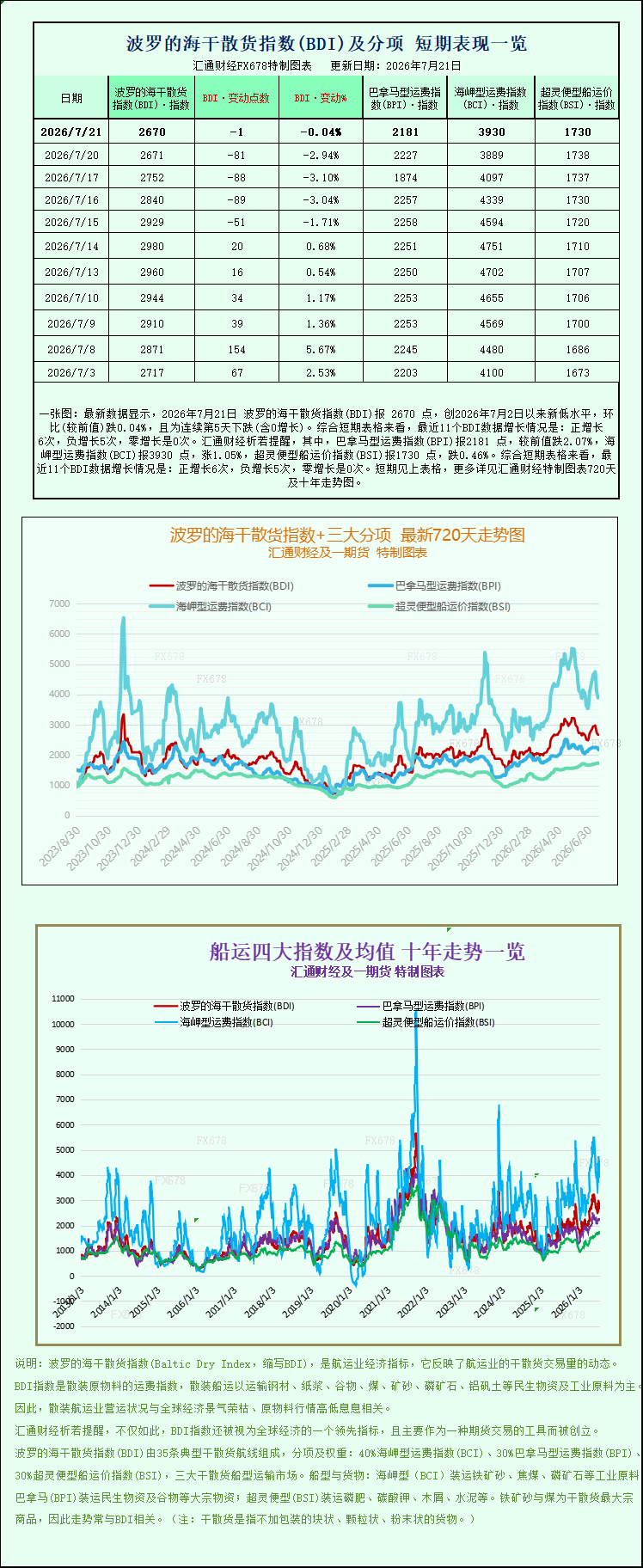 On July 21, 2026, the latest market data showed that the international dry bulk shipping market was experiencing a slight correction and structural differentiation. The core Baltic Dry Index (BDI) declined slightly, but Capesize (Good Hope Size) vessel freight rates saw a temporary rebound, effectively offsetting the market losses caused by the decline in freight rates for small and medium-sized vessels. This resulted in the smallest decline in the index since the start of this market adjustment cycle, highlighting the overall market resilience. Recently, the global dry bulk shipping market has been in a period of fluctuation and adjustment. Affected by multiple factors such as commodity price fluctuations, regional weather disturbances, and changes in port operation rhythms, freight rates for different vessel types have shown significant divergence. Large mining vessels have bucked the trend and strengthened, while small and medium-sized vessels mainly transporting coal and grain have faced downward pressure. Specifically, the Baltic Dry Index (BDI), which covers the freight rates of the three major vessel types—Capesize, Panamax, and Supramax—has slightly declined, with the overall trend stabilizing. As of the close of trading on July 21, the Baltic Dry Index (BDI) fell 1 point, a drop of only 0.04%, closing at 2670 points. In terms of the magnitude of the decline, this slight adjustment represents the smallest drop during the current market downturn, fully reflecting the continued weakening of downward momentum. The strong rebound of the Capesize vessel sector has become the core support for stabilizing the market, effectively alleviating the downward pressure on the entire market and preventing a sharp decline in the index. As the mainstay of large dry bulk shipping, the Capesize vessel market saw a crucial recovery today, ending its previous continuous slump. Data shows that the Baltic Capesize freight rate index rose sharply by 41 points, an increase of 1.1%, closing at 3930 points. This is the first rebound in the index since July 14, marking a phase of recovery in the large ore transport vessel market. In terms of freight revenue, the average daily revenue of Capesize vessels mainly engaged in the transportation of 150,000-ton bulk raw materials also increased, with average daily revenue increasing by $369 compared to the previous trading day, reaching a latest average daily revenue of $32,137. The recovery in the Capesize vessel market is mainly attributed to the phased recovery in global seaborne iron ore demand. Previously, large mining vessel freight rates remained sluggish due to factors such as extreme weather, port congestion, and a slowdown in trade. However, recently, the steady increase in overseas mine shipments, coupled with restocking demand from some steel mills, has led to an increase in long-haul iron ore shipping orders, driving a rebound in large vessel freight rates. However, the market recovery is relatively limited and has not yet formed a sustained upward trend, remaining within a range of fluctuation and correction. It is worth noting that the weak fundamentals of the iron ore industry chain cast a shadow over the future trend of the Capesize vessel market. Typhoon Bavi, which previously affected operations at Chinese coastal ports, has gradually dissipated, completely alleviating port congestion. The concentrated arrival of previously accumulated cargo has led to a rapid accumulation of domestic iron ore spot inventories, and market concerns about excessive raw material inventories continue to rise. As a result, domestic iron ore futures prices fell sharply, while prices of other ferrous commodities such as coking coal and coke fell even more significantly. Weak commodity prices and sluggish end-user demand also limited the potential for a recovery in seaborne iron ore demand, restricting the rebound in Capesize freight rates. In stark contrast to the Capesize rebound, the medium and small dry bulk shipping markets generally faced downward pressure, becoming a major factor dragging down the overall market index. Panamax freight rates saw the most significant decline, with the Baltic Panamax Index falling 46 points, a single-day drop of 2.1%, closing at 2181 points. Correspondingly, vessel earnings declined as well. Panamax vessels, primarily engaged in the transport of 60,000 to 70,000 tons of coal, grain, and other bulk cargo, saw their average daily earnings decrease by $416, with the latest average daily earnings falling to $19,629. The core reason for the weakening Panamax market is the temporary weakness in global seaborne energy and food demand. Global coal demand is currently subdued, with the peak summer energy restocking season over and coal import demand in Eurasia contracting. Simultaneously, the international grain market is well-supplied, and the growth rate of grain shipping orders has slowed. These two factors combined have resulted in a loose supply and demand situation for medium-sized bulk carriers, putting continued pressure on freight rates. The small vessel market has also ended its previous stable trend, experiencing a temporary correction. The Supramax freight rate index fell 8 points, or 0.5%, to 1730 points, marking the first decline for this vessel type since early July, signifying a break in the stable operation of small bulk carriers. Supramax vessels mainly handle short-haul, small-volume bulk cargo transportation, covering a wide range of commodities including building materials, minor minerals, and grains. The decline in their freight rates reflects an overall cooling of global small- and medium-sized commodity trade activity and a contraction in regional shipping demand. In summary, the slight decline in the Baltic Dry Index is essentially a result of structural market differentiation. Large ore carriers rebounded due to restocking demand, providing support to the overall market; while smaller vessels continued to decline due to weak demand for traditional cargoes such as coal and grains. This interplay of bullish and bearish forces ultimately kept the market index stable with minor adjustments. In the short term, the global dry bulk shipping market will continue its divergence in vessel types. Future trends will heavily depend on the recovery of domestic demand for ferrous metals, the pace of overseas mine shipments, and changes in global commodity trade policies. The market as a whole is expected to remain volatile.
On July 21, 2026, the latest market data showed that the international dry bulk shipping market was experiencing a slight correction and structural differentiation. The core Baltic Dry Index (BDI) declined slightly, but Capesize (Good Hope Size) vessel freight rates saw a temporary rebound, effectively offsetting the market losses caused by the decline in freight rates for small and medium-sized vessels. This resulted in the smallest decline in the index since the start of this market adjustment cycle, highlighting the overall market resilience. Recently, the global dry bulk shipping market has been in a period of fluctuation and adjustment. Affected by multiple factors such as commodity price fluctuations, regional weather disturbances, and changes in port operation rhythms, freight rates for different vessel types have shown significant divergence. Large mining vessels have bucked the trend and strengthened, while small and medium-sized vessels mainly transporting coal and grain have faced downward pressure. Specifically, the Baltic Dry Index (BDI), which covers the freight rates of the three major vessel types—Capesize, Panamax, and Supramax—has slightly declined, with the overall trend stabilizing. As of the close of trading on July 21, the Baltic Dry Index (BDI) fell 1 point, a drop of only 0.04%, closing at 2670 points. In terms of the magnitude of the decline, this slight adjustment represents the smallest drop during the current market downturn, fully reflecting the continued weakening of downward momentum. The strong rebound of the Capesize vessel sector has become the core support for stabilizing the market, effectively alleviating the downward pressure on the entire market and preventing a sharp decline in the index. As the mainstay of large dry bulk shipping, the Capesize vessel market saw a crucial recovery today, ending its previous continuous slump. Data shows that the Baltic Capesize freight rate index rose sharply by 41 points, an increase of 1.1%, closing at 3930 points. This is the first rebound in the index since July 14, marking a phase of recovery in the large ore transport vessel market. In terms of freight revenue, the average daily revenue of Capesize vessels mainly engaged in the transportation of 150,000-ton bulk raw materials also increased, with average daily revenue increasing by $369 compared to the previous trading day, reaching a latest average daily revenue of $32,137. The recovery in the Capesize vessel market is mainly attributed to the phased recovery in global seaborne iron ore demand. Previously, large mining vessel freight rates remained sluggish due to factors such as extreme weather, port congestion, and a slowdown in trade. However, recently, the steady increase in overseas mine shipments, coupled with restocking demand from some steel mills, has led to an increase in long-haul iron ore shipping orders, driving a rebound in large vessel freight rates. However, the market recovery is relatively limited and has not yet formed a sustained upward trend, remaining within a range of fluctuation and correction. It is worth noting that the weak fundamentals of the iron ore industry chain cast a shadow over the future trend of the Capesize vessel market. Typhoon Bavi, which previously affected operations at Chinese coastal ports, has gradually dissipated, completely alleviating port congestion. The concentrated arrival of previously accumulated cargo has led to a rapid accumulation of domestic iron ore spot inventories, and market concerns about excessive raw material inventories continue to rise. As a result, domestic iron ore futures prices fell sharply, while prices of other ferrous commodities such as coking coal and coke fell even more significantly. Weak commodity prices and sluggish end-user demand also limited the potential for a recovery in seaborne iron ore demand, restricting the rebound in Capesize freight rates. In stark contrast to the Capesize rebound, the medium and small dry bulk shipping markets generally faced downward pressure, becoming a major factor dragging down the overall market index. Panamax freight rates saw the most significant decline, with the Baltic Panamax Index falling 46 points, a single-day drop of 2.1%, closing at 2181 points. Correspondingly, vessel earnings declined as well. Panamax vessels, primarily engaged in the transport of 60,000 to 70,000 tons of coal, grain, and other bulk cargo, saw their average daily earnings decrease by $416, with the latest average daily earnings falling to $19,629. The core reason for the weakening Panamax market is the temporary weakness in global seaborne energy and food demand. Global coal demand is currently subdued, with the peak summer energy restocking season over and coal import demand in Eurasia contracting. Simultaneously, the international grain market is well-supplied, and the growth rate of grain shipping orders has slowed. These two factors combined have resulted in a loose supply and demand situation for medium-sized bulk carriers, putting continued pressure on freight rates. The small vessel market has also ended its previous stable trend, experiencing a temporary correction. The Supramax freight rate index fell 8 points, or 0.5%, to 1730 points, marking the first decline for this vessel type since early July, signifying a break in the stable operation of small bulk carriers. Supramax vessels mainly handle short-haul, small-volume bulk cargo transportation, covering a wide range of commodities including building materials, minor minerals, and grains. The decline in their freight rates reflects an overall cooling of global small- and medium-sized commodity trade activity and a contraction in regional shipping demand. In summary, the slight decline in the Baltic Dry Index is essentially a result of structural market differentiation. Large ore carriers rebounded due to restocking demand, providing support to the overall market; while smaller vessels continued to decline due to weak demand for traditional cargoes such as coal and grains. This interplay of bullish and bearish forces ultimately kept the market index stable with minor adjustments. In the short term, the global dry bulk shipping market will continue its divergence in vessel types. Future trends will heavily depend on the recovery of domestic demand for ferrous metals, the pace of overseas mine shipments, and changes in global commodity trade policies. The market as a whole is expected to remain volatile.
- Risk Warning and Disclaimer
- The market involves risk, and trading may not be suitable for all investors. This article is for reference only and does not constitute personal investment advice, nor does it take into account certain users’ specific investment objectives, financial situation, or other needs. Any investment decisions made based on this information are at your own risk.