UK employment data releases and the inauguration of the new Chancellor of the Exchequer caused the pound/dollar exchange rate to break down.
2026-07-22 01:24:14
On Tuesday (July 21), a UK employment report released in early European trading showed that the country's labor market was stabilizing overall, but the recovery was weak and the overall economic climate was sluggish. Data showed that the UK unemployment rate fell slightly to 4.9% in the third to fifth month of this year, while the employment rate rose slightly to 75.1%. Specifically, the number of new unemployment claims was only 6,700, significantly lower than the market expectation of 29,000; however, the average wage growth over the three months was 4.3% year-on-year, lower than economists' forecast of 4.5%.  Overall, slowing wage growth and sluggish job market expansion further confirm the continued easing of inflationary pressures in the UK, which will alleviate the Bank of England's concerns about raising interest rates. However, it is worth noting that various employment survey data are currently inconsistent, and recent UK employment statistics have been flawed in quality. Therefore, the market should not rely solely on single-month data to make definitive judgments about the labor market and inflation trends. New Chancellor of the Exchequer Takes Office, New Electricity VAT Policy Implemented Newly appointed British Prime Minister Andy Burnham recently unveiled his first policy initiatives, appointing John Healy as Chancellor of the Exchequer yesterday. Healy previously held a junior position at the Treasury, but his recent political career has primarily focused on his time at the Ministry of Defence. During his tenure at the Ministry of Defence, he publicly criticized the Treasury's conservative policies, arguing they hindered national development planning, and advocated for increasing UK defense spending to 3% of GDP by 2030. Upon assuming his new role as Chancellor, Healy made his first public statement, clearly stating that strict control of fiscal revenue and expenditure and maintaining market credit are the core policy directions of his government. The UK is currently burdened by high debt and financing costs, resulting in severely limited fiscal space and making it difficult to implement large-scale fiscal expenditures without financial support. This statement accurately reflects the current economic situation in the UK. To alleviate the pressure of the cost of living for its citizens, the UK government has introduced its first policy to benefit the people: from October 1, 2026, the VAT on household electricity will be temporarily reduced from 5% to 0%, for a period of six months. After the policy is implemented, the average household's annual electricity bill will be reduced by approximately £45, and the implementation cost for the 2026-2027 fiscal year is approximately £850 million. The UK government stated that the funding for this policy will be raised by canceling the £1.8 billion digital identity project planned by the previous government. However, the Institute for Fiscal Studies points out that the digital identity project has never had a clear source of funding, so canceling the project will not directly create a substantial fiscal surplus, and the government's explanation of funding is unconvincing. From a macroeconomic perspective, although this tax reduction policy can slightly lower overall inflation and reduce the burden on residents, the policy's scope and strength are limited, and its effect on boosting the overall economy is relatively weak. The market will closely monitor the policy statements of the new UK government, with the November budget being a key event influencing the pound's exchange rate. Technical Analysis: GBP/USD 4-hour chart.
 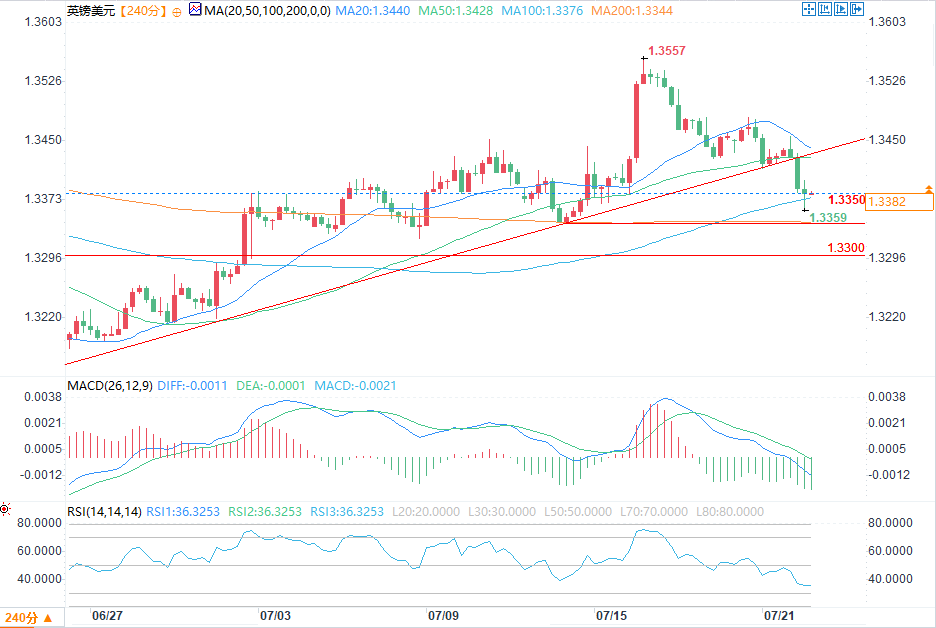 (GBP/USD 4-hour chart source: FX678) The capital markets have shown clear signs of caution and skepticism towards the new UK government. Since the announcement of the appointments, the yield on the benchmark 10-year UK government bond has risen by 6 basis points, breaking through the key psychological level of 5% again. In terms of exchange rates, the pound has been weak today, ranking first among major global currencies in terms of decline. As of this writing, the pound has fallen by approximately 50 points against the dollar, officially breaking below the one-month-long uptrend line, indicating significant short-term pressure. Regarding support levels, the first short-term support for GBP/USD is at last week's low of 1.3350, with the core support level below at 1.3300. Only a rebound and stabilization above 1.3450 can completely reverse the short-term bearish trend.
Overall, slowing wage growth and sluggish job market expansion further confirm the continued easing of inflationary pressures in the UK, which will alleviate the Bank of England's concerns about raising interest rates. However, it is worth noting that various employment survey data are currently inconsistent, and recent UK employment statistics have been flawed in quality. Therefore, the market should not rely solely on single-month data to make definitive judgments about the labor market and inflation trends. New Chancellor of the Exchequer Takes Office, New Electricity VAT Policy Implemented Newly appointed British Prime Minister Andy Burnham recently unveiled his first policy initiatives, appointing John Healy as Chancellor of the Exchequer yesterday. Healy previously held a junior position at the Treasury, but his recent political career has primarily focused on his time at the Ministry of Defence. During his tenure at the Ministry of Defence, he publicly criticized the Treasury's conservative policies, arguing they hindered national development planning, and advocated for increasing UK defense spending to 3% of GDP by 2030. Upon assuming his new role as Chancellor, Healy made his first public statement, clearly stating that strict control of fiscal revenue and expenditure and maintaining market credit are the core policy directions of his government. The UK is currently burdened by high debt and financing costs, resulting in severely limited fiscal space and making it difficult to implement large-scale fiscal expenditures without financial support. This statement accurately reflects the current economic situation in the UK. To alleviate the pressure of the cost of living for its citizens, the UK government has introduced its first policy to benefit the people: from October 1, 2026, the VAT on household electricity will be temporarily reduced from 5% to 0%, for a period of six months. After the policy is implemented, the average household's annual electricity bill will be reduced by approximately £45, and the implementation cost for the 2026-2027 fiscal year is approximately £850 million. The UK government stated that the funding for this policy will be raised by canceling the £1.8 billion digital identity project planned by the previous government. However, the Institute for Fiscal Studies points out that the digital identity project has never had a clear source of funding, so canceling the project will not directly create a substantial fiscal surplus, and the government's explanation of funding is unconvincing. From a macroeconomic perspective, although this tax reduction policy can slightly lower overall inflation and reduce the burden on residents, the policy's scope and strength are limited, and its effect on boosting the overall economy is relatively weak. The market will closely monitor the policy statements of the new UK government, with the November budget being a key event influencing the pound's exchange rate. Technical Analysis: GBP/USD 4-hour chart. (GBP/USD 4-hour chart source: FX678) The capital markets have shown clear signs of caution and skepticism towards the new UK government. Since the announcement of the appointments, the yield on the benchmark 10-year UK government bond has risen by 6 basis points, breaking through the key psychological level of 5% again. In terms of exchange rates, the pound has been weak today, ranking first among major global currencies in terms of decline. As of this writing, the pound has fallen by approximately 50 points against the dollar, officially breaking below the one-month-long uptrend line, indicating significant short-term pressure. Regarding support levels, the first short-term support for GBP/USD is at last week's low of 1.3350, with the core support level below at 1.3300. Only a rebound and stabilization above 1.3450 can completely reverse the short-term bearish trend.
- Risk Warning and Disclaimer
- The market involves risk, and trading may not be suitable for all investors. This article is for reference only and does not constitute personal investment advice, nor does it take into account certain users’ specific investment objectives, financial situation, or other needs. Any investment decisions made based on this information are at your own risk.