Japan's interest rate disaster: Without the Bank of Japan's continued bond purchases, Japan's long-term yields would have soared to double digits.
2026-07-22 02:00:14
Japan is facing a severe crisis. Its massive public debt has forced the Bank of Japan to continuously purchase government bonds. If this operation were to cease, long-term bond yields would rise uncontrollably, pushing Japan towards a debt crisis. However, artificially suppressing yields would put downward pressure on the yen: in the absence of sufficient risk premium, capital would flee the Japanese market. This is why official foreign exchange intervention and the repatriation of funds from the Government Pension Investment Fund (GPIF) have failed to stabilize the yen. The root cause of the yen's continued depreciation lies in its excessively high debt level. Only by reducing debt can Japan end the cycle of currency depreciation it has faced since the COVID-19 pandemic.  The core question of this whole affair is: if the Bank of Japan abandons yield control, how much further can Japanese government bond yields rise? Imagine if they only rise by 10 to 20 basis points; the risk wouldn't be too alarming. But if they rise by hundreds of basis points or more, the consequences would be terrifying—considering that Japan's total public debt has reached 240% of its GDP. This article will explore this question. My view is that once the Bank of Japan stops its continuous bond purchases, Japanese long-term government bond yields will reach double digits. In fact, Japan is already deeply mired in a serious debt crisis. This crisis is not just about Japan. In 2022, the European Central Bank (ECB) proactively suppressed Italian and Spanish bond yields and introduced a new tool—the Transmission Protection Instrument (TPI)—artificially lowering the yields of these two countries' bonds in the long term. A "natural experiment" occurred in 2022: ECB President Christine Lagarde made a gaffe at a press conference, stating that lowering bond yields was not the ECB's responsibility. This event confirms that without policy support, the yields of these countries' bonds would rise significantly. Globally, there are numerous instances of artificially suppressing yields and concealing debt crises.
 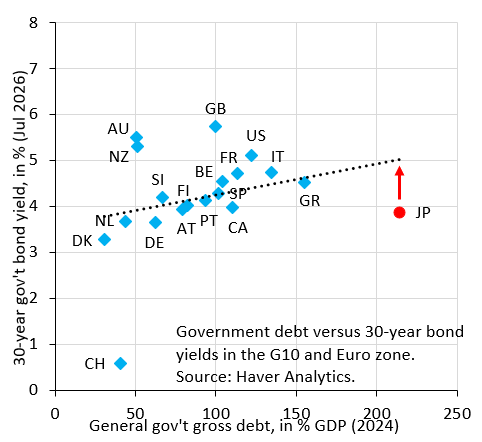 The vertical axis of the chart above represents the latest 30-year government bond yields of the G10 countries, and the horizontal axis represents the ratio of total public debt to GDP in each country in 2024. The dotted line in the chart shows a positive correlation between long-term yield levels and the size of public debt, but the correlation is not significant; that is, the slope of this trend line is quite gentle. Based solely on this trend line, the yield on Japanese 30-year government bonds should theoretically be about 100 basis points higher than the current level.
  However, the first chart and its black dotted line have a major flaw: the data is affected by the yield control policies of central banks in various countries. The data points from Japan clearly illustrate this point; at the same time, as mentioned earlier, many debt-ridden Eurozone countries also artificially suppress yields.
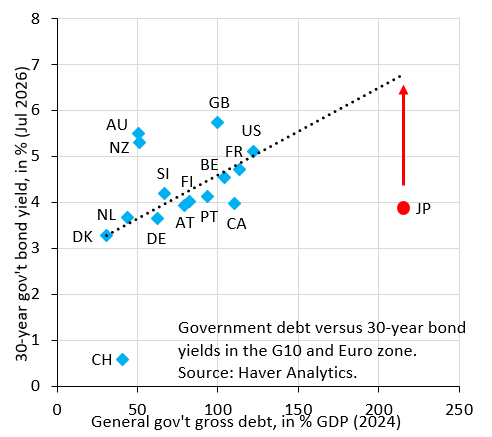
 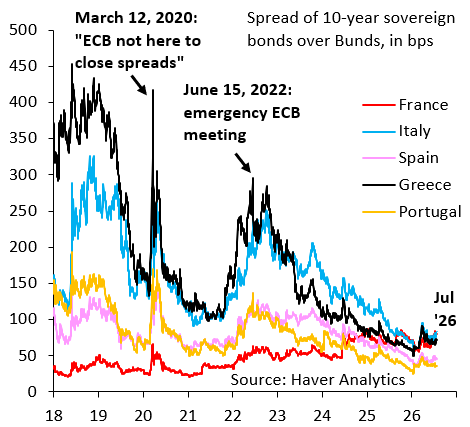 The second chart removes the most extreme yield control measures from Japan, Greece, Italy, and Spain in the sample, and redraws the trend line based on this "purified" data. According to this calculation, the reasonable level for the Japanese 30-year government bond yield should be 300 basis points higher than the current level. In my opinion, this figure still severely underestimates the potential upside for yields. In this "purified sample," central banks of many countries, including the US, UK, and France, have also significantly increased their holdings of their own government bonds. If all bond-buying activities were included in the model and removed, the slope of the trend line would be even steeper. In conclusion, I maintain my judgment: without the support of the Bank of Japan, the yield on long-term Japanese government bonds will rise to double digits. This conclusion sounds very radical, but it is actually based on evidence. The "natural experiment" conducted by the European Central Bank in March 2020 can explain the underlying logic. That month, Lagarde made a gaffe at a press conference, stating, "The ECB's responsibility is not to narrow interest rate spreads." As shown in the chart, the spread between 10-year government bonds from peripheral Eurozone countries and German bonds surged instantly; had the ECB not immediately launched emergency quantitative easing to stabilize the spread, it would have widened further. I believe that without the market-rescue policies implemented at that time, the yields on bonds from neighboring countries would have reached double digits within just a few days. Therefore, the "shadow yield" (the real yield after deviating from central bank control) of Japanese 30-year government bonds reaching 10% or even higher is entirely reasonable.
The core question of this whole affair is: if the Bank of Japan abandons yield control, how much further can Japanese government bond yields rise? Imagine if they only rise by 10 to 20 basis points; the risk wouldn't be too alarming. But if they rise by hundreds of basis points or more, the consequences would be terrifying—considering that Japan's total public debt has reached 240% of its GDP. This article will explore this question. My view is that once the Bank of Japan stops its continuous bond purchases, Japanese long-term government bond yields will reach double digits. In fact, Japan is already deeply mired in a serious debt crisis. This crisis is not just about Japan. In 2022, the European Central Bank (ECB) proactively suppressed Italian and Spanish bond yields and introduced a new tool—the Transmission Protection Instrument (TPI)—artificially lowering the yields of these two countries' bonds in the long term. A "natural experiment" occurred in 2022: ECB President Christine Lagarde made a gaffe at a press conference, stating that lowering bond yields was not the ECB's responsibility. This event confirms that without policy support, the yields of these countries' bonds would rise significantly. Globally, there are numerous instances of artificially suppressing yields and concealing debt crises. The vertical axis of the chart above represents the latest 30-year government bond yields of the G10 countries, and the horizontal axis represents the ratio of total public debt to GDP in each country in 2024. The dotted line in the chart shows a positive correlation between long-term yield levels and the size of public debt, but the correlation is not significant; that is, the slope of this trend line is quite gentle. Based solely on this trend line, the yield on Japanese 30-year government bonds should theoretically be about 100 basis points higher than the current level. However, the first chart and its black dotted line have a major flaw: the data is affected by the yield control policies of central banks in various countries. The data points from Japan clearly illustrate this point; at the same time, as mentioned earlier, many debt-ridden Eurozone countries also artificially suppress yields. The second chart removes the most extreme yield control measures from Japan, Greece, Italy, and Spain in the sample, and redraws the trend line based on this "purified" data. According to this calculation, the reasonable level for the Japanese 30-year government bond yield should be 300 basis points higher than the current level. In my opinion, this figure still severely underestimates the potential upside for yields. In this "purified sample," central banks of many countries, including the US, UK, and France, have also significantly increased their holdings of their own government bonds. If all bond-buying activities were included in the model and removed, the slope of the trend line would be even steeper. In conclusion, I maintain my judgment: without the support of the Bank of Japan, the yield on long-term Japanese government bonds will rise to double digits. This conclusion sounds very radical, but it is actually based on evidence. The "natural experiment" conducted by the European Central Bank in March 2020 can explain the underlying logic. That month, Lagarde made a gaffe at a press conference, stating, "The ECB's responsibility is not to narrow interest rate spreads." As shown in the chart, the spread between 10-year government bonds from peripheral Eurozone countries and German bonds surged instantly; had the ECB not immediately launched emergency quantitative easing to stabilize the spread, it would have widened further. I believe that without the market-rescue policies implemented at that time, the yields on bonds from neighboring countries would have reached double digits within just a few days. Therefore, the "shadow yield" (the real yield after deviating from central bank control) of Japanese 30-year government bonds reaching 10% or even higher is entirely reasonable.
- Risk Warning and Disclaimer
- The market involves risk, and trading may not be suitable for all investors. This article is for reference only and does not constitute personal investment advice, nor does it take into account certain users’ specific investment objectives, financial situation, or other needs. Any investment decisions made based on this information are at your own risk.