Brent crude oil broke through 95, and short-term risks are expected to have been fully released.
2026-07-22 17:50:16
International crude oil prices surged, rising over 4% intraday, driven by escalating geopolitical tensions in the Middle East. US Secretary of State Marco Rubio publicly stated that Iran lacked sincerity in negotiations, adding that the US would weaken Iran's ability to disrupt shipping to the best of its ability, while remaining willing to reach a diplomatic solution. The deadlock in US-Iran negotiations over the Strait of Hormuz, a crucial oil shipping route, became the core geopolitical driver of this price surge. The tense geopolitical situation directly propelled the sharp rise in crude oil prices. At the ASEAN Foreign Ministers' Meeting held in the Philippines, Rubio reiterated the US's commitment to diplomatic mediation but accused Iran of violating previous agreements on Strait control, stating that if Iran was unwilling to engage in sincere negotiations, the US would take all necessary measures to protect its own and its allies' core interests. 
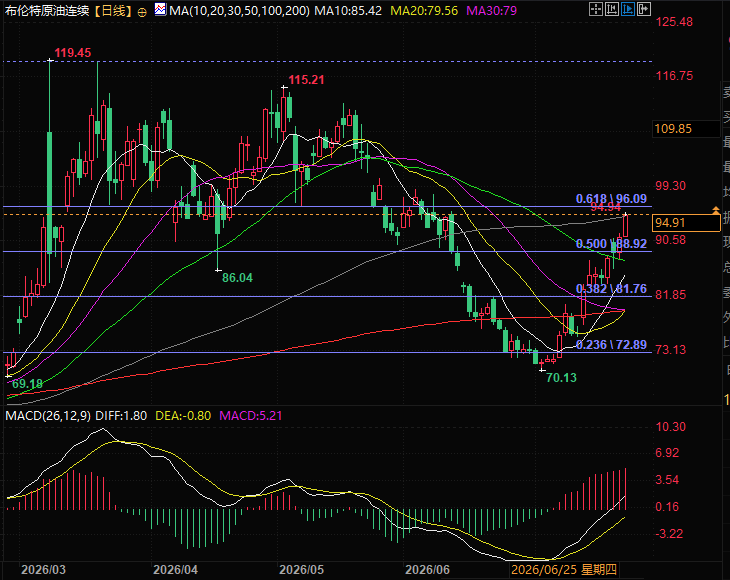 (Brent crude oil futures daily chart, source: EasyTrade) At 17:32 Beijing time, Brent crude oil futures were trading at $95.06 per ounce.
The US continues its airstrikes against Iran, bringing the Taiwan Strait dispute to a complete stalemate.
Tensions in the Middle East have remained high recently, with the US military launching eleven consecutive nights of airstrikes against Iran. This latest round of strikes, led by the US Central Command, targeted Iran's military command center, naval forces, aircraft hangars, drone storage facilities, and various military logistical infrastructure. The US has explicitly stated that the core objective of these military operations is to weaken Iran's ability to disrupt commercial shipping in the Strait of Hormuz. As a crucial shipping route for global crude oil and other major commodities, the Strait of Hormuz has consistently been a central point of contention in US-Iran negotiations. Rubio accused Iran of attempting to control the waterway and warned that if left unchecked, it would set a highly risky global precedent.The failure of peace talks and the risk of stagflation have boosted oil prices.
Market analysts point out that the lack of breakthroughs in US-Iran talks has shifted market focus back to inflation and stagflation risks, further supporting stronger oil prices. Deutsche Bank analyst Jim Reid stated that Brent crude has once again stabilized above $90 per barrel after more than a month, even breaking through $92 per barrel in early trading. Coupled with the continued US military strikes against Iran, there is currently no significant downward pressure on oil prices, and market concerns about widespread stagflation are resurfacing. However, a spokesperson for the Iranian Interior Ministry stated that there are currently no negotiations with the US. "Information exchange" with the US is possible.Rising energy prices are reshaping expectations for Federal Reserve rate hikes.
The continued rise in crude oil and energy prices has completely altered market expectations for the Federal Reserve's monetary policy, with hawkish expectations for rate hikes continuing to rise. Data shows that as of Tuesday's close, the market-priced probability of a Fed rate hike in July rose to 26%, a new high since last week's weaker-than-expected US CPI data. Before the CPI data release, this probability had reached as high as 45%, and briefly fell to 10% after the data was released. Combined with the latest data from the CME FedWatch Tool, money market pricing on Wednesday morning showed a 24.1% probability of a Fed rate hike in July, and the probability of at least a 25 basis point rate hike in September had climbed to 69%.Multiple supply risks combined put pressure on global crude oil supply.
In addition to the Middle East geopolitical crisis, the global crude oil market is facing multiple supply risks, further exacerbating upward pressure on oil prices. ING analysts stated that market expectations for a temporary ceasefire between the US and Iran have completely faded, and supply risks in the energy market continue to accumulate. Meanwhile, the Black Sea oil transportation chain has experienced sudden disruptions; the Union Pipeline terminal in Russia's Caspian Sea has completely suspended receiving and loading operations for Kazakh crude oil due to successive attacks on oil tankers.With supply shortage expectations rising, oil prices are expected to remain strong in the short term.
This terminal plays a significant role in the global crude oil export market, with an average daily loading volume of 1.7 million barrels in June. If the current suspension continues, Kazakhstan will likely be forced to reduce its upstream crude oil production capacity, further widening the global crude oil supply gap and providing sustained support for stronger oil prices. Under the combined influence of multiple negative factors, the international crude oil market is expected to maintain a highly volatile and bullish trend in the short term. (Brent crude oil futures daily chart, source: EasyTrade) At 17:32 Beijing time, Brent crude oil futures were trading at $95.06 per ounce.
- Risk Warning and Disclaimer
- The market involves risk, and trading may not be suitable for all investors. This article is for reference only and does not constitute personal investment advice, nor does it take into account certain users’ specific investment objectives, financial situation, or other needs. Any investment decisions made based on this information are at your own risk.