What happened in the Kuwaiti bond market, from 40 basis points to 110 basis points?
2026-07-22 18:58:16
On Wednesday, July 22, Kuwait proceeded with the issuance of three-year, five-year, and ten-year US dollar sovereign bonds amid attacks and damage to energy and public infrastructure. Initial price guidance was set at approximately 95, 100, and 110 basis points above the yields on comparable US Treasury bonds, respectively. The issuance size is yet to be finalized. External markets did not provide a low-cost financing environment. The US dollar index was last quoted at approximately 101.15; the ten-year US Treasury yield rose to approximately 4.63%, near a two-month high; and Brent crude oil prices rose to around $94 per barrel, a daily increase of about 3%. This means that Kuwait's financing faces triple pricing pressures: rising risk-free interest rates, widening regional risk premiums, and disruptions to energy transportation. 
 If the new 10-year bond is priced 110 basis points above US Treasury yields, coupled with a 4.63% yield on 10-year US Treasury bonds, its nominal yield could be around 5.7%, significantly higher than the credit cost during the same period last year. Here, it's crucial to distinguish between two types of risk: changes in US Treasury yields determine the underlying financing cost, while changes in the Kuwaiti interest rate spread reflect sovereign event risk. Even if the conflict eases and the spread narrows, as long as US Treasury yields remain high, the issuer's overall coupon rate will be difficult to decrease rapidly. Therefore, the real signal from this transaction isn't just whether it can be issued, but rather the sensitivity of 10-year orders to the initial 110-basis-point premium. More stable long-term demand indicates that the market still believes Kuwait's balance sheet is sufficient to withstand short-term cash flow shocks; conversely, if funds are concentrated in 3-year bonds, it suggests that investors are more willing to bear liquidity risk than long-term fiscal and security risks.
New bond premiums have doubled, and the market is reassessing tail risks.
In October 2025, Kuwait ended its international debt market lull since 2017 by issuing $11.25 billion in sovereign bonds in a single offering. The three-year and five-year bonds were priced 40 basis points above US Treasuries, and the ten-year bonds 50 basis points above US Treasuries, with total demand approaching $30 billion. The initial guidance for this issuance was significantly wider than the previous one, with the three-year premium increasing by 55 basis points and the ten-year premium by 60 basis points. This widening of spreads should not be simply interpreted as a sudden deterioration in credit quality. Kuwait still possesses a high sovereign rating, vast oil reserves, and substantial public assets, thus its bond spreads remain in the lower range of emerging markets. The current new premium is more closely related to event risk compensation, primarily covering the probability of infrastructure damage, disruption of export cash flow, increased fiscal financing needs, and secondary market liquidity discounts. It is noteworthy that the final pricing of the new bonds may narrow compared to the initial guidance. Initial prices typically need to allow for a buffer in the order book, but whether a significant compression will occur this time depends not on the apparent subscription multiple, but on the order structure. If long-term funds, sovereign wealth funds, and insurance funds account for a high proportion, it indicates that investors still view the conflict as a temporary disturbance; if the demand mainly comes from high-turnover accounts, then high subscription volume may not prevent the spread from widening again after listing.Rising oil prices may not necessarily improve public finances; transportation capacity is the key variable.
Traditional analytical frameworks often equate rising oil prices directly with improved fiscal conditions in oil-producing countries. However, Kuwait currently faces constraints on its sales channels. With the Strait of Hormuz blocked, rising oil prices and declining exports can occur simultaneously. Latest shipping data shows that in early July, daily crude oil and condensate exports from the Gulf region briefly rebounded to approximately 12 million to 13.06 million barrels, but this was still about 32% lower than the pre-conflict peak of 17.6 million barrels in February. As tensions escalated again, the number of commodity tankers passing through the key waterway daily dropped to as low as three. Kuwait lacks large-scale alternative export routes that completely bypass the strait; therefore, its actual fiscal revenue depends on its available shipping capacity, not spot oil prices. Previous estimates indicated that during the extreme phase where most oil exports were forced to halt, Kuwait's annualized fiscal deficit approached 40% of its GDP. A recent survey of economists further predicts that if transportation disruptions persist, Kuwait's economy may contract by about 8% in 2026, but there is room for a recovery of about 10% in 2027. This explains why Kuwait chose to raise funds before the risks had subsided. Issuing dollar bonds not only fills budget gaps but also involves a cost comparison between banking system liquidity, continuity of public spending, and the realization of foreign exchange assets. Locking up medium- to long-term funds in advance reduces the pressure of being forced to sell overseas assets in a concentrated manner.The US dollar and US Treasury bonds have both raised the financing threshold, shifting the pricing focus to real yields.
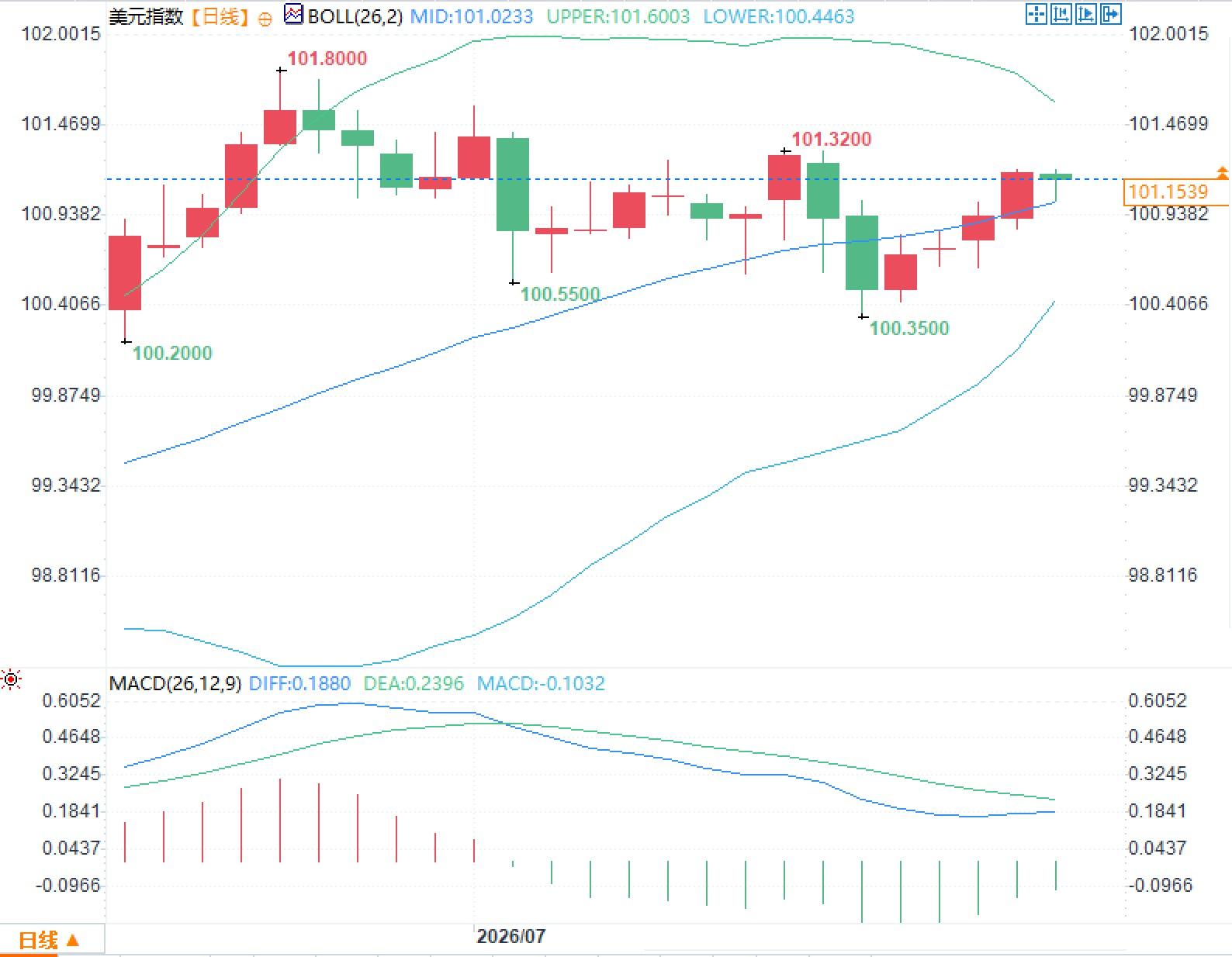
From a cross-asset perspective, the US dollar index remains above the Bollinger Middle Band at approximately 101.02, but is approaching the upper band resistance near 101.60. The MACD fast line is around 0.1880, below the slow line at approximately 0.2396, with a histogram value of approximately -0.1032, reflecting that the US dollar remains in a relatively strong range, but short-term momentum has not strengthened accordingly. If the new 10-year bond is priced 110 basis points above US Treasury yields, coupled with a 4.63% yield on 10-year US Treasury bonds, its nominal yield could be around 5.7%, significantly higher than the credit cost during the same period last year. Here, it's crucial to distinguish between two types of risk: changes in US Treasury yields determine the underlying financing cost, while changes in the Kuwaiti interest rate spread reflect sovereign event risk. Even if the conflict eases and the spread narrows, as long as US Treasury yields remain high, the issuer's overall coupon rate will be difficult to decrease rapidly. Therefore, the real signal from this transaction isn't just whether it can be issued, but rather the sensitivity of 10-year orders to the initial 110-basis-point premium. More stable long-term demand indicates that the market still believes Kuwait's balance sheet is sufficient to withstand short-term cash flow shocks; conversely, if funds are concentrated in 3-year bonds, it suggests that investors are more willing to bear liquidity risk than long-term fiscal and security risks.
- Risk Warning and Disclaimer
- The market involves risk, and trading may not be suitable for all investors. This article is for reference only and does not constitute personal investment advice, nor does it take into account certain users’ specific investment objectives, financial situation, or other needs. Any investment decisions made based on this information are at your own risk.