Tensions between the US and Iran fueled a return of safe-haven buying, extending gold's rebound.
2026-07-23 10:36:14
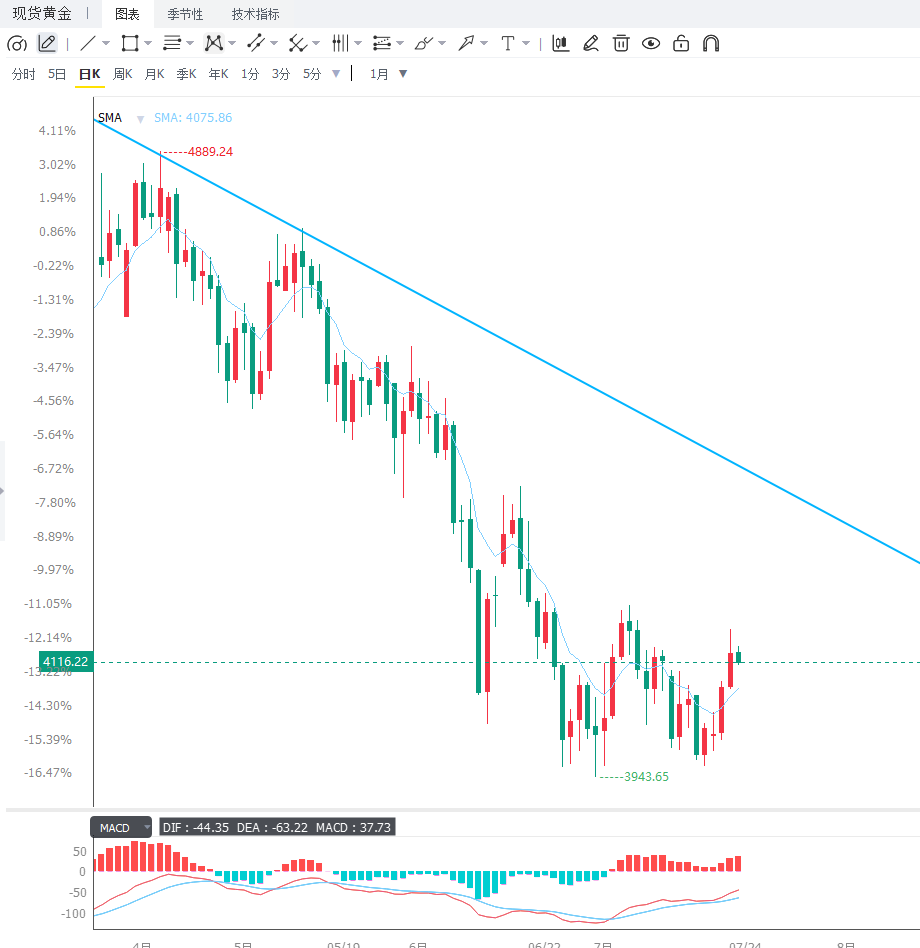
Spot gold prices continued to rise in early Asian trading on Thursday, with XAU/USD trading around $4120, extending its recent rebound. As global risk aversion has resurfaced, investors have increased their gold holdings, providing some support to the precious metals market. The recent rise in gold prices has been primarily driven by continued tensions in the Middle East. With the conflict between the US and Iran entering its second week, markets are concerned that related events could further impact energy transport security and the performance of global risk assets. The US has stated that it will respond with measures against related infrastructure if Iran takes action against shipping in the Strait of Hormuz; Iran, in turn, has warned that it will retaliate against related US infrastructure and regional energy facilities if the US takes further action.  The market believes that current geopolitical risks are reinforcing gold's safe-haven appeal. Escalating tensions between the US and Iran have driven a return of safe-haven funds, pushing gold prices back above the key $4,100 level . Since gold is typically seen as an asset to hedge against geopolitical risks and financial market uncertainty, any risk events involving energy supply, regional security, and global economic stability can stimulate capital inflows into the gold market. Meanwhile, the US, while emphasizing that diplomatic channels remain open, is maintaining a strong level of pressure, keeping the market cautious about future developments. US Secretary of State Marco Rubio previously stated that Iran lacks sufficient sincerity in reaching an agreement, but the US remains committed to resolving regional issues diplomatically. Besides geopolitical factors, the gold market is also influenced by monetary policy expectations. Recently, the market has begun to readjust its assessment of the Federal Reserve's policy path. According to market interest rate tools, investors believe the likelihood of a Fed rate hike in the near term has significantly increased, with the market expecting a rate hike this month to rise to about 34%, up from about 10% a week ago. At the same time, the market's expectation of at least a 25 basis point rate hike in September has risen to about 78%. Changes in interest rate expectations typically put pressure on gold, as gold itself does not generate interest income. When the market believes that interest rates may remain higher, the opportunity cost of holding gold increases. However, geopolitical risks currently dominate the market, keeping gold resilient. Ryan McKay, senior commodities strategist at TD Securities, said that the recent gold rebound was driven more by capital flows, with some investors buying on dips after finding support around $4,000. But he believes this does not necessarily mean that gold has started a new long-term upward trend, as rising energy prices could reignite inflationary pressures and limit further upside for gold. Changes in energy prices are also an important variable in the future trend of gold. If crude oil continues to rise due to supply risks, the market may again worry about global inflationary pressures, thereby affecting expectations for Federal Reserve policy. On the one hand, inflation concerns may increase demand for gold as an inflation hedge; on the other hand, a higher interest rate environment may suppress gold valuations, so these two forces may create a tug-of-war in the market. Investors are currently focusing on three core factors: first, whether the situation in the Middle East continues to escalate; second, whether US interest rate expectations will further shift towards a hawkish stance; and third, the trends of the US dollar index and US Treasury yields. If the US dollar weakens while safe-haven demand remains, gold may continue to gain upward momentum; however, if the market re-emphasizes expectations of interest rate hikes, gold prices may face downward pressure. The daily chart for gold shows that XAU/USD rebounded after finding significant support near $4000 and is currently retesting the $4120 area. The short-term trend is gradually improving, the moving average structure is beginning to repair, and market bullish sentiment has recovered somewhat. Resistance is seen in the $4150-$4180 area; a successful break above this level could lead to a further challenge of the $4200 psychological level. Support is first seen at $4050, followed by the key psychological level of $4000. The MACD indicator shows weakening bearish momentum and recovering bullish strength, but the risk of high-level consolidation still needs to be monitored. Looking at the 4-hour chart, gold prices are maintaining a volatile rebound, with short-term moving averages providing upward support and the RSI indicator rising into the bullish zone, indicating strengthening buying power. However, the current gold price is approaching the previous resistance area; if it fails to break through the $4150 area, a technical pullback may occur. If the price holds above $4,100, there is still room for further gains in the short term; if it falls below $4,050, it may retest the support level near $4,000.
  Editor's Summary: The recent rebound in gold prices has been primarily driven by safe-haven demand, rather than entirely by a change in fundamental trends. The escalating situation in the Middle East has refocused funds on gold's safe-haven value, pushing prices back above $4,100. However, at the same time, increased expectations of a Fed rate hike and policy pressure from rising energy prices may still limit gold's upside potential. Future gold price movements will depend on the balance between risk events and monetary policy. If geopolitical risks continue to escalate, gold may challenge the $4,200 area; however, if the market refocuses on a high-interest-rate environment, gold prices may enter a period of consolidation. The gold market remains highly volatile, and investors need to closely monitor safe-haven fund flows, the dollar's performance, and changes in Fed policy signals.
The market believes that current geopolitical risks are reinforcing gold's safe-haven appeal. Escalating tensions between the US and Iran have driven a return of safe-haven funds, pushing gold prices back above the key $4,100 level . Since gold is typically seen as an asset to hedge against geopolitical risks and financial market uncertainty, any risk events involving energy supply, regional security, and global economic stability can stimulate capital inflows into the gold market. Meanwhile, the US, while emphasizing that diplomatic channels remain open, is maintaining a strong level of pressure, keeping the market cautious about future developments. US Secretary of State Marco Rubio previously stated that Iran lacks sufficient sincerity in reaching an agreement, but the US remains committed to resolving regional issues diplomatically. Besides geopolitical factors, the gold market is also influenced by monetary policy expectations. Recently, the market has begun to readjust its assessment of the Federal Reserve's policy path. According to market interest rate tools, investors believe the likelihood of a Fed rate hike in the near term has significantly increased, with the market expecting a rate hike this month to rise to about 34%, up from about 10% a week ago. At the same time, the market's expectation of at least a 25 basis point rate hike in September has risen to about 78%. Changes in interest rate expectations typically put pressure on gold, as gold itself does not generate interest income. When the market believes that interest rates may remain higher, the opportunity cost of holding gold increases. However, geopolitical risks currently dominate the market, keeping gold resilient. Ryan McKay, senior commodities strategist at TD Securities, said that the recent gold rebound was driven more by capital flows, with some investors buying on dips after finding support around $4,000. But he believes this does not necessarily mean that gold has started a new long-term upward trend, as rising energy prices could reignite inflationary pressures and limit further upside for gold. Changes in energy prices are also an important variable in the future trend of gold. If crude oil continues to rise due to supply risks, the market may again worry about global inflationary pressures, thereby affecting expectations for Federal Reserve policy. On the one hand, inflation concerns may increase demand for gold as an inflation hedge; on the other hand, a higher interest rate environment may suppress gold valuations, so these two forces may create a tug-of-war in the market. Investors are currently focusing on three core factors: first, whether the situation in the Middle East continues to escalate; second, whether US interest rate expectations will further shift towards a hawkish stance; and third, the trends of the US dollar index and US Treasury yields. If the US dollar weakens while safe-haven demand remains, gold may continue to gain upward momentum; however, if the market re-emphasizes expectations of interest rate hikes, gold prices may face downward pressure. The daily chart for gold shows that XAU/USD rebounded after finding significant support near $4000 and is currently retesting the $4120 area. The short-term trend is gradually improving, the moving average structure is beginning to repair, and market bullish sentiment has recovered somewhat. Resistance is seen in the $4150-$4180 area; a successful break above this level could lead to a further challenge of the $4200 psychological level. Support is first seen at $4050, followed by the key psychological level of $4000. The MACD indicator shows weakening bearish momentum and recovering bullish strength, but the risk of high-level consolidation still needs to be monitored. Looking at the 4-hour chart, gold prices are maintaining a volatile rebound, with short-term moving averages providing upward support and the RSI indicator rising into the bullish zone, indicating strengthening buying power. However, the current gold price is approaching the previous resistance area; if it fails to break through the $4150 area, a technical pullback may occur. If the price holds above $4,100, there is still room for further gains in the short term; if it falls below $4,050, it may retest the support level near $4,000. Editor's Summary: The recent rebound in gold prices has been primarily driven by safe-haven demand, rather than entirely by a change in fundamental trends. The escalating situation in the Middle East has refocused funds on gold's safe-haven value, pushing prices back above $4,100. However, at the same time, increased expectations of a Fed rate hike and policy pressure from rising energy prices may still limit gold's upside potential. Future gold price movements will depend on the balance between risk events and monetary policy. If geopolitical risks continue to escalate, gold may challenge the $4,200 area; however, if the market refocuses on a high-interest-rate environment, gold prices may enter a period of consolidation. The gold market remains highly volatile, and investors need to closely monitor safe-haven fund flows, the dollar's performance, and changes in Fed policy signals.
- Risk Warning and Disclaimer
- The market involves risk, and trading may not be suitable for all investors. This article is for reference only and does not constitute personal investment advice, nor does it take into account certain users’ specific investment objectives, financial situation, or other needs. Any investment decisions made based on this information are at your own risk.