Gold prices have been fluctuating around the $4,000 mark, with institutions saying the healthy consolidation supports a long-term bull market.
2026-07-24 17:51:05
Gold prices retreated again this week after encountering resistance at higher levels. On Thursday (July 24) in Asian trading, spot gold briefly fell to around $4,020, but overall market support remained solid, and there was no panic selling. Analysts point out that the current pullback is a typical example of rational profit-taking, rather than a stampede of funds or a reversal of the long-term trend. The core reasons for this consolidation are retail investors holding substantial profits and actively reducing their positions, waiting for lower entry points, coupled with expectations of interest rate hikes suppressing short-term buying. Meanwhile, the three long-term positive factors—continuous gold purchases by central banks, ongoing geopolitical risks, and rising inflation stickiness—have not subsided, and the fundamentals for gold remain robust. While short-term gold prices are fluctuating due to expectations of Fed policy changes, the medium- to long-term bullish logic remains intact, and the market generally expects gold prices to rise by the end of the year. Looking back at historical market trends, during periods of significant stock market decline, a "liquidity stampede" often occurs: investors are forced to sell gold, their only safe-haven asset, to offset losses in other assets. However, this phenomenon has not occurred in the current correction. Retail investors currently selling gold are those who have accumulated substantial unrealized profits during the previous bull market; they are proactively taking profits and locking in gains, rather than passively cutting losses or selling at a loss. From an investor sentiment perspective, market sentiment is very rational. Retail investors clearly recognize the allocation value of gold; their short-term reduction in holdings is simply due to gold prices reaching a key technical turning point, choosing to temporarily exit the market and wait for a lower entry price. This does not negate the bullish logic of gold. This orderly profit-taking and orderly turnover is precisely a typical characteristic of a healthy market correction in the middle of a bull market.
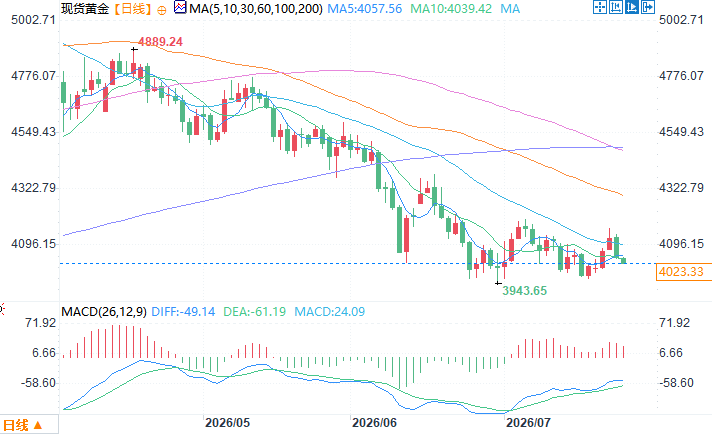 Spot gold daily chart source: FX678. At 11:14 AM Beijing time on July 24, spot gold was trading at $4031.65 per ounce.
Current gold price correction: A healthy time for profit-taking, not panic selling.
Regarding the recent low-level fluctuations of gold around $4,000, Chris Gaffney, President of Global Markets at EverBank, pointed out that this correction is fundamentally different from previous crisis-driven sell-offs. While selling pressure currently outweighs buying pressure for a period, there is no panic, and investors are not bearish on the long-term value of gold. Looking back at historical market trends, during periods of significant stock market decline, a "liquidity stampede" often occurs: investors are forced to sell gold, their only safe-haven asset, to offset losses in other assets. However, this phenomenon has not occurred in the current correction. Retail investors currently selling gold are those who have accumulated substantial unrealized profits during the previous bull market; they are proactively taking profits and locking in gains, rather than passively cutting losses or selling at a loss. From an investor sentiment perspective, market sentiment is very rational. Retail investors clearly recognize the allocation value of gold; their short-term reduction in holdings is simply due to gold prices reaching a key technical turning point, choosing to temporarily exit the market and wait for a lower entry price. This does not negate the bullish logic of gold. This orderly profit-taking and orderly turnover is precisely a typical characteristic of a healthy market correction in the middle of a bull market.The interplay of bullish and bearish forces: short-term negative factors exert downward pressure, while long-term positive factors provide support.
The current gold market is in a balancing act between bulls and bears, with short-term negative factors and long-term positive factors significantly offsetting each other, causing gold prices to consolidate within a range. The core factor suppressing gold prices in the short term stems from expectations of Federal Reserve policy; rising market expectations of interest rate hikes have significantly increased the opportunity cost of holding gold. As a non-interest-bearing asset, gold's attractiveness has temporarily decreased in a high-interest-rate environment, causing many retail investors to remain on the sidelines and postpone entering the market.Key Market Divergence: Short-Term Observation Does Not Change Long-Term Optimism
The current market's core disagreement lies in short-term pace, not long-term trends. In the short term, the market generally anticipates further downward fluctuations in gold prices, leading most funds to avoid chasing highs and instead hold cash, waiting for a better entry window. If the Federal Reserve subsequently raises interest rates, the high-interest-rate environment will continue to suppress the rebound in gold prices, and the consolidation phase may continue. However, from a medium- to long-term perspective, market consensus is highly unified. Inflation concerns, global geopolitical risks, and the need for diversified asset allocation remain the three core logics supporting the gold bull market, and these have not fundamentally weakened. Currently, retail investors are only temporarily leaving the market, not completely abandoning gold assets, and the market's bullish sentiment has not collapsed. The vast majority of commodity analysts are optimistic about the future market, predicting that gold prices will be significantly higher than the current trading range around $4,000 by the end of the year, and this round of adjustment is merely a temporary pause in the bull market.Summary and Outlook
In summary, the recent adjustment in gold prices around the $4,000 mark is a healthy fluctuation resulting from rational profit-taking and short-term pressure from high interest rates. There are no signs of panic selling or a trend reversal. Orderly turnover by retail investors and continued support from central banks keep the fundamentals of the gold market healthy. In the short term, gold prices will continue to fluctuate within a range, likely oscillating around expectations of a Fed rate hike. However, in the medium to long term, the core positive factors of inflation protection, safe-haven appeal, and central bank gold purchases remain intact, solidifying the foundation for a bull market. The current trading range presents a good entry point, and as policy uncertainties subside and market sentiment recovers, gold prices still have ample room to rise. Spot gold daily chart source: FX678. At 11:14 AM Beijing time on July 24, spot gold was trading at $4031.65 per ounce.
- Risk Warning and Disclaimer
- The market involves risk, and trading may not be suitable for all investors. This article is for reference only and does not constitute personal investment advice, nor does it take into account certain users’ specific investment objectives, financial situation, or other needs. Any investment decisions made based on this information are at your own risk.