The ECB's hawkish stance boosted the euro, while Middle East conflicts supported the dollar; the euro's future performance will depend on PMI data.
2026-07-24 17:53:29
The euro edged higher against the dollar in Asian trading on Friday (July 24), trading around 1.1380, supported by hawkish signals from the European Central Bank (ECB) at its meeting on Thursday. The ECB kept interest rates unchanged as expected, but clearly left open the possibility of a rate hike in September – soaring energy prices are threatening to keep inflation well above the 2% target. Lagarde stated at the press conference that the central bank expects inflation to be "well above target" until the first half of 2027, and officials remain highly vigilant about a "second wave of inflationary shocks" triggered by the US-Iran conflict. 
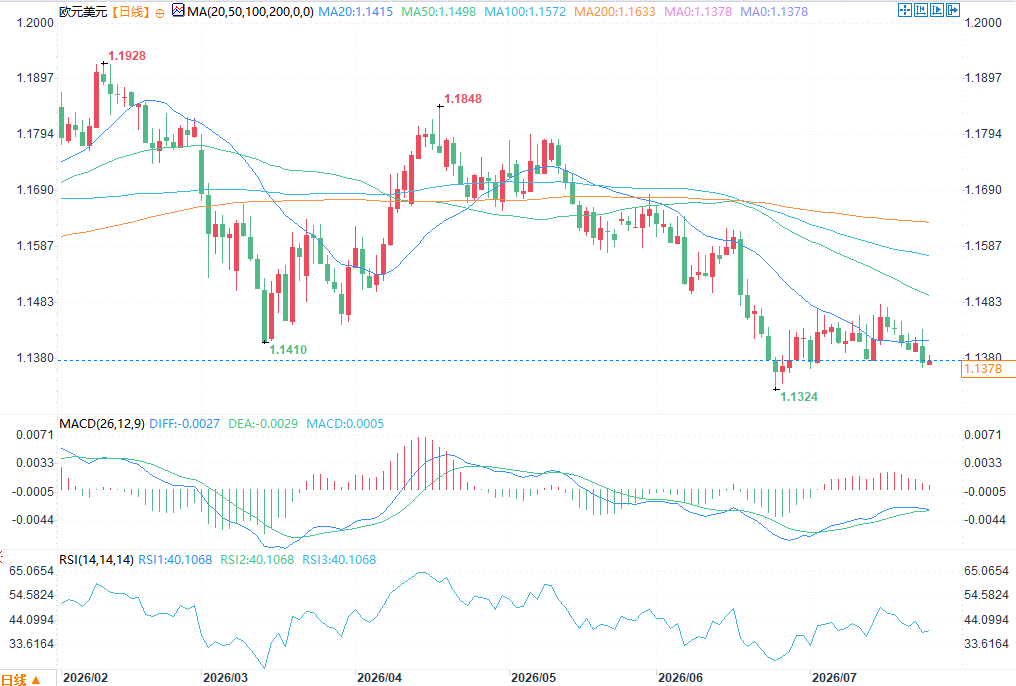 (Euro/USD daily chart, source: FX678) At 14:21 Beijing time on July 24, the euro was trading at 1.1382/83 against the US dollar.
The probability of the European Central Bank raising interest rates in September is as high as 95%.
The European Central Bank's (ECB) interest rate decision on Thursday was a typical "hawkish hold-up" move. As expected, policymakers kept the three key interest rates unchanged—the deposit facility rate at 2.25%, the main refinancing rate at 2.40%, and the marginal lending rate at 2.65%—but the wording of the policy statement and Lagarde's press conference conveyed a clear hawkish signal. Lagarde stated at the press conference that the central bank expects inflation to be "well above target" until the first half of 2027. This longer timeframe than the market had previously anticipated suggests that the ECB believes the impact of the energy shock on inflation will be more persistent than previously estimated. She also emphasized that officials remain highly vigilant about a "second wave of inflationary shocks" triggered by the US-Iran conflict—the risk that rising energy prices will transmit to core inflation through wage negotiations and corporate pricing behavior. The market responded quickly and clearly to this signal. Data from well-known institutions shows that traders are currently pricing in a 95% probability of a 25 basis point rate hike in September, with a similarly high probability of another rate hike in December. This means that the market has essentially fully priced in a September rate hike and also has high expectations for a third rate hike this year. Analysts at MUFG observed that against the backdrop of rising energy prices, "market participants have been pricing in a more hawkish outlook from major central banks, including the ECB and the Fed, pushing short-term yields to new highs year-to-date." They specifically noted that "European short-term yields have recently outpaced those in the US, causing yield spreads to move against the dollar"—which explains why the euro found support after Thursday's ECB decision.Which is more hawkish, the European Central Bank or the Federal Reserve?
Mitsubishi UFJ's analysis provides a key perspective for understanding the recent euro's movements: short-term yield spreads are shifting in a direction unfavorable to the dollar. Specifically: the Eurozone interest rate market is currently pricing in 2 to 3 ECB rate hikes within the next year; the US interest rate market is pricing in approximately 2 Fed rate hikes in the same period; and recent increases in European short-term yields have outpaced those in the US, leading to a narrowing of the US-European yield spread. This shift in the spread means that even though the Fed is still raising rates, the expectation of ECB rate hikes is rising faster than the Fed's, narrowing the yield spread between US and European bonds and thus weakening the dollar's interest rate advantage relative to the euro. This is the core logic behind the euro's support around 1.1380. However, whether this yield spread logic can continue depends on two key variables: first, whether the situation in the Middle East will further push up oil prices and force the Fed to accelerate its tightening pace; and second, whether Eurozone economic data can support the ECB's hawkish expectations—Friday's Eurozone PMI data will be an important basis for this judgment.The conflict in the Middle East continues to escalate.
Parallel to the European Central Bank's hawkish signals is the continued escalation of the Middle East conflict, currently the most significant external headwind suppressing the euro's upside potential. The US Central Command confirmed that it has launched airstrikes against targets in Iran for the 13th consecutive night, targeting drone facilities and coastal surveillance sites. Trump publicly stated on Thursday that the US will hold Iran accountable for its actions against the Houthis and warned that Iran and its Houthi allies "will soon face severe military punishment." This is another hardline escalation of Trump's stance on Iran, following his statement that "they haven't suffered enough." For the euro, the Middle East conflict exerts a suppressive effect through the following channels: Safe-haven channel: With both the Strait of Hormuz and the Red Sea, two major energy chokepoints, under threat, global capital continues to flow into dollar assets, putting systemic selling pressure on the euro as a risk currency. Trump's vow of "severe military punishment" means that the conflict lacks a political basis for de-escalation in the short term, and safe-haven buying of the dollar will continue. Inflation channel: After Brent crude oil broke through $100 per barrel, global inflation expectations rose. While this logic supports the ECB's hawkish stance (beneficial to the euro), it also reinforces the Fed's rationale for maintaining high interest rates (beneficial to the dollar). The market currently seems to be oscillating between these two effects—which channel dominates depends on the market's judgment of "which central bank will be more hawkish." Data-driven verification: The preliminary July PMI figures for the Eurozone, Germany, and the US, released later on Friday, will be key data for testing this game. If the Eurozone PMI data is stronger than expected, it will reinforce the ECB's hawkish logic and push the euro above 1.1400; if the data is weak, "economic growth concerns" may outweigh "interest rate hike expectations," putting downward pressure on the euro.Institutional Views
In early July, Citigroup stated that global growth resilience and the AI cycle supported risk appetite, but US fundamentals limited a sharp decline in the dollar. The Fed's easing path and the Eurozone's moderate recovery created a balance. At the current exchange rate level of around 1.14 in July, the dollar index continued its slow downward trend, but European political and fiscal risks constrained the euro's gains. Supply-side disturbances and geopolitical events increased uncertainty, suggesting that the euro/dollar exchange rate would fluctuate within a range in the medium to long term, with limited upside potential. JPMorgan Global Research held a bearish stance on the euro/dollar exchange rate, emphasizing the continued strength of the dollar. The bank believes that the Fed's hawkish bias and the resilience of the US economy will continue to support the euro/dollar exchange rate. A stable labor market, AI-driven growth, and inflation dynamics provided organic support for the dollar. The Fed's potential rate hike path further widened its interest rate advantage. JPMorgan stated that the euro faces multiple pressures, including widening growth divergence within the EU, deteriorating terms of trade, and political uncertainty. It predicts that the euro/dollar exchange rate will struggle to break 1.15 in the short term, with a medium-term target still leaning towards the 1.13-1.15 range.Summary: The euro is searching for direction between a "hawkish bottom" and "geopolitical headwinds".
The euro is currently in a situation driven by both policy and geopolitics. The European Central Bank's hawkish stance on Thursday—especially Lagarde's warning that inflation is "far above target" until 2027—provided clear interest rate support for the euro. Market pricing in a 95% probability of a September rate hike, coupled with the interest rate differential where European short-term yields have risen more than those in the US, together formed a bottom support for the euro. However, the continued escalation of the Middle East conflict (13 consecutive nights of airstrikes + Trump's vow of "major military punishment") continues to drive safe-haven demand for the US dollar, limiting the euro's upside potential. The euro's short-term direction depends on marginal changes in two variables: first, whether Friday's PMI data can verify the resilience of the Eurozone economy; and second, whether there are any signs of easing or further deterioration in the Middle East situation. Until these two factors become clearer, the euro/dollar exchange rate is likely to consolidate within the 1.1350-1.1430 range. For traders, the ECB's hawkish signals provided a "foundation" for going long on the euro, but Middle East geopolitical risks require realistic constraints on upside potential. (Euro/USD daily chart, source: FX678) At 14:21 Beijing time on July 24, the euro was trading at 1.1382/83 against the US dollar.
- Risk Warning and Disclaimer
- The market involves risk, and trading may not be suitable for all investors. This article is for reference only and does not constitute personal investment advice, nor does it take into account certain users’ specific investment objectives, financial situation, or other needs. Any investment decisions made based on this information are at your own risk.