Rising Japanese inflation failed to boost the yen, and the USD/JPY pair remained range-bound at high levels.
2026-07-24 17:53:52
The US dollar remained stable against the Japanese yen (USD/JPY) in Asian trading on Friday, trading around 163.80. Despite the latest Japanese inflation data showing a recovery in domestic price pressures, the yen remained near multi-year lows against the dollar, with limited market expectations for further monetary tightening by the Bank of Japan. Meanwhile, investors continued to focus on whether the Japanese government would intervene in the foreign exchange market.  Data released by Japan's Statistics Bureau on Friday showed that Japan's national consumer price index (CPI) rose 1.7% year-on-year in June, up from 1.5% in May. Meanwhile, the core CPI, excluding fresh food, rose 1.6% year-on-year, a slight increase from the previous 1.4%, in line with market expectations. This is the first time Japan's core inflation has rebounded since March. However, the closely watched "core-core" inflation indicator, the underlying inflation rate excluding fresh food and energy prices, fell to 1.7% year-on-year in June, down from 1.8% previously and reaching its lowest level since August 2022. This indicates that underlying price pressures in Japan remain relatively mild, and the basis for a sustained rise in inflation still needs further confirmation. The data was released on the eve of the Bank of Japan's policy meeting. Currently, the market generally expects the Bank of Japan to maintain its current interest rate level, therefore the impact of this inflation data on the yen is limited. Investors believe that a single month's inflation change is insufficient to prompt the Bank of Japan to quickly adjust its policy direction; the market focus is more on the central bank's future policy signals and whether the government will intervene in the exchange rate market. Japanese Finance Minister Satsuki Katayama previously stated that the Japanese government will continue to monitor foreign exchange market volatility and is prepared to take "appropriate and bold" actions. She emphasized that Japan's policy stance on potential foreign exchange intervention remains unchanged, and relevant departments will take necessary measures if excessive market volatility occurs. The main reason for the current weakness of the yen remains the US-Japan interest rate differential. The persistently high US interest rates have increased the attractiveness of dollar assets, while the Bank of Japan, although gradually exiting its ultra-loose policy, still maintains significantly lower interest rates than the US, and this difference in capital flows continues to put pressure on the yen. At the same time, the escalating situation in the Middle East has further strengthened the demand for the dollar as a safe haven. Increased regional risks have prompted investors to reduce their risk exposure, supporting the dollar as a major global safe-haven asset. While the yen traditionally possesses safe-haven attributes, its safe-haven performance is limited due to Japan's domestic policy environment and interest rate differentials. The market is currently focused on the upcoming preliminary reading of the S&P Global Purchasing Managers' Index (PMI) in the US. If US economic activity continues to show resilience, it may strengthen expectations that the Federal Reserve will maintain high interest rates, thereby further supporting the USD/JPY exchange rate. In addition, the situation between the US and Iran remains an important factor influencing the exchange rate market. US President Donald Trump previously stated that the US would hold Iran accountable for its actions related to the Houthis and warned of possible stronger measures. This risk could drive market funds to continue flowing into the US dollar, putting short-term pressure on the Japanese yen. From a daily chart perspective, USD/JPY is currently in a clear upward trend, with the price consistently trading above major moving averages, indicating that bulls are in control of the market. The current exchange rate is approaching the key psychological level of 164.00, with resistance at the 164.50-165.00 area. A successful break above this level could lead to further testing of previous highs. Support is first seen around 162.80, followed by the 161.50 area. A break below this area could weaken the short-term upward structure. From a 4-hour chart perspective, USD/JPY has recently entered a consolidation phase at higher levels, oscillating around the 163.50-164.00 range. The MACD indicator shows a slowdown in upward momentum, while the RSI indicator is in a neutral-to-strong zone, indicating that bulls still hold the advantage, but short-term upward momentum has weakened. If the exchange rate breaks through and holds above 164.00, it may open up further upside potential; if it falls below the support level of 163.00, a technical pullback may occur, and attention should be paid to the support level around 162.50.
 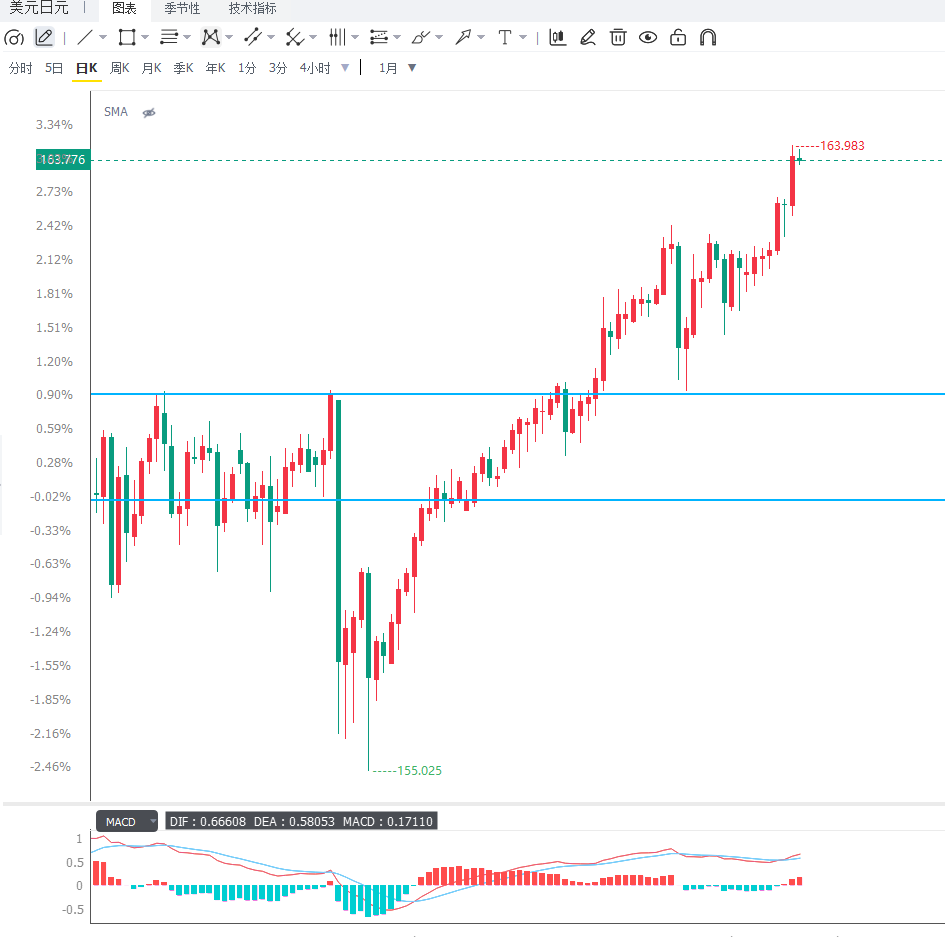 Editor's Summary: The USD/JPY pair is currently influenced by the USD/JPY interest rate differential, safe-haven demand for the dollar, and uncertainty surrounding Japanese policy. While Japanese inflation data has improved, the core trend is insufficient to significantly increase market expectations for a Bank of Japan rate hike, thus limiting the yen's short-term upside potential. Future movements will largely depend on three factors: US economic data performance, changes in Federal Reserve policy expectations, and whether the Japanese government intervenes in the foreign exchange market. If the US economy continues to be strong, the USD/JPY pair may continue to challenge higher levels; however, if a rapid depreciation of the yen triggers actual intervention by the Japanese authorities, market volatility could significantly intensify. Currently, the USD/JPY pair maintains a bullish bias, but the 164-165 area may become a significant resistance zone, and investors should be wary of the risk of high-level consolidation.
Data released by Japan's Statistics Bureau on Friday showed that Japan's national consumer price index (CPI) rose 1.7% year-on-year in June, up from 1.5% in May. Meanwhile, the core CPI, excluding fresh food, rose 1.6% year-on-year, a slight increase from the previous 1.4%, in line with market expectations. This is the first time Japan's core inflation has rebounded since March. However, the closely watched "core-core" inflation indicator, the underlying inflation rate excluding fresh food and energy prices, fell to 1.7% year-on-year in June, down from 1.8% previously and reaching its lowest level since August 2022. This indicates that underlying price pressures in Japan remain relatively mild, and the basis for a sustained rise in inflation still needs further confirmation. The data was released on the eve of the Bank of Japan's policy meeting. Currently, the market generally expects the Bank of Japan to maintain its current interest rate level, therefore the impact of this inflation data on the yen is limited. Investors believe that a single month's inflation change is insufficient to prompt the Bank of Japan to quickly adjust its policy direction; the market focus is more on the central bank's future policy signals and whether the government will intervene in the exchange rate market. Japanese Finance Minister Satsuki Katayama previously stated that the Japanese government will continue to monitor foreign exchange market volatility and is prepared to take "appropriate and bold" actions. She emphasized that Japan's policy stance on potential foreign exchange intervention remains unchanged, and relevant departments will take necessary measures if excessive market volatility occurs. The main reason for the current weakness of the yen remains the US-Japan interest rate differential. The persistently high US interest rates have increased the attractiveness of dollar assets, while the Bank of Japan, although gradually exiting its ultra-loose policy, still maintains significantly lower interest rates than the US, and this difference in capital flows continues to put pressure on the yen. At the same time, the escalating situation in the Middle East has further strengthened the demand for the dollar as a safe haven. Increased regional risks have prompted investors to reduce their risk exposure, supporting the dollar as a major global safe-haven asset. While the yen traditionally possesses safe-haven attributes, its safe-haven performance is limited due to Japan's domestic policy environment and interest rate differentials. The market is currently focused on the upcoming preliminary reading of the S&P Global Purchasing Managers' Index (PMI) in the US. If US economic activity continues to show resilience, it may strengthen expectations that the Federal Reserve will maintain high interest rates, thereby further supporting the USD/JPY exchange rate. In addition, the situation between the US and Iran remains an important factor influencing the exchange rate market. US President Donald Trump previously stated that the US would hold Iran accountable for its actions related to the Houthis and warned of possible stronger measures. This risk could drive market funds to continue flowing into the US dollar, putting short-term pressure on the Japanese yen. From a daily chart perspective, USD/JPY is currently in a clear upward trend, with the price consistently trading above major moving averages, indicating that bulls are in control of the market. The current exchange rate is approaching the key psychological level of 164.00, with resistance at the 164.50-165.00 area. A successful break above this level could lead to further testing of previous highs. Support is first seen around 162.80, followed by the 161.50 area. A break below this area could weaken the short-term upward structure. From a 4-hour chart perspective, USD/JPY has recently entered a consolidation phase at higher levels, oscillating around the 163.50-164.00 range. The MACD indicator shows a slowdown in upward momentum, while the RSI indicator is in a neutral-to-strong zone, indicating that bulls still hold the advantage, but short-term upward momentum has weakened. If the exchange rate breaks through and holds above 164.00, it may open up further upside potential; if it falls below the support level of 163.00, a technical pullback may occur, and attention should be paid to the support level around 162.50. Editor's Summary: The USD/JPY pair is currently influenced by the USD/JPY interest rate differential, safe-haven demand for the dollar, and uncertainty surrounding Japanese policy. While Japanese inflation data has improved, the core trend is insufficient to significantly increase market expectations for a Bank of Japan rate hike, thus limiting the yen's short-term upside potential. Future movements will largely depend on three factors: US economic data performance, changes in Federal Reserve policy expectations, and whether the Japanese government intervenes in the foreign exchange market. If the US economy continues to be strong, the USD/JPY pair may continue to challenge higher levels; however, if a rapid depreciation of the yen triggers actual intervention by the Japanese authorities, market volatility could significantly intensify. Currently, the USD/JPY pair maintains a bullish bias, but the 164-165 area may become a significant resistance zone, and investors should be wary of the risk of high-level consolidation.
- Risk Warning and Disclaimer
- The market involves risk, and trading may not be suitable for all investors. This article is for reference only and does not constitute personal investment advice, nor does it take into account certain users’ specific investment objectives, financial situation, or other needs. Any investment decisions made based on this information are at your own risk.