With an 82% probability of a Fed rate hike in September, why is Natixis insisting on holding rates steady?
2026-07-24 17:54:32
On Friday (July 24) during the European session, the US dollar index, after hitting a high of 101.54 (its highest level since July 2) the previous day, entered a period of consolidation at high levels, currently trading around 101.35. Market opinions remain divided regarding the Fed's interest rate pricing at next week's meeting – maintaining the current rate is still the baseline scenario, but the option of a rate hike has not been completely ruled out. According to CME's "FedWatch," the probability of the Fed maintaining the current rate in July is 65.3%, and the probability of a cumulative 25 basis point rate hike is 34.7%. The probability of the Fed maintaining the current rate by September is 17.6%, the probability of a cumulative 25 basis point rate hike is 57%, and the probability of a cumulative 50 basis point rate hike is 25.4%. However, economists Christopher Hodge and Selin Aker of Natixis pointed out in their latest FOMC forward report that recent data has given the Fed some "breathing room," and they expect the Fed to maintain the current rate at next week's meeting, and this "extended pause" may continue until 2026. 
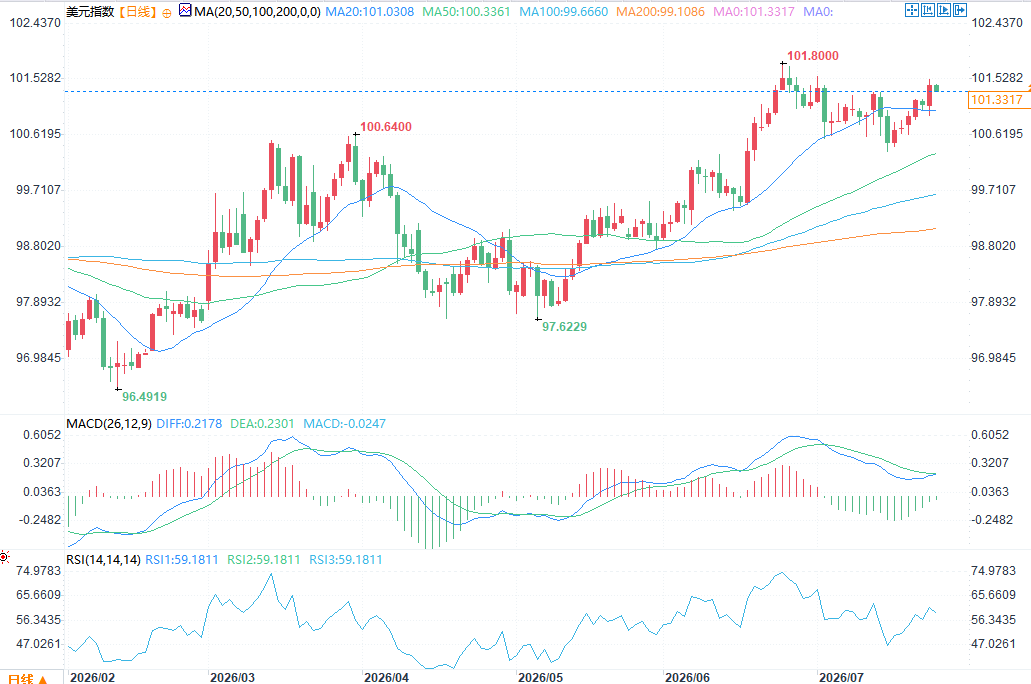 (US Dollar Index Daily Chart, Source: EasyForex) At 15:39 Beijing time on July 24, the US Dollar Index was at 101.31.
The data gave the Federal Reserve some breathing room.
Natixis points out that while the incremental data since the June FOMC meeting is "relatively small," it is generally "dovish," providing data support for the Fed to maintain its current interest rate stance. The job market: The June jobs report was "mixed but weaker than previous months." Non-farm payrolls increased by only 57,000, far below the average increase of 164,000 over the previous three months. More noteworthy is the structural change in the labor force participation rate—previously, the decline was mainly driven by older Americans (boosted by rising asset prices) leaving the labor market, but the June decline was concentrated among the prime working-age population (25-54 years old). Natixis warns that if this trend continues, it will signal that "America's largest working-age group is feeling frustrated in the job search process," posing a concern for the consumption outlook. Inflation data: The overall CPI fell 0.4% month-on-month in June, mainly driven by a sharp drop in energy prices during the temporary ceasefire between the US and Iran. However, the core CPI—which remained flat month-on-month—is more relevant for policy reference, indicating that the de-inflation process is still underway. Natixis estimates that sub-indices of the CPI and PPI, mapped to the Federal Reserve's preferred inflation gauge (PCE deflator), suggest that the June PCE reading may have been below the Fed's 2% target. This combination—soft employment + cooling inflation—provides ample data support for the Fed's "extended pause." Natixis emphasizes that the June inflation data was "abnormal in magnitude" (significantly below consensus), but its "significance is not unusual"—the de-inflation process is still progressing towards the 2% target.Walsh's statement is particularly crucial.
Despite the dovish data, public communications from Federal Reserve officials have presented a mixed picture, leaning towards hawkishness overall. The hawkish camp: Waller, Logan, Hammark, and Kashkari have all expressed continued concerns about inflation. Dallas Fed President Logan is currently the only FOMC voting member who has publicly advocated for a rate hike. Natixis expects her to object at next week's meeting, and Cleveland Fed President Hammark and Minneapolis Fed President Kashkari may also join the opposition. The dovish camp: New York Fed President Williams is a "clearly dovish" figure, stating that "the current policy stance is well-positioned" and that "there are encouraging reasons to expect inflation to have peaked and will decline in the coming quarters." The most crucial voice—Fed Chairman Warsh: In his congressional testimony last week, Warsh stated that the Fed would not tolerate "persistently high inflation," but described AI construction as "a one-off price pressure." Natixis interprets this statement as "at least some willingness to 'see through' the near-term inflationary effects and expect them to prove temporary"—the clearest dovish signal since Warsh took office. Natixis concludes that while hawkish members continue to favor rate hikes, "more influential voices" within the committee appear to prefer waiting – the softer-than-expected inflation data in June has reduced the need to adjust policy rates in the short term.In July, no action was taken, extending the suspension until 2026.
Based on the above data and communication assessment, Natixis's baseline scenario is as follows: The July meeting will maintain the current interest rate – although Logan may object, and Hammark and Kashkari may join, a majority of the committee will support keeping rates unchanged; the policy statement will be “virtually unchanged” – largely consistent with the simplified statement from the June meeting; the “pause” will continue until 2026 – Natixis believes the Fed will maintain the current interest rate for the foreseeable future. Natixis's core judgment is based on the following logic: The inflation outlook is “cautiously optimistic” – the main inflation drivers of recent years (rapid wage growth and housing inflation) will cool in the coming quarters; the labor market is stable but does not pose inflationary pressures – while the labor market remains stable, it will not provide additional inflationary impetus; the de-inflation process, though volatile, is on a clear direction – Natixis interprets the June inflation data as “a clear signal,” meaning progress toward the 2% target is continuing. Natixis points out that the Federal Reserve needs to "wait for clearer evidence that inflationary pressures are driven by cyclical rather than exogenous factors," and Natixis expects inflation to not accelerate again, so "extending the pause" is a reasonable baseline scenario.The situation in Iran and tariffs are the biggest variables affecting the inflation outlook.
Natixis acknowledges two major upside risks to its inflation outlook: Risk 1: Escalation of the Iranian situation. Following the breakdown of the interim peace agreement between the US and Iran, Brent crude oil has broken through $100 per barrel. If the conflict in the Middle East escalates further, energy prices may continue to climb, pushing up overall inflation and potentially transmitting to core inflation, forcing the Federal Reserve to reconsider raising interest rates. Risk 2: A new round of tariffs. The Trump administration plans to impose new tariffs of 10%-12.5% on 60 major trading partners. Tariffs will directly push up the prices of imported goods and may be transmitted through the supply chain to a wider price level, putting upward pressure on inflation. Natixis points out that if inflation data unexpectedly rises or remains high, Federal Reserve Chairman Warsh "may need to raise interest rates to maintain his credibility." This assessment places Warsh in a delicate balancing act—he must combat inflation while avoiding excessive tightening that could unnecessarily damage economic growth and the job market. Another scenario – if consumption slows, the probability of an interest rate cut increases. Natixis also proposes another scenario: if the slowdown in consumption exceeds expectations, the Fed's next move may not be a rate hike, but a rate cut. Natixis's baseline forecast is a gradual slowdown in consumption. If this assessment is correct, then "the Fed can avoid raising rates in the short term." If the slowdown in consumption exceeds expectations, the probability of a rate cut will increase – but Natixis warns that this scenario is "unlikely to materialize before next year." This assessment provides the market with an important medium-term perspective: currently, the market is highly focused on "when the Fed will raise rates," but Natixis's analysis suggests that if economic data weakens further, the market narrative may shift from "rate hikes" to "rate cuts" in 2027 – although this turning point has not yet arrived.In summary, Natixis's decision to "extend the suspension" faces the dual challenges of Iran and tariffs.
Natixis's outlook on Federal Reserve policy can be summarized as follows: the baseline scenario is an "extended pause"—keeping rates steady in July and continuing until 2026, but the situation in Iran and a new round of tariffs pose significant upside risks. Natixis's core logic is based on a "cautiously optimistic" assessment of inflation—believing that while the deleveraging process may be bumpy, its direction is clear, and the stable job market does not pose inflationary pressures. This gives the Fed room to maintain interest rates, awaiting clearer evidence that inflationary pressures are driven by cyclical rather than exogenous factors. However, Natixis acknowledges that this assessment faces two major "upside risks"—escalating tensions in the Middle East pushing up energy prices, and new tariffs increasing import costs. If either risk materializes, Fed Chairman Warsh may "need to raise interest rates to maintain his credibility." For the market, this means that while the Fed's "extended pause" narrative is the baseline scenario, its credibility is being continuously tested by geopolitical and trade policy uncertainties. The real focus of the July FOMC meeting is not the interest rate decision itself (keeping rates steady is almost a certainty), but how Warsh will balance the tension between "improving data" and "upside risks"—and how this balance will affect the market's pricing of the policy path in September and beyond. (US Dollar Index Daily Chart, Source: EasyForex) At 15:39 Beijing time on July 24, the US Dollar Index was at 101.31.
- Risk Warning and Disclaimer
- The market involves risk, and trading may not be suitable for all investors. This article is for reference only and does not constitute personal investment advice, nor does it take into account certain users’ specific investment objectives, financial situation, or other needs. Any investment decisions made based on this information are at your own risk.