The Reserve Bank of India intervened to support the rupee; how long can the 96.80 support level hold?
2026-07-24 17:55:49
On Friday (July 24) during the European session, the Indian rupee strengthened, and the US dollar fell back to around 96.45 against the Indian rupee. According to reports from well-known institutions, the Reserve Bank of India (RBI) sold dollars around 96.80, and state-owned banks were observed providing dollar liquidity on behalf of the central bank in the spot and non-deliverable forward (NDF) markets to curb the rupee's depreciation. 
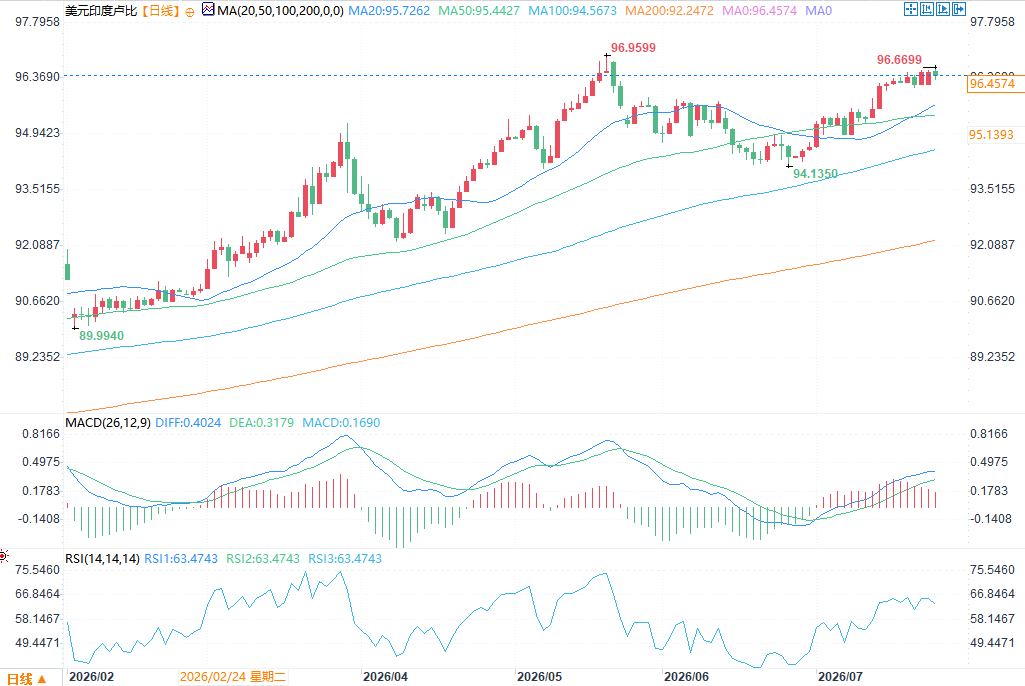 (USD/INR daily chart, source: FX678) At 15:58 Beijing time on July 24, the USD/INR exchange rate was 96.45/46.
The Reserve Bank of India intervened.
The Indian rupee has been under sustained pressure recently, with the combined pressures of the Middle East conflict driving up oil prices, a stronger US dollar, and capital outflows pushing the USD/IRR exchange rate near record highs. Faced with this situation, the Reserve Bank of India (RBI) has taken proactive measures. According to media reports, the RBI sold dollars around 96.80 rupees to curb the rupee's depreciation. State-owned banks have been observed providing dollar liquidity on behalf of the central bank in the spot and NDF markets, taking similar action on Thursday. This series of operations indicates that the RBI considers 96.80 a short-term "red line"—intervening whenever the USD/IRR exchange rate approaches this level. However, the sustainability of this intervention is questionable. While the RBI's foreign exchange reserves remain near historical highs, continued dollar sales will deplete these reserves. More importantly, intervention cannot fundamentally change the structural factors driving the rupee's depreciation—oil prices and the dollar's trajectory.Oil prices soar
The recent surge in oil prices is the most direct headwind facing the rupee. Brent crude oil once broke through $101 per barrel, driven by the continued escalation of the US-Iran conflict. The Houthi rebels have blocked the Bab el-Mandeb Strait—the southern entrance to the Red Sea—further tightening global energy supplies. With no signs of a diplomatic breakthrough, the market is concerned that the oil supply shortage may persist for a longer period. This situation is particularly significant for India. As the world's third-largest oil importer, India relies on imports for over 80% of its energy needs. Every $10 increase in oil prices significantly increases India's import bill, widening its trade deficit and directly suppressing the rupee's exchange rate. Although the Reserve Bank of India's intervention around 96.80 has temporarily stabilized the rupee, as long as oil prices remain high, the medium-term trend for the rupee remains depreciation rather than appreciation.Expectations of a Fed rate hike have reignited.
Another headwind facing the rupee comes from the external interest rate environment. Soaring oil prices are shaking market expectations for inflation, fueling renewed expectations of a Federal Reserve rate hike. The CME FedWatch tool shows that the probability of a 25 basis point rate hike at next week's Fed meeting has risen to 35.8%, significantly higher than last week's 11.8%. This shift in expectations has already impacted the US Treasury market. US Treasury yields have risen to around 4.70%, the highest level since January 2025. The rising yields have attracted global capital flows to dollar assets, further pushing up the dollar index. For the Indian rupee, rising US Treasury yields mean less attractiveness for global carry trades, and capital may flow back to the US from emerging markets, exacerbating downward pressure on the rupee. This external factor, combined with high oil prices, creates a "double headwind," meaning that the Reserve Bank of India's intervention can only buffer the impact, not reverse the trend.India's PMI cools down
Domestic economic data in India also failed to provide support for the rupee. HSBC's preliminary July composite PMI for India was 54.3, down from 57.1 in June, indicating a slowdown in both manufacturing and service sector activity. Pranjul Bhandari, HSBC's chief India economist, noted: "Renewed tensions in the Middle East have led companies to build up buffer inventories to cope with uncertainty surrounding supply-side shocks. Both finished goods and input inventories increased, and purchasing volumes rose accordingly. Output and new export orders both increased, but the overall pace of manufacturing expansion slowed slightly. Price pressures intensified, with output price inflation accelerating, indicating that companies are again pushing to protect profit margins." While this PMI reading remains in expansion territory (above 50), the slowdown is noteworthy. If economic growth continues to cool, the rupee's fundamental support will weaken further.In summary: The Reserve Bank of India's intervention provided a floor for the rupee, but oil prices and the US dollar will determine the medium-term direction.
The Indian rupee temporarily halted its decline following intervention by the Reserve Bank of India (RBI), with the USD/IRR pair falling back to around 96.50. The RBI's dollar selling near 96.80 provided a temporary buffer for the rupee, but the sustainability of this support remains questionable. The rupee faces three headwinds: high oil prices continue to push up India's import bills; renewed expectations of a Fed rate hike have pushed US Treasury yields up to 4.70%, increasing the risk of capital outflows; and Indian PMI data shows a slowdown in economic growth, weakening fundamental support. For traders, the key question now is: can the RBI's foreign exchange reserves hold the 96.80 level in the long term under the dual pressures of persistently high oil prices and a strengthening US dollar? Historically, central bank intervention can only alter the pace, not reverse the trend. (USD/INR daily chart, source: FX678) At 15:58 Beijing time on July 24, the USD/INR exchange rate was 96.45/46.
- Risk Warning and Disclaimer
- The market involves risk, and trading may not be suitable for all investors. This article is for reference only and does not constitute personal investment advice, nor does it take into account certain users’ specific investment objectives, financial situation, or other needs. Any investment decisions made based on this information are at your own risk.